


Seven wonders of RNA modification biology
- Corresponding author: meierjl{at}nih.gov
Abstract
This Perspective discusses seven frontiers in RNA modification research. The examples cited highlight technological advances, regulatory principles both unique and broad-spanning, and questions about how biological information is post-transcriptionally encoded in chemical marks comprising just a few atoms.
I was invited to write about RNA modifications for this journal, which seemed straightforward enough until I thought about it and realized I had no clear idea what to say about them that had not been said before. The literature around the topic continues to grow and grow, with each discovery revealing new dimensions of nucleobase chemistry whose functional consequences we continue to understand more about every day.
Driving across America this July with my children (and already far past my deadline), I was listening to a podcast that mentioned Lewis Thomas's “Seven Wonders of Biology” (Thomas 1983). Reading this 42 year old essay, I was struck by how Thomas used wonder as a method of inquiry—a way of paying attention to phenomena so remarkable that they compel us to ask new questions. I considered whether a similar treatment might help view RNA modifications anew. Certainly, I could use some wonder in my life right now. Additionally, it would be something that I had not read before. Both of these seemed reason enough to try.
Below are seven wondrous observations about RNA modifications that genuinely astonish me. Some, but not all, are seen through the lens of my own laboratory's decade-long study of N4-acetylcytidine (ac4C). I make no claims for completeness or objectivity. These are simply phenomena I chose because they strike me as remarkable and because they usefully point to some broader ideas and questions that exemplify this extraordinary, expanding field.
WONDER 1: SEEKING
My first wonder is that we can see these RNA modifications at all. Consider this audacious goal: to observe a single methyl group, one carbon and three hydrogen atoms, attached to one nitrogen atom on one adenosine residue somewhere in the vast RNA library of the cell. In a typical mammalian cell containing ∼200,000 messenger RNA (mRNA) molecules, the most abundant mRNA modification, N6-methyladenosine (m6A), occurs at around 0.2% of all adenosines. If the entire transcriptome were a book the size of War and Peace (∼1500 pages), we would be hunting for individual punctuation marks found on average once or twice a page, but heterogeneously distributed with some pages containing many and some none. And yet we can find them. First, chromatography, radiolabeling, and mass spectrometry told us how many of these modifications existed relative to the normal nucleotides, providing a census of unknown letters (Holley et al. 1965; Staehelin et al. 1968; Perry and Kelley 1974; Takeda et al. 1991). Then, antibody-based immunoprecipitation techniques told us which transcripts harbored these marks, identifying the chapters where the strange characters appeared (Dominissini et al. 2012; Meyer et al. 2012). Finally, sequencing-based methods told us the precise locations—pinpointing not just the sentence but the exact position within each word where the modification resided (Liu et al. 2023; Xiao et al. 2023).
I take some pride witnessing this progression as a chemical biologist. Many of the tools we now use to see these modifications are small miracles of chemistry—sequencing reactions that can distinguish a methylated adenosine from its unmethylated cousin, metabolic labeling schemes that let us trace the life history of individual modifications (Shu et al. 2020; Heiss et al. 2021), mechanism-based inhibitors or mutants that freeze the modification machinery in the act of doing its work (Hussain et al. 2013; Khoddami and Cairns 2013; Dai et al. 2021). Our own lab's experience with ac4C (Gamage et al. 2024) has followed paths blazed for m6A, pseudouridine (Ψ) (Khoddami et al. 2019; Xu and Song 2024; Zhang et al. 2024), 5-methylcytidine (m5C) (Huang et al. 2019; Lu et al. 2024), and other RNA modifications (Bartee et al. 2021), each requiring its own particular chemical or biochemical “trick” to coax these molecular species into visibility. One challenge is that often what we are trying to detect lies right at the edge of what is measurable. Sometimes what looks like a modification is an artifact, a signal nearly identical to the real thing that originates from unrelated technical noise (Kong et al. 2023). But this does not diminish the wonder. We can still learn much from looking at the night sky, even if the light we first take for an alien spaceship sometimes later turns out to be a satellite. Seeing is not the same as understanding, but it is the first step.
WONDER 2: HIDING
My second wonder concerns a peculiar form of hiding: RNA modifications that make molecules invisible to certain cellular machinery while leaving them perfectly visible to the rest. The hallmark example of this is N1-methylpseudouridine (m1Ψ), the modification found in commercial messenger RNA therapies (Nance and Meier 2021). This single nucleotide disguises synthetic mRNA from TLR7 and TLR8, the cellular sensors that normally sound the alarm when foreign RNA appears (Berouti et al. 2025). The newly discovered TRIM25 surveillance system—a proton-sensing guardian that captures RNAs escaping from damaged endosomes—cannot bind effectively to m1Ψ-modified transcripts (Kim et al. 2025). Yet the ribosome, which must read every codon to synthesize proteins, processes these modified messages nearly as well as unmodified ones. The use of m1Ψ in synthetic mRNAs was inspired by the study of natural RNA modifications (Kariko et al. 2005), which can act as either beacons or shields depending on the protein encountered (Edupuganti et al. 2017). But there are limits to this concealment. Internal ribosomal entry sites (IRESs) and suppressor transfer RNAs (tRNAs) in which every uridine is replaced with m1Ψ are inactive (Kameda et al. 2023; Ignatova and Albers 2025). The addition of 2′-O-methylation to coding sequences can cause mRNA to become not just hidden but inert, unrecognizable to the ribosome it requires to function (Choi et al. 2018). The wonder lies in the ability of evolution and directed chemistry to thread this needle—crafting modifications that hide and reveal simultaneously, depending on who is looking.
WONDER 3: PRECISION
Unlike the indiscriminate way we apply RNA modifications in therapeutics, Nature deposits modifications at specific sites using recognition systems that combine both sequence and structure. This leads to my third wonder, enzymatic precision. Some enzymes like EMG1 modify exactly one site in ribosomal RNA and no other, like a jeweler placing a single diamond in the exact spot where light will catch it best (Wurm et al. 2010). Others like THUMPD3 are more like tailors, measuring tRNA structures and modifying only sequences with the correct spacing between recognition elements (Yang et al. 2021). Even mRNA modifications whose deposition at first seemed chaotic have an underlying logic: m6A writers prefer to modify DRACH motifs distal from exon-junction complex (Yang et al. 2022; He et al. 2023; Uzonyi et al. 2023); PUS1 locates and isomerizes uridines stem–loops that resemble its ancient tRNA substrates (Carlile et al. 2019) (why the vast majority are not modified remains a mystery); and so on (Safra et al. 2017; Zhang et al. 2025).
What amazes is not just that these catalysts find their needle-in-haystack substrates among the billions of nucleotides which flow through every living cell, but that this specificity is comprehensible at all. When researchers first coined terms like “RNA epigenetics” (He 2010; Yi and Pan 2011) and “epitranscriptome” (Saletore et al. 2012) in the 2010s, part of what was electrifying was the possibility that post-transcriptional modifications could, in principle, rewire any transcript—the same way DNA methylation and histone modifications can silence or activate any gene. The substrates seemed limitless, the regulatory potential infinite. But our continually advancing understanding of enzymatic specificity is revealing something perhaps more beautiful: the recognition codes in which cellular improvisation occurs. And the persistence of this precision! We and others have observed that the RNA modifier NAT10 does not efficiently acetylate cytosines outside its preferred 5′-CCG-3′ motif even when we use guide RNAs to physically drag it to the wrong targets (Thalalla Gamage et al. 2022; Yu et al. 2025). This stubborn fidelity hints that if we want to rewire these systems, we may have to learn to work with their natural preferences, or else completely redesign them. Perhaps in so doing, we might observe new functions and learn why Nature bothered to be so precise.
WONDER 4: DETERMINISM
Imagine you could change exactly one chemical bond in a living cell—subtract a single methyl group from one specific nucleotide in one particular RNA molecule. What would happen? Common sense suggests: nothing. After all, cells contain billions of chemical bonds, millions of RNA molecules, thousands of different proteins. One change should be like removing a single grain of sand from a beach. But among the vast landscape of RNA modifications, some individual sites wield disproportionate power. This is my fourth wonder: RNA modifications that have deterministic effects. As opposed to mutations in modification enzymes (discussed below), here I am attempting to get at something different—if we take a single substrate mRNA that is normally modified, and make it so it cannot be, can it have a severe consequence? In a few cases, the answer is yes. In yeast, a mutation that limits the ability to install one m6A modification into the 3′ UTR of RME1 mRNA triggers the switch from mitosis to meiosis—the difference between ordinary cell division and the process that creates new life (Bushkin et al. 2019). In cultivated cucumbers, synonymous mutations in aminocyclopropane-1-carboxylic acid (ACC) synthase that disrupt m6A sites attenuate ethylene production and facilitate fruit elongation (Xin et al. 2025). Synonymous mutations in CDKN2A and BRCA2 that create m6A DRACH motifs silence these tumor suppressors and promote tumor growth (Lan et al. 2025). A point mutation that abolishes the ability of yeast α-tubulin mRNA to be dihydrouridinylated prolongs metaphase (Finet et al. 2022). An analogy can also be drawn with the deaminase ADAR2, which edits (rather than modifies) thousands of adenosines to inosines throughout the transcriptome, yet mice lacking this enzyme can be completely rescued by a single point mutation that mimics just one editing event (Higuchi et al. 2000). These examples reveal that even when broad targeting patterns of modification enzymes are discovered, certain sites have outsized consequences, and begs the question: Is function heterogeneously distributed for all modifications, or only for some? And how may these critical substrates be identified?
WONDER 5: CHANGE
The hyperthermophilic archaeon Thermococcus kodakarensis is one of Earth's strangest creatures. It breathes sulfur and calls scalding water home, living where no complex life should exist. Yet within its microscopic form it harbors a revelation about the mutability of life's most fundamental machinery. My fifth wonder is dynamic modification of ribosomal RNA. At 65°, precisely five acetylated cytidines stand guard in the T. kodakarensis ribosome like watchmen at critical bridges between its two ribosomal subunits. But raise the temperature 20° to its optimal growth temperature, and 69 acetyl groups suddenly appear in the cryo-EM structure, each one replacing a structured water molecule with a covalent carbon–nitrogen bond that anchors the ribosome against entropy (Sas-Chen et al. 2020). More advanced sequencing methods have revealed that this phenomenon extends beyond acetylation and beyond T. kodakarensis. Its close relative Pyrococcus furiosus simultaneously induces hundreds of methylation sites directly adjacent to acetylation, with nearly 50% of all detected modifications in both organisms responding dynamically to temperature (Garcia-Campos et al. 2025). Imagine if just the 69 acetylation sites in T. kodakarensis rRNA detectable by cryo-EM could be modified or unmodified. The mathematics are dizzying. Two raised to the 69th power, more possible ribosomes than could ever be built, yet each variation potentially meaningful, each pattern potentially a specialized tool forged by temperature's demands.
Ribosomes have long been thought to be invariant structures assembled once and forever, like Gothic cathedrals built to withstand centuries. But in these archaeal thermophiles, they are more like living cities that rebuild themselves street by street as the seasons change. This dynamism extends beyond the archaeal realm. The parasite Trypanosoma brucei, which shuttles between the cold body of a tsetse fly and the warm blood of a human host, rewrites 21 positions in its rRNA using snoRNAs whose expression rises and falls with temperature like a tide (Chikne et al. 2016). Beyond ribosomal modifications, the cephalopod Octopus bimaculoides uses ADAR enzymes to rewrite over 20,000 sites in its neural transcriptome, editing kinesin motors and neurotransmitter release proteins to confront the thermal challenges of marine existence (Birk et al. 2023). What I find wondrous about these modifications is the choreography of cellular response and mechanism. The TkNat10 enzyme that writes acetyl marks becomes both more highly expressed and more active as temperature rises (Thalalla Gamage et al. 2025a), a stimulus that simultaneously unfolds its RNA substrates so they can receive the chemical change that allows them to survive. In the 1950s, before mRNA was discovered, researchers believed ribosomes themselves contained genetic information—each “microsomal particle” a specialized template for making one specific protein (Crick 1958). The discovery of mRNA demolished this notion. But these archaea make one wonder about the latent capacity for specialization present in all ribosomes (Aspden et al. 2025), debatable though it may be, and the wonderful ways in which organisms accomplish survival through the endless adaptation of molecules that once seemed immutable.
WONDER 6: WAITING
Most of parenting is waiting. Waiting for the baby to sleep through the night, waiting for the toddler to put on their shoes, waiting for the day when the teenager both breaks your heart and makes it soar by growing up. While we often think of parenting as active intervention, mere presence can also create change. This connects to my sixth wonder: passive regulation. Recent work indicates that the m6A methyltransferase complex floats around the nucleus like a rain cloud, methylating every DRACH sequence it encounters unless something stands in its way (Yang et al. 2022; He et al. 2023; Uzonyi et al. 2023). The exon-junction complex forms a molecular umbrella, sheltering the RNA from this chemical precipitation. When this complex is depleted, thousands of new methylation sites bloom like flowers in the rain. Extending the passive principle further, mRNAs that linger in the nucleus longer appear to become more heavily marked by their extended stay (Tang et al. 2024; Dierks et al. 2025). No transcript-specific recognition, no local cofactor generation, no hyperactive proteoforms—just the simple properties of steric occlusion and time, with every mRNA not under an umbrella getting steadily soaked the longer it is in the rain. What tickles me about passive control of RNA methylation is how it challenges preconceptions of cellular intention versus cellular history. The most abundant mRNA modification in our cells is controlled by the absence of interference rather than the presence of activity, its specificity is directed by what does not happen rather than what does. Waiting leaves a mark—of how long each transcript spent packaged in ribonucleoprotein complexes, of how many exons required splicing, of the patience each mRNA received before leaving its nuclear home and becoming who they were always meant to become.
WONDER 7: CONVERGENCE
My seventh wonder is convergent sensing. tRNAs are the densest sites of modification in the RNA universe. These chains of roughly 70–90 nucleotides gather chemistry with a gravitational force, attracting methyl and acetyl groups and complex multistep reaction products such as wybutosine, forming neutron stars of chemical heterogeneity compressed into a cloverleaf architecture. The great puzzle emerges when you delete these modifications one by one in yeast cells growing in laboratory dishes. Given the resources the cell puts into making them, you might expect catastrophe. Instead, the response is often silence, often, mostly life continuing as if that missing chemistry didn't matter at all. But probe deeper, stress cells with heat or chemical challenge, combine deletions, or examine only the most sensitive tRNA isoacceptors, and suddenly the modifications reveal their necessity. In yeast, a rapid tRNA decay pathway exists that monitors molecular integrity like a cellular quality control inspector, sensing the absence of modification-dependent tertiary interactions and targeting hypomodified tRNAs for destruction by 5′ to 3′ exonucleases that prowl the cytoplasm (Alexandrov et al. 2006; Chernyakov et al. 2008; Dewe et al. 2012). Reduced levels of tRNAs cause ribosome collisions and phosphorylation cascades that trigger the integrated stress response (De Zoysa and Phizicky 2020; De Zoysa et al. 2024). The mammalian translation machinery appears to employ similar surveillance mechanisms when tRNA modification enzymes responsible for installing m1A (Stuart et al. 2025), m7G (Li et al. 2024), or ac4C (Thalalla Gamage et al. 2025b) are deleted.
What makes this convergence a wonder is its elegant efficiency. These studies suggest any stimulus affecting these specific tRNA modifications could feed into the same ribosomal detection system, turning the machinery of protein synthesis into a sensitive monitor of cellular homeostasis. This has striking parallels with how the ribosome is proposed to sense DNA damage (Sinha et al. 2024). A colleague once told me that biochemistry tells you what could be true, genetics tells you what is true. As a biochemist I object, but here I cannot deny that human genetics reveals something important: Mutations in at least 14 different tRNA modification enzymes have been linked to neurological disease (Guo et al. 2024). If this convergent sensing mechanism proves prevalent, it raises the possibility that we may be able to someday treat multiple tRNA modification disorders through a single therapeutic approach and identify a universal downstream fix capable of compensating for diverse upstream failures. And the deeper mystery remains: What endogenous features do these nonessential modifications report on that have allowed them to persist through millions of years of evolutionary pressure?
There are far more than seven wonders of RNA modification biology and still so many questions to ask. I wonder about the coordination between chemically distinct modifications and how they may be mapped on single molecules (Acera Mateos et al. 2024). I wonder if nucleotides other than m1Ψ can be arranged in new ways to enable next-generation mRNA medicines (Nance et al. 2022; Chen et al. 2025; McGee et al. 2025). I wonder about examples of substoichiometric ribosomal RNA modifications in humans, and the fascinating idea that dimethyladenosine may function as a form of epigenetic memory (Liu et al. 2021; Liberman et al. 2023; Rothi and Greer 2023; Rothi et al. 2025). But what I wonder about most is convergence. Not just the mechanistic convergence mentioned above, but the field's convergence on understanding which resembles tRNA modifications themselves—individually small, but collectively transformative. A methylation here, a pseudouridine there, an acetylation in just the right place. The real wonder is not only in what evolution has created but in the way researchers are transforming facts into understanding, building a lexicon of life and an arsenal for medicine by defining what these tiny chemical marks mean.
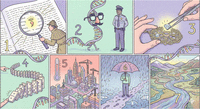
Seven wonders of RNA modification biology: (1) seeking, (2) hiding, (3) precision, (4) determinism, (5) change, (6) waiting, (7) convergence. (Figure was created using Google Gemini.)
ACKNOWLEDGMENTS
I am grateful to coworkers in my laboratory and to members of the RNA community, too numerous to list, for many generous and helpful discussions. This work was supported by the Intramural Research Program of the National Institutes of Health (NIH), National Cancer Institute (NCI), Center for Cancer Research (CCR), ZIA BC011488. The contributions of the NIH author are considered Works of the United States Government. The findings and conclusions presented in this paper are those of the author and do not necessarily reflect the views of the NIH or the U.S. Department of Health and Human Services. Portions of this manuscript were edited for clarity and conciseness using Google Gemini. Assistance was restricted to improving readability, with scientific content remaining the sole responsibility of the author. Google Gemini was used to create Figure 1.
Footnotes
-
Article is online at http://www.rnajournal.org/cgi/doi/10.1261/rna.080887.125.
-
Freely available online through the RNA Open Access option.
This article is a U.S. Government work and is in the public domain of the USA.




