


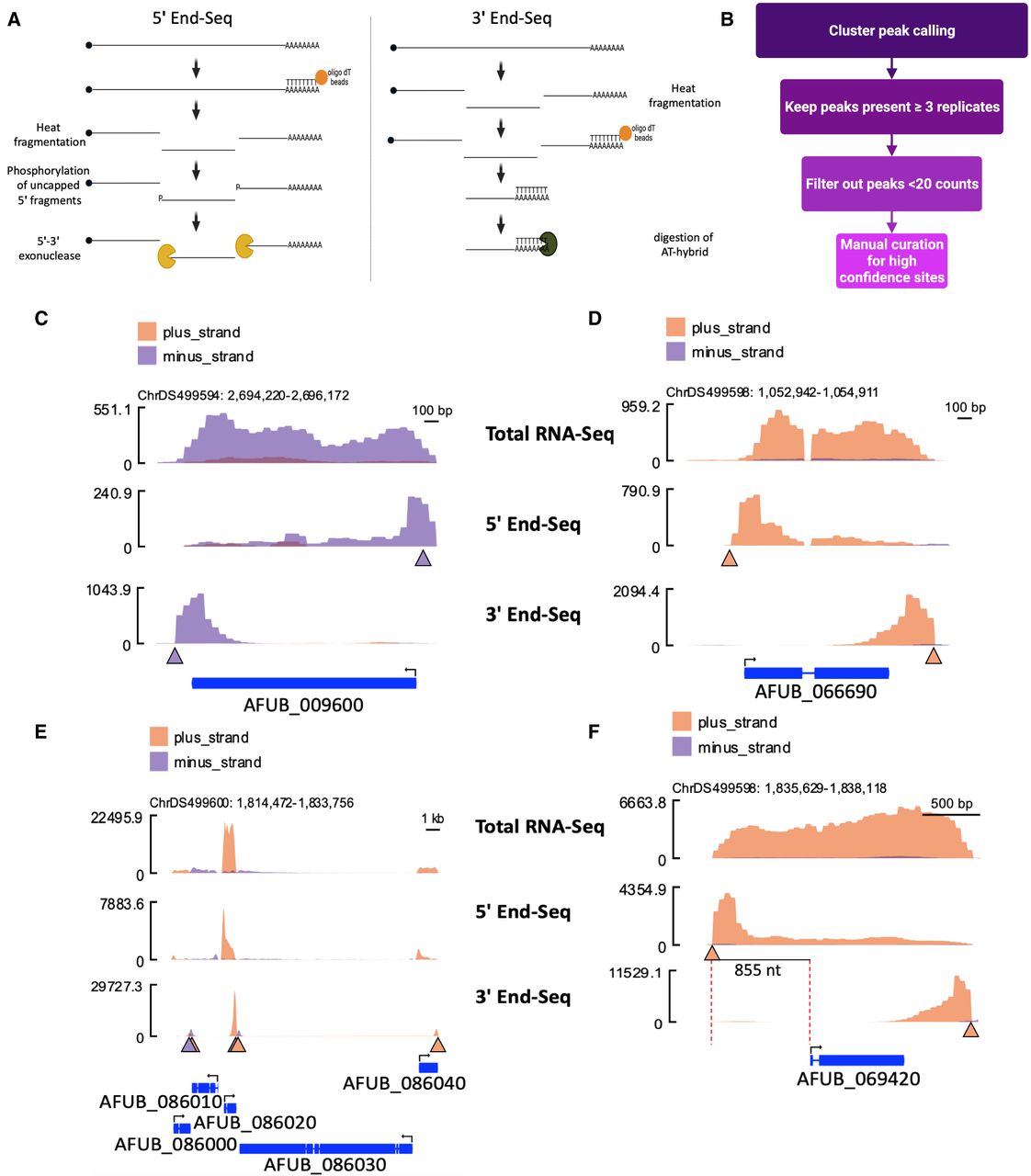
End-Seq defines UTRs in A. fumigatus. (A) Graphical description of the sequencing strategy using commercially available 5′ and 3′ End-Seq kits from Eclipse Bioinnovations (USA). For 5′ End-Seq, we combined three biological replicates of fungus grown at 37°C and 42°C each for a total of six replicates, and for 3′ End-Seq, we had four biological replicates for each condition resulting in eight total replicates. (Created in BioRender, Blango 2025, https://biorender.com/lguy6bt.) (B) Schematic depiction of the filtering strategy to achieve high-confidence sites. (Created in BioRender, Blango 2025, https://biorender.com/j5p9m7c.) (C–F) Example plots of mRNA-seq, 5′ End-Seq, and 3′ End-Seq read coverage. Orange indicates reads aligning to the + strand, while purple indicates the − strand. The annotated AUG is indicated by a black arrow, the CDS is indicated by the thick blue line, and introns by a thin blue line. The y-axis indicates total read counts. Read tracks were smoothened to improve viewability, and this infrequently masks some small introns. Arrowheads indicate the positions of detected high-confidence 5′/3′ end sites. Plots show (C) AFUB_009600, an mRNA splicing factor; (D) AFUB_066690 encoding Aspf2, a major allergen of A. fumigatus; (E) genes of the pseurotin A biosynthetic gene cluster; and (F) AFUB_069420 encoding CpcA with the length of the newly defined 5′ UTR indicated.




