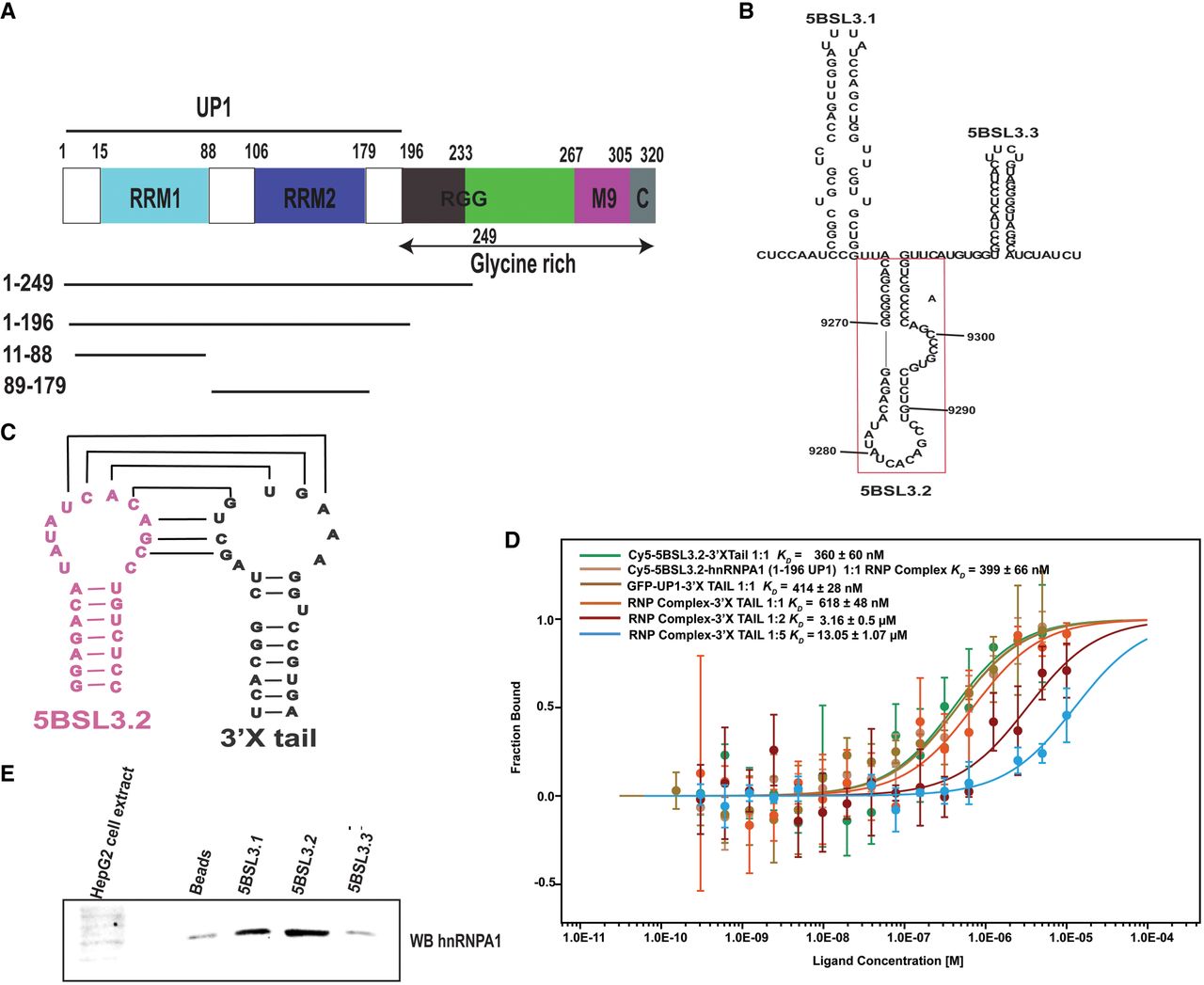
hnRNPA1 binds the 5BSL3.2 element and disrupts its kissing-loop interaction with the 3′X-tail (SL2). (A) The protein contains two RNA recognition motifs (RRMs), RRM1 (residues 15–88) and RRM2 (residues 106–179), followed by an RGG box (residues 196–233), a glycine-rich region (residues 233–267), an M9 nuclear localization/export signal (residues 267–305), and a C-terminal region (residues 305–320). The UP1 fragment includes both RRMs (residues 1–196). Truncated constructs used in this study are indicated below the domain map. (B) Secondary structure of the HCV cis-acting replication element (CRE) encompassing the 5BSL3.1, 5BSL3.2, and 5BSL3.3 stem–loop regions. The 5BSL3.2 stem–loop, important for long-range RNA–RNA interactions with the 3′X tail (SL2) region, is highlighted by a red box. Nucleotide positions are numbered according to the HCV genome. (C) Secondary structure diagram showing the long-range RNA–RNA interaction between the apical loops of the 5BSL3.2 element and the 3′X tail (SL2) region, forming a conserved kissing-loop complex essential for HCV replication. (D) Microscale Thermophoresis (MST) analysis showing the interaction between the 5BSL3.2–UP1 complex and the 3′X tail (SL2). The experiment was performed by preforming the 5BSL3.2–UP1 complex at increasing UP1:5BSL3.2 molar ratios, followed by titration with the 3′X tail. The binding affinity between the RNP complex and the 3′X tail decreases progressively with increasing amounts of UP1 relative to 5BSL3.2. (E) RNA pull-down assays reveal that hnRNPA1 is preferentially enriched with 5BSL3.2 compared to 5BSL3.1 or 5BSL3.3.