


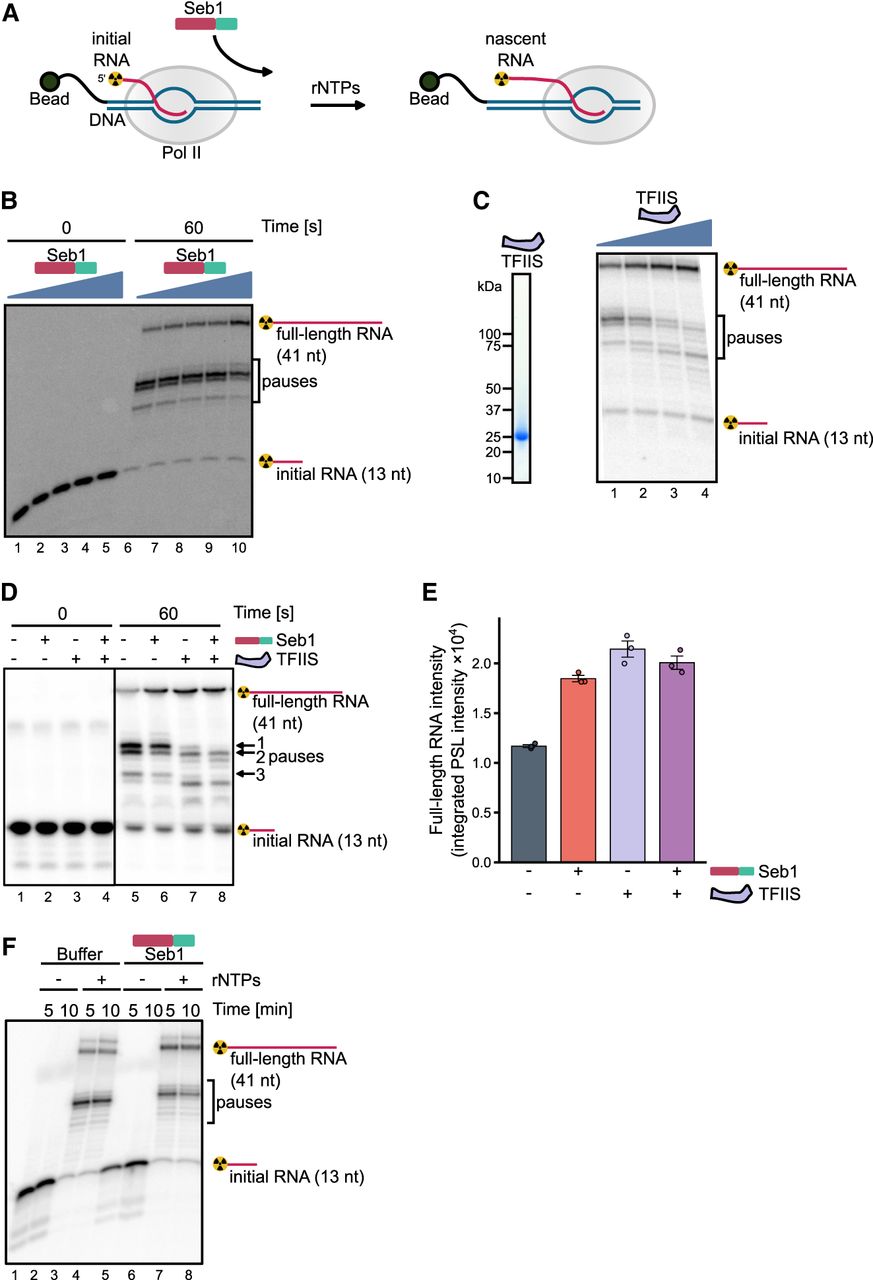
Seb1 affects pausing in vitro. (A) Schematic of the in vitro assay with Pol II transcriptional elongation complexes immobilized on streptavidin beads via biotin on the DNA template strand. RNA is 32P-labeled at the 5′-end. (B) Seb1 decreases pausing in a concentration-dependent manner. The initial RNA has a length of 13 nt and the full-length RNA is 41 nt. Transcription complexes were incubated with 0, 0.5, 1, 2, or 4 µM Seb1, and transcription was initiated with 100 µM rNTPs and 10 mM Mg2+. (C) The left panel shows an SDS gel of purified TFIIS (S. pombe TFIIS comprising 115–293 residues). The pausing pattern changes when TFIIS (0, 25, 75, or 240 nM) is present during 30 sec transcription initiated with 900 µM rNTPs and 10 mM Mg2+ (right panel), indicating backtracking of the elongation complex at these positions. (D) TFIIS and Seb1 promote transcription but do not show an additive effect. Transcription complexes were incubated with 1.3 µM Seb1, 60 nM TFIIS, or both, and transcription was initiated with 100 µM rNTPs and 10 mM Mg2+. (E) Quantification of full-length RNA produced in the experiments in D. PSL intensity—photostimulated luminescence intensity. (F) Seb1 aids in overcoming TFIIS-sensitive pauses. Transcription complexes were incubated with or without 800 nM Seb1, and transcription was initiated with 900 µM rNTPs and 10 mM Mg2+.




