


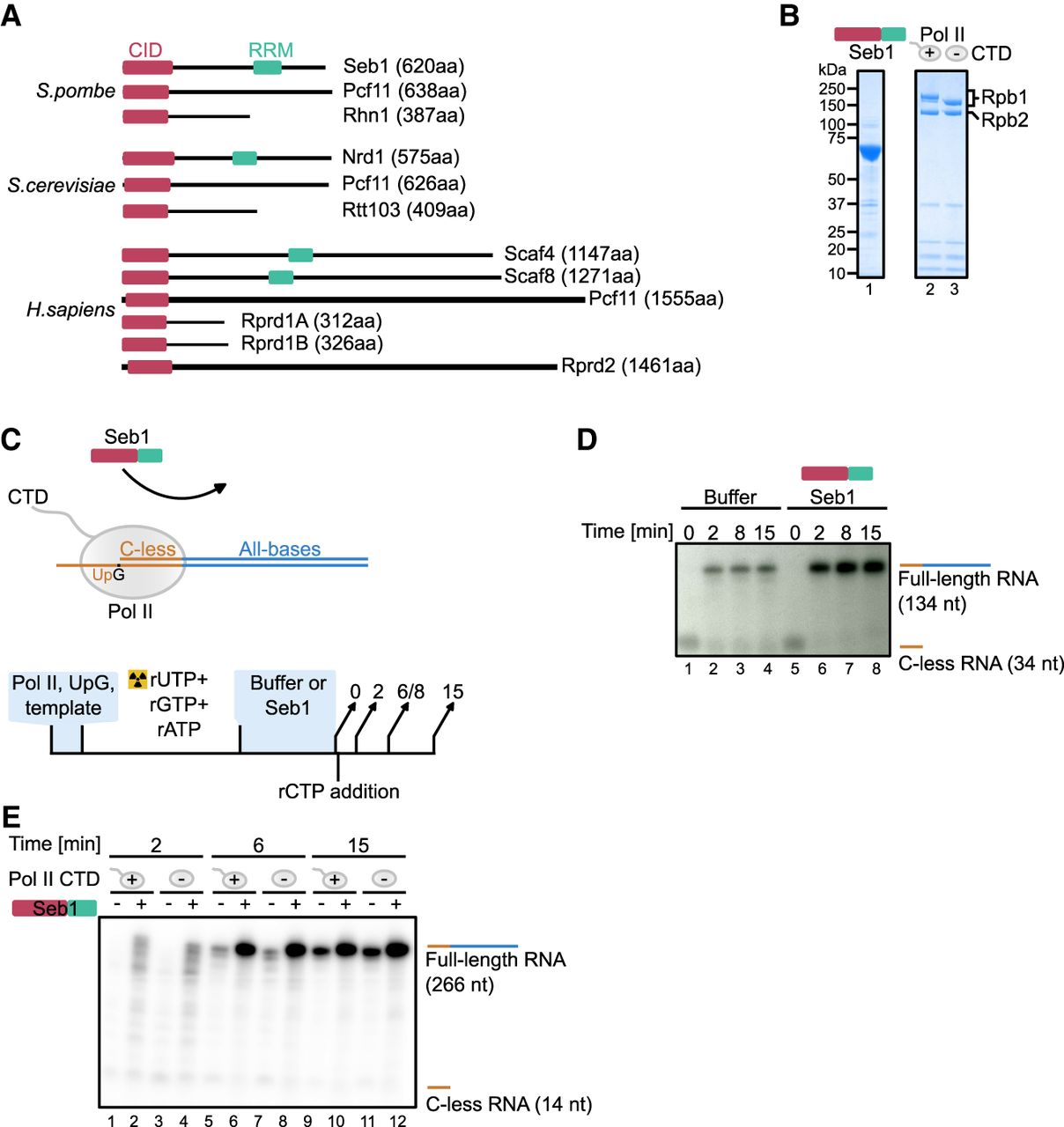
Seb1 stimulates transcriptional output in vitro. (A) Seb1 is a conserved protein in eukaryotes. In humans, Seb1 has undergone gene duplication (Scaf4 and Scaf8). This family of proteins contains the CTD interacting domain (CID) and RNA recognition motif (RRM). (B) SDS-PAGE showing exemplary purification of Seb1 or Pol II (±CTD). (C) Schematics of in vitro transcription, which allows multiple rounds of reinitiation. Tailed DNA template with a single-stranded overhang on the 3′-end of the template strand has a C-less track allowing the elongation complex to stop in the absence of rCTP (upper panel). Transcription is primed by an UpG dinucleotide and initiated with α-[32P]-UTP, rGTP, rATP. The stopped elongation complex is incubated with or without Seb1 (1.5 µM), and transcription is resumed upon rCTP addition. Products are collected at different time points (lower panel). (D) Seb1 stimulates transcription in vitro. Marked C-less RNA is 34 nt, whereas extended RNA is 134 nt long. (E) Seb1 stimulatory effects on Pol II do not require the CTD. Rpb1 has a TEV-cleavage site, which allows efficient removal of the CTD (Fig. 1B). Marked C-less RNA is 14 nt long, whereas full-length RNA is 266 nt long.




