


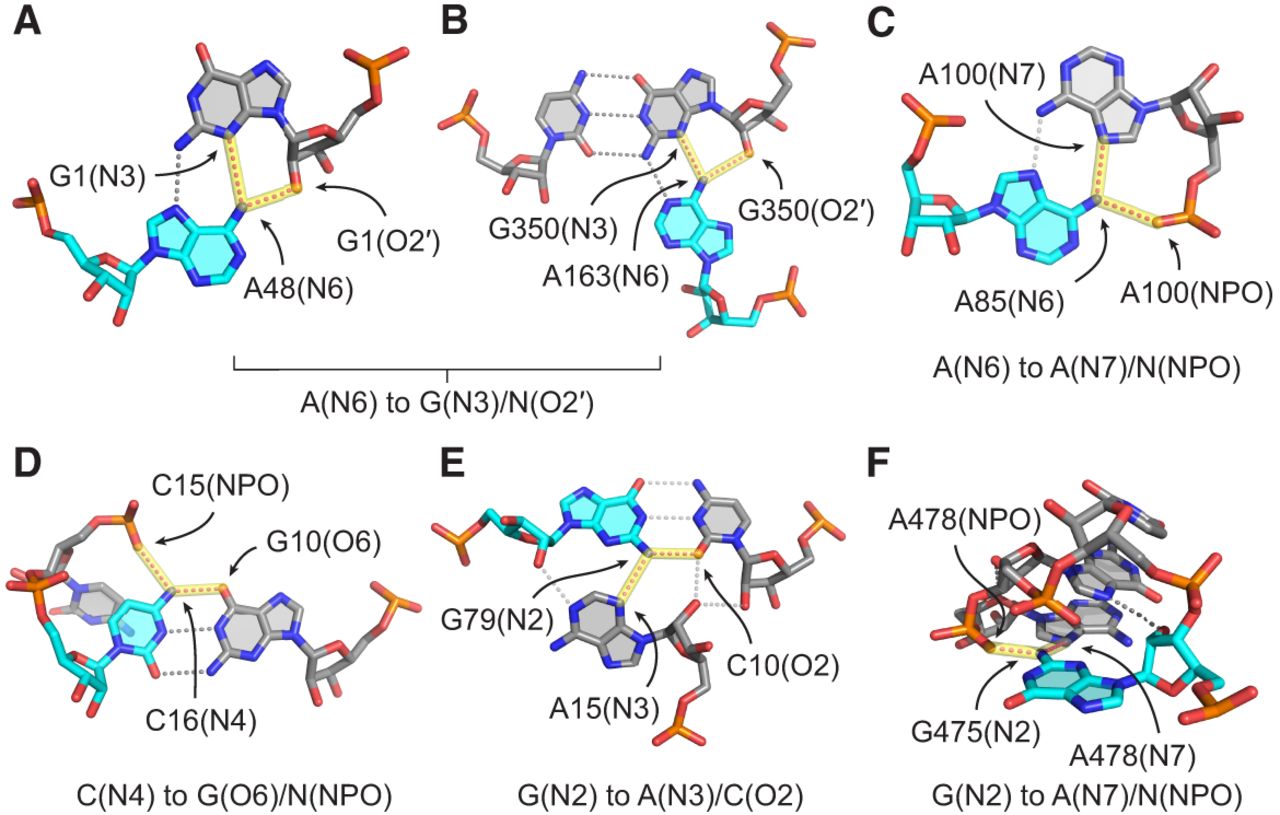
Common acceptor examples for dual-donating amines. (A,B) Adenine dual-donating amines interacting with the N3 and O2′ of the same G forming (A) a sheared GA base pair (PDB ID 3FS0, chain A, A48) (Pitt and Ferré-D'Amaré 2009) and (B) a WC/H A-minor motif (PDB ID 7QCA, chain L50, A163) (McLaren et al. 2023). (C) A85(N6) dual donates to the N7 and NPO of A100 (PDB ID 9AXU, chain 2, A85) (Gemin et al. 2024). (D) C16(N4) dual donates to a G(O6) in a canonical GC base pair and an NPO from a different residue (PDB ID 7B9V, chain 6, C16) (Wilkinson et al. 2021). (E) G79(N2) dual donates to a C(O2) in a canonical GC base pair and an A(N3), forming a traditional type I A-minor motif (Baulin 2021) (PDB ID 8A22, chain A5, G79) (Tobiasson et al. 2022). (F) G475(N2) dual donates to the N7 and NPO of A478 within a GNRA tetraloop (PDB ID 6ERI, chain AA, G475) (Perez Boerema et al. 2018). In all six panels, magenta dots highlighted in yellow depict H-bonds from dual-donating amines, and gray dots represent other H-bonds. All instances of these dual-donor-to-acceptor-pair interactions are provided within CSV and Python files; see Supplemental Table S1 and Supplemental Material.




