


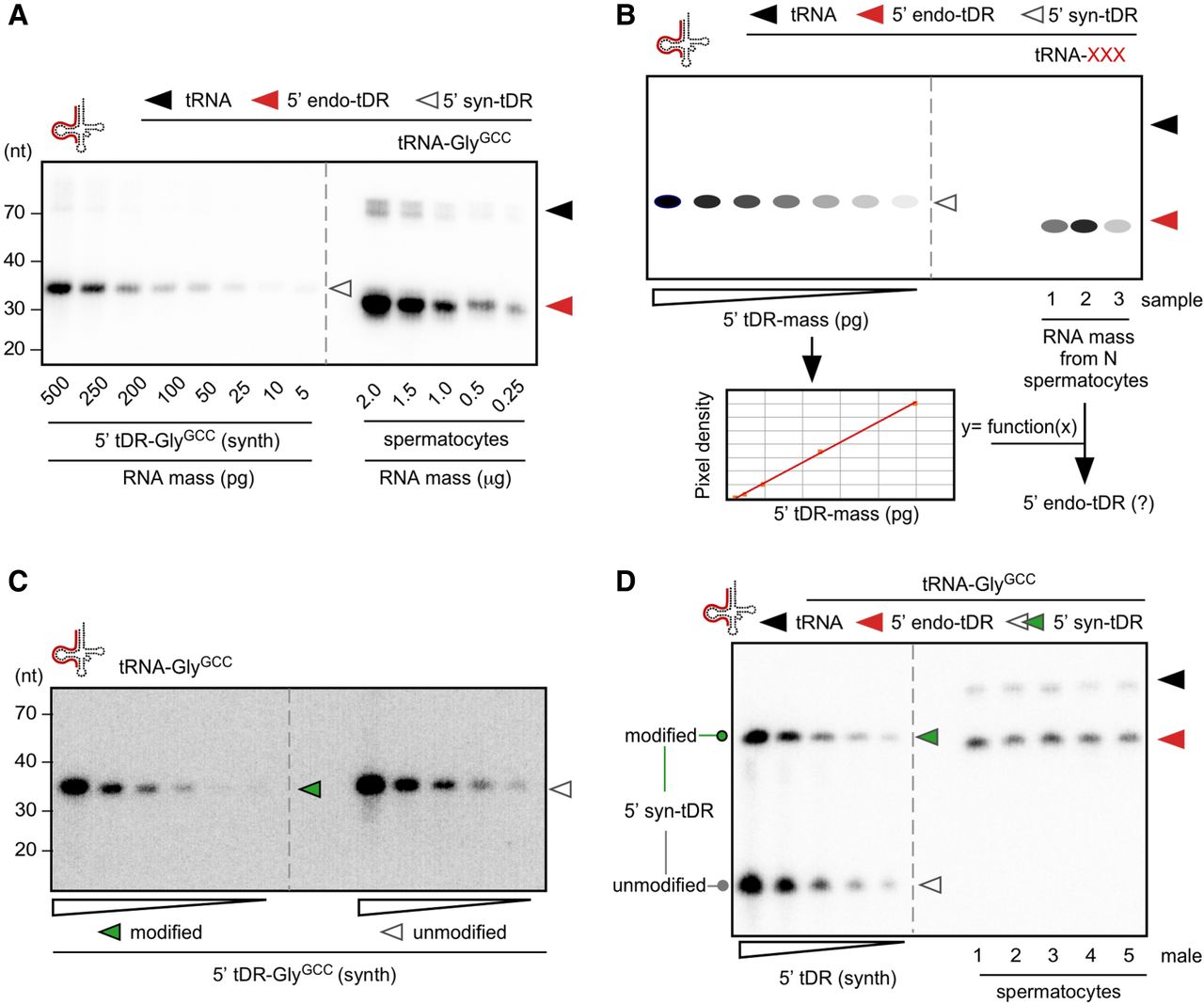
Determining 5′ tDR copy numbers in murine spermatocytes using quantitative northern blotting. (A) Northern blotting of a mass titration series of an unmodified 5′ tDR-GlyGCC along with decreasing masses of total RNA corresponding to decreasing numbers of murine spermatocytes using a probe against the 5′ moiety of tRNA-GlyGCC. (B) Cartoon depicting the approach of quantitative northern blotting on different masses of a synthetic 5′ tDR. Signals obtained by phospho-imaging are used to measure pixel densities, which are then plotted against tDR mass. The derived linear function allows determining a mass value as a function of pixel density recorded from a biological sample that contains 5′ tDRs. (C) Representative northern blot of a mass titration series of modified and unmodified 5′ tDR-GlyGCC (500-5 pg) using a probe against the 5′ moiety of tRNA-GlyGCC. (D) Representative northern blot of a mass titration series of unmodified and modified 5′ tDR-GlyGCC (500-5 pg), loaded sequentially into the same lanes alongside total RNA (50 ng) extracted from epididymal spermatocytes of three different males, using a probe against the 5′ moiety of tRNA-GlyGCC. Black arrowheads: mature tRNAs; red arrowheads: 5′ tDRs; empty arrowheads: mass titration series of unmodified RNAs; green arrowheads: mass titration series of modified 5′ tDR-GlyGCC.




