


Tribute to Timothy W. Nilsen (1948–2024)
- 1Department of Microbiology, Immunology and Molecular Genetics, UCLA, Los Angeles, California
- 2Department of Biological Sciences, Columbia University, New York
- 3CRUK Cambridge Institute, University of Cambridge, Cambridge, UK
- 4Guangzhou Women and Children's Medical Center, Guangzhou Medical University, Guangzhou 510623, China
- 5Executive Director and Publisher, Cold Spring Harbor Laboratory Press, Cold Spring Harbor, New York
- dougb{at}microbio.ucla.edu; jlm2{at}columbia.edu
- greg.hannon{at}cruk.cam.ac.uk; yuyang{at}gwcmc.org
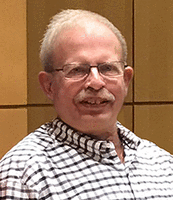
TIM NILSEN: AN EXCEPTIONAL SCIENTIST AND EDITOR-IN-CHIEF OF RNA
Douglas L. Black1 and James L. Manley2
1Department of Microbiology, Immunology and Molecular Genetics, UCLA, Los Angeles, California
2Department of Biological Sciences, Columbia University, New York
dougb{at}microbio.ucla.edu; jlm2{at}columbia.edu
We were saddened to learn that Professor Timothy W. Nilsen passed away in December after an extended illness. Tim was the founding Editor-in-Chief of RNA and made major contributions to RNA science and to our community.
Tim was born in 1948 in Minneapolis, Minnesota. He later moved east and attended Fordham University in New York as an undergraduate. After college by Tim's own words: “In the early seventies I drove used cars around the country for wholesale car dealers in the Bronx and supplemented that meager income by gambling on board games and cards. When it dawned on me that this was not a viable long-term career, I went to graduate school.” Those of us who knew him can see in this quote several aspects of Tim that would hold true for his later career: his blunt, no-nonsense personality, and his exceptional memory. Tim obtained a master's degree from City University of New York before moving to the State University of New York at Albany for his PhD studies with Corrado Baglioni, working on DNA replication. In the Baglioni lab, Tim met a research associate, Patricia Maroney, who would become his lifetime partner. Completing his PhD in four years, Tim stayed in the Baglioni lab as a postdoc to study the mechanisms of interferon-induced innate immunity. He coauthored over 20 papers during this time, using biochemistry to characterize the antiviral effects of interferon and the stimulation of RNase L by oligoadenylates and dsRNA.
In 1982, Tim was appointed Assistant Professor of Molecular Biology and Microbiology at Case Western Reserve University (CWRU). Patricia became a research associate in his group and would be a key contributor to his laboratory for his entire career. Tim remained at Case until his retirement in 2016. In 1984, he received a Presidential Young Investigator Award from the NSF, and in 1990 he was named a Burroughs Wellcome Scholar in Molecular Parasitology. In 1992, he was appointed as the founding director of the Center for RNA Molecular Biology at CWRU. This was perhaps the first research center to explicitly focus on RNA, and Tim recruited multiple successful scientists to be part of the center.
Tim's lab at Case continued to delve into important questions in RNA biology. Early on, these included investigations of cellular responses to viral infection, with papers on avian leukosis virus perturbation of the c-erbB gene and on interferon induction by influenza virus. His group also worked on ribosomal RNA processing and notably began studies of the human parasitic nematode Brugia malayi. Studies of mRNA biogenesis in trypanosomes had shown that these organisms use an unusual trans-splicing mechanism to attach a common leader RNA to the 5′ end of each mRNA, and a similar process had been shown to occur in the roundworm C. elegans. Tim's group demonstrated that trans-splicing also occurs in Brugia, and they went on to carry out extensive studies of trans-splicing in a larger human parasite, Ascaris lumbricoides. They heroically developed an in vitro system from these creatures that allowed them to examine the trans-splicing reaction biochemically and compare it to cis-splicing. Among many other findings, they showed that the trans-spliced leader RNA carried a tri-methyl G cap and formed its own RNP bound by Sm proteins that eliminated the requirement for the U1 snRNP, needed in cis-splicing for 5′ splice site recognition. And the quality of the data was always amazing. We especially remember their “T1 fingerprints”—they were beautiful! Tim and colleagues went on to describe the assembly of the trans-spliceosome and how its splice sites are recognized. These papers constitute a remarkable body of work on this unusual but important and mechanistically fascinating cellular process. With the discovery of micro (mi)RNAs and the RNA interference pathways, Tim became very interested in the mechanisms of gene silencing by these small RNAs. His group published several papers on the effects of miRNAs on translation, including the important demonstration that turnover of miRNA-targeted mRNAs can occur while they are being translated. Several of Tim's trainees who contributed to these studies went on to very successful careers studying RNA.
In addition to his own research, Tim expended enormous effort in service to the RNA community; we daresay that the scale of these contributions is unique, far beyond the usual call of duty. Over nearly 30 years, he served on numerous (an understatement) grant review panels for the NIH, NSF, and HHMI. This included a remarkable 13 years as a full member of one or another NIH Study Sections, in addition to many ad hoc appointments. He served as chair of the MGA study section, and of special study sections on Extracellular RNAs and on Epigenetic Modification. We both remember Tim in these study sections going to bat for grants, often from young faculty members, that had raised concerns elsewhere around the table. His unmatched knowledge and memory of our field made it difficult to argue with him. Tim also had a sense of humor. We remember he had a way of bugging his eyes at you across the table when a grant was receiving what he thought was an overly long presentation from a reviewer. Tim's dedication to the assessment of research publications was similarly extensive, serving on the editorial boards for many journals, including on the board of reviewing editors for Science from 2007 to 2016. In 1994, Tim was tasked by the newly formed RNA Society to be the founding Editor-in-Chief of RNA, a position he held until 2022. He recruited the editorial board and set the standards for review, seemingly reading all papers submitted to the journal. In 2003, Tim successfully helped change the publisher of the journal to Cold Spring Harbor Laboratory Press, where it continues to thrive. Tim was equally active in organizing meetings on RNA biology, serving as an organizer for a Keystone meeting, several annual meetings of the RNA Society, and six of the biennial Eukaryotic mRNA Processing meetings at Cold Spring Harbor Laboratory. In 2004, Tim was recognized by the RNA Society with their Lifetime Service Award, and in 2006 he was elected Fellow of the American Association for the Advancement of Science.
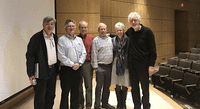
Symposium Honoring Tim Nilsen, April 5, 2017, Case Western Reserve University. (Left to right) Xiang-Dong Fu, Doug Black, Jim Manley, Tim Nilsen, Joan Steitz, and Reinhard Lührmann. (Photo courtesy of Kristian Baker.)
Tim's extensive service on editorial boards and review panels and as Director of the Case RNA Center gave him great influence over the RNA field. His own papers were models of clarity. He wrote many influential reviews across the fields of RNA biology, as well as coauthoring RNA: A Laboratory Manual from Cold Spring Harbor Laboratory Press. Tim was known to give detailed feedback to younger scientists and nonnative English speakers on how to make their papers clearer. His extensive reviewing of RNA science gave Tim an encyclopedic knowledge of the field. Coupled with a photographic memory for research results, this made him an unequalled resource of information and critical judgment. His advice was typically rendered straight up, without varnish, in his own inimitable way—opinions that often got more colorful as the meeting progressed from the auditorium to the bar.
Tim had a huge impact on our society, our journal, and our field. He is survived by his partner Patricia Maroney. He will be greatly missed by the numerous scientists he worked with over many years and in many capacities.
Recollections of Tim from some of his friends and colleagues
I came to know of Tim Nilsen while I was a postdoc in the Cech lab. In 1995, I learned that there would be a new journal called RNA, and that the Editor-in-Chief would be Tim Nilsen. In a year, I would meet Tim for the first time, when I interviewed for a faculty position at Case Western Reserve in his RNA Center—the first such center of its kind and perhaps the only one with a neon sign. After the interview, Tim took me into his office and told me that I wasn't getting the job. But he gave me sage advice on how to improve. And a year later, after working on these items, I would land a job at Penn State, where I've had the pleasure of being ever since. Over the years, I came to know Tim better. I would see him at the annual RNA meetings and when I did a sabbatical at Case Western in 2007 in Paul Carey's lab. Tim would eventually ask me to be on the Editorial Board at RNA, and he and I, along with the then current President of RNA, would choose the two Scaringe Award winners for best RNA graduate student and postdoctoral fellow every year, something we did for over 15 years. Tim had an encyclopedic mind and could remember details about each candidate. Amazingly enough, we almost always came up with the same short list, and in cases when we didn't, Tim would listen carefully to our points of view and together we would come to a unified decision.
My personal interactions with Tim as an author for RNA were quite positive. I remember very clearly one small paper that my group wrote for the journal. After struggling for an embarrassingly long time with blurry gel images, we came up with a way to fix the problem with a cheap and effective change to the gel cassette. We wrote a short methods piece on it and sent it to the journal. Tim had it reviewed and accepted it, creating a special category in the journal that didn't exist before called “A Methods Note.” I appreciated Tim's guidance and assistance, and I hope that paper has helped some in the field.
Tim could be tough at times, but he was smart, compassionate, and he knew what he was talking about. Through his tireless efforts, the journal grew in reputation. Tim Nilsen had a profound impact on the RNA community and on my life in particular. We owe him a mountain of gratitude for all that he did for our journal and field.
—Philip Bevilacqua, Pennsylvania State University
I first met Tim Nilsen in the 1980s, and I'll never forget him extolling the virtues of Ascaris lumbricoides as an experimental system for RNA trans-splicing. Nematode RNA trans-splicing, in which a spliced leader (SL) RNA is used as a splice donor for intermolecular splicing, had been discovered in C. elegans, an organism exquisitely amenable to genetics and cell biology. But Tim was a biochemist, and the thought of harvesting enough of these almost-invisible worms to make splicing extracts was daunting. So, Tim embraced an animal that few could love—a foot-long parasitic intestinal worm. Between the mid-1980s and 2002, Tim used extracts of Ascaris embryos to isolate the SL RNA and RNP, reconstitute trans-splicing in vitro, dissect its mechanistic features, and discover protein components specialized for trans-splicing. Tim went on to make other major contributions, but his creative foray into Ascaris RNA trans-splicing will be remembered as a great example of how choosing the right experimental organism can spark biological discovery.
—Tom Cech, Howard Hughes Medical Institute
Tim Nilsen was a giant in the RNA world who made groundbreaking discoveries in a variety of areas, most notably on the mechanisms of trans-splicing in nematodes. Tim was a remarkable individual, a great leader of the RNA field, and a true friend to many of us. Although I never worked in Tim's laboratory, I considered him to be one of my key mentors in my career. Tim was always willing to give you his opinion on a grant, paper, or talk. If you were ever on the receiving end of this, you know his opinions could be strong, yet fair.
Tim had a legendary photographic memory and could recall not only every scientific detail, but the journal, book, or abstract it was published in, the date it was published, and often the page number. This was remarkable to behold, and to be honest, pretty annoying. Tim also had a keen eye for outstanding science and the impact that a study would have. These two facts made Tim an outstanding reviewer, which was an activity Tim was deeply involved in. In addition to reviewing nearly every paper ever submitted to the journal RNA, of which Tim was Editor-in-Chief, Tim reviewed RNA-related papers for nearly every other journal in the field. Tim also reviewed most grants around the world related to RNA biology. I spent many years as a member of the MGA study section. It was amazing to see Tim in action and was a valuable mentoring experience for me.
Given Tim's incredible knowledge of nearly every aspect of RNA biology, Tim was shockingly bad with technology. To say that Tim was old school is a bit of an understatement. Tim and I were invited to coauthor a review article on alternative splicing to be published in Nature. I would email Tim a section of text that I had worked on, and Tim would have his assistant Ann Marie Michenmacher print him out a hard copy on which he would scribble his revisions. Any new text that Tim wrote would be handwritten on a yellow pad, and then Ann Marie would either fax these to me, or scan and email them to me. At this point, it was up to me to interpret Tim's handwriting, which could be challenging. Though I was not used to working in this manner, working on this article together made me a better writer and scientist.
I will miss Tim, as will the RNA field. Meetings without Tim in the front row of the auditorium or at the bar after talks will not be the same. Those of us who know his science are saddened by his loss, but those of us who had the fortune of knowing him personally are left with a gap that simply can't be filled because Tim was such a unique individual.
—Brenton Graveley, UConn Health Center
Tim was a first-rate scientist, as we all know, having made many important contributions to discoveries about different RNAs and their functions and roles. But Tim was also an enthusiastic person as far as discussions of his as well as other people's work. Tim contributed in many ways to the CSHL summer programs of Meetings and Courses, which were very important in themselves, but also in making the lab a place that was known for bringing scientists from many places to discuss their latest discoveries with their colleagues. In this, Tim was an enthusiastic participant in the biannual meeting on Eukaryotic mRNA Processing. Tim gave many good talks, answering questions about the studies after the talk and asking plenty of questions after other people's talks as well—he was tough but fair. Of course there was time for informal discussions—at breaks, during meals, and after the sessions ended—aka going to Blackford.
Starting in 1999, Tim became one of the organizers of the meeting. Because the field had grown, it took someone who could work effectively with co-organizers who might work in different areas, which Tim did well. Almost all talks were chosen from abstracts, so one had to read carefully a lot of them, for sure, to put together the program. Also, there was a three-term limit on how often one could be an organizer. Now Tim enjoyed doing this so much that he really didn't want to retire and, in his inimitable style, made it clear that he was going to continue. David Stewart, the Director of Meetings and Courses, met with Tim, and he pretty much said that he was doing it for the next (fourth) time. I think that it took five times before Tim agreed to relinquish his role and we finally moved on. Actually, Tim was quite good-natured and almost amusing. And I should say that Tim continued to come to the meeting even after his health started declining, and it was clearly more difficult for him to walk around easily. It was really sort of heroic.
Thus, Tim contributed greatly to the very important meetings that made scientists want to come to Cold Spring Harbor and exchange results, which benefited the lab enormously. It was really a pleasure and an honor to know him. I always looked forward to seeing him as often as possible; he will be sorely missed.
—Terri Grodzicker, Cold Spring Harbor
I got to know Tim well in a variety of venues. At scientific meetings, seminars, at NIH study sections, by co-organizing meetings and writing a part for the Cold Spring Harbor RNA Lab Manual. There was a lot to like about Tim: his opinions, which were always valuable and never hidden beneath the surface, his encyclopedic knowledge of the RNA field, his role as Editor-in-Chief at the RNA journal, his editorial role at other journals, and his role at many NIH grant review panels. His scientific impact was wide and deep, mostly on splicing and microRNAs. It was always interesting to talk science with Tim, because you always came away knowing something new. I got to spend time with Tim when we were writing the Cold Spring Harbor manual, again a unique and educational experience. Tim also, in his role as editor of the RNA journal, solicited papers to make the journal great. I believe he always made sure, unlike some journals today, that papers were handled quickly and fairly. I learned a lot from him. I miss him and his comradery.
—Don Rio, University of California, Berkeley
I was very sorry to hear of Tim Nilsen's passing when a Brandeis colleague told me about it. Jim Manley contacted me shortly thereafter and asked whether I'd be willing to write a paragraph or two about Tim. I was fond of Tim and also respected him and so said “It would be my pleasure.”
Tim was a very strong scientist with high standards as well as an enthusiastic citizen of the RNA world. Many people will certainly remember and praise his devotion to the journal RNA and with good reason. He had excellent taste and would chase after a good story and publish it quickly with minimal fuss, exactly what we are missing today in our world of demanding reviewers and too many figures per paper. Tim prioritized the central message of a story and didn't sweat the small stuff. Although Tim also had a number of other professional assets, what truly distinguished Tim from other top RNA practitioners was his unusual demeanor.
I will relay the brief exchange I had with my wife at home the evening after receiving Manley's email. (She is—like me—an ex-RNA person who also knew and liked Tim.) I told her that my thoughts about Tim reminded me of a famous song, and she guessed immediately what I had in mind: “My Way” by Frank Sinatra.
To illustrate this principle, Tim drank and smoked too much and made no bones about it. Importantly, however, this behavior hardly ever caused any professional issues. For example, falling profoundly asleep in the middle of a work dinner never qualified as “an issue.” Based on the couple of times I visited his home and many one-on-one conversations, the private Tim was no different from the public Tim. He was, in short, his own man with no artifice: high standards, speak the truth and live the way you want as long as you don't impinge on others. “His way.”
I last saw Tim only six months ago, in August 2024. We met in Berlin, at Reinhard Luhrmann's retirement festschrift. I hadn't seen Tim in a long time and was shocked. He did not look well and was also in pain from back trouble. Notably, however, he was cognitively sharp, even sweet and charming. He was interested in the talks, asked good questions and was keen to interact. I loved seeing him and was so pleased that he was recognizably engaged and enjoyed being around old friends and colleagues despite being quite ill. He will be missed.
—Michael Rosbash, Brandeis University
My comments about Tim are necessarily terse, because he always seemed to be in a different league from the rest of us in endeavoring to make contributions to the scientific enterprise.
What I respected about Tim the most was something that I cannot do—that is to remember the details of stories about science, no matter how long ago they were published or circulated. I recall instances where Tim recalled experiments/data my lab had published that I frankly forgot we had ever even thought about. This unusual capability is what I understand supported Tim's post-high school education by winning him sustenance money in gaming houses primarily in NYC! Amazing!
These talents also contributed significantly to Tim's expertise as an editor. I shall be forever grateful that he was willing to take on editorship of a new journal (RNA) at a time when snootiness precluded publication of even some of the most exciting advances in RNA science in journals extant at the time. I recall meeting with Tim (and one or two others) one day in August in Manhattan, when we trudged from one address to another in the extreme heat in order to secure a publisher for the new RNA journal. But that was only the beginning of Tim's devotion to the cause.
It was Tim's caring and high standards of excellence that made the RNA journal a paradigm. I suspect that every single paper was read (and perhaps revised) by Tim. What a pleasure it was to know that exciting new advances in the structure and function of RNA were in such good hands.
Tim, we miss your insights so much and are so grateful for what you brought to all of us through your devotion to RNA. Thank you.
—Joan Steitz, Yale University
Remembering Tim: a tribute to Tim Nilsen from those whom he trained and mentored
Gregory J. Hannon1 and Yang Yu2
1CRUK Cambridge Institute, University of Cambridge, Cambridge, UK
2Guangzhou Women and Children's Medical Center, Guangzhou Medical University, Guangzhou 510623, China
greg.hannon{at}cruk.cam.ac.uk; yuyang{at}gwcmc.org
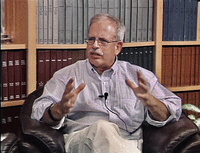
Tim Nilsen being interviewed during the 2006 Cold Spring Harbor Symposium in Quantitative Biology: Regulatory RNAs. (Photo courtesy of the Cold Spring Harbor Laboratory Library and Archives.)
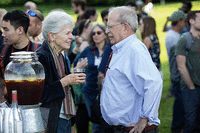
Tim Nilsen and Joan Steitz, 2019 Cold Spring Harbor Symposium: RNA Control and Regulation. (Photo courtesy of the Cold Spring Harbor Laboratory Library and Archives.)
As one of Tim's early students, I still vividly remember my PhD thesis defense. I was pressed on reconstructing the logic of a particular piece of RNase T1 fingerprinting secondary analysis, where we demonstrated the identity of a particular fragment by following the transfer of labeled phosphate groups from defined NTPs. My committee was patient, but I simply failed to get there. It was the only question I flubbed. Charlie Miller, a microbiologist and chair of my committee, said afterwards that my failure on that point simply proved that I had not yet achieved the god-like status of my advisor. This was both true (and remains so) and an apt description of how we all thought about Tim. God-like, indeed, and a Norse one at that. Tim could wield his intellect like Thor's hammer, but like Thor, we also remember him for his “fatherly goodness.” One theme that runs through the reminiscences below is how, at its core, Tim's mentoring philosophy was to always support his trainees first and foremost. Tim cared about the science and he cared about his people. He tried to make every one of his trainees the best that they could be, instilling within them drive and a purity of purpose. He wanted us to identify and tackle important questions, to innovate and be scientifically fearless, and to make a mark in our own right. Importantly, he taught us to be critical, critical of our own science as much as of that done by others, and to be critical only in a way that was constructive.
Tim always ran a small group, and I was both surprised and pleased to see that the experience of his final PhD student, Trinh, was so similar to my own as one of his early students. Each day started out with a meeting and discussion, equally often of big ideas or concepts as the details of experiments and recent results. For me, this always helped to place our work in a broader context and to ensure that we were seeking answers that were important, not just those that were easy to uncover.
Tim's passion for RNA biology was contagious. Even those of us who entered other fields felt the gravitational pull of RNA science throughout our own careers. But even when we worked on other topics, we took the drive and passion that Tim taught us and applied it to those new areas. The rigor and purity of RNA science built a key foundation for success and impact in any topic that we explore.
Tim was also passionate about clarity in communication. He drilled into each and every one of us how to present our ideas and our work to others in an accessible way. For all the time I knew him, he never used a word processor, but instead wrote everything longhand—to be typed by others. I remember him telling me that this avoided the tendency to view each page in isolation and made ideas flow more smoothly. It also slowed down the process of writing, so that each sentence and idea was formulated more clearly. I will confess that at least through the end of my postdoc, I wrote a first draft of every paper or grant by hand on a yellow legal pad—just like Tim. I only gave up when even I couldn't read my own handwriting, but I still tried to conserve the underlying principle of thinking each idea and each sentence through fully before committing it to paper.
Tim also taught us the importance of service to the community, selfless service. In this, as in all things, he led by example. From his helping to found the RNA Society, his serving as founding editor of its journal, and his service on grants review panels to his creation of the RNA Center at CWRU, Tim taught us that we all benefit from a strong community. In this, he taught us not only to be good scientists but also good citizens. I'm sure we all have little doubt what he would make of the current politicization of science in the US.
Though we, and the community of RNA biology as a whole, are deeply saddened by his loss, we count ourselves lucky for the good fortune of having had his caring and mentorship. Tim will never really leave us, as we are each formed (or perhaps forged), in one way or another, by the time we spent together.
Reflections on Tim from those whom he profoundly influenced
The Nilsen lab was brand new when I joined in mid-1984. During my medical training, in Internal Medicine and Neurology, I'd decided to focus on understanding and treatment of multiple sclerosis (MS). Given the complexity of that condition, I felt basic research training would serve me well. Of those I met, Tim's account of a proposed research project was the most precise, clear and concise. I joined without either technical or conceptual skills in research, carrying nothing but a willingness to learn. My first action in the lab was to recognize a cousin's name (Frank Westheimer) on the cover of a copy of Annual Review of Biochemistry, perched unaccountably on a pile of paper towels, which were assembled on a glass plate, seated across a baking dish. Excitedly, I seized the book to show Tim my cousin's imprint, only to realize by the look on his face, as the paper-towel tower collapsed, that I'd introduced myself with a gigantic faux pas. Things got slowly better. Tim took away from precious time building a new lab to show me how to write a fundable fellowship application, allowed me to take the attention of lab personnel, particularly that of his partner Pat Maroney, to learn from absolute zero how to plan, conduct and interpret experiments. After five years in Tim's lab, and in the engaging, inspiring environment of Fritz Rottman's Department of Molecular Biology and Microbiology, I was able to start my own lab and maintain continuous competitive funding for the next 25 years, before moving to biotech, where I'm still working.
Tim was larger than life in many ways—fiercely intelligent, tirelessly scholarly, ribaldly humorous, and very funny. His emotions were large too—both those of pride and gratification with new discoveries, and those of frustration and disappointment—particularly when human error slowed or derailed the doing of research. The environment in the lab could be intense—and there were typically no more than five of us to absorb that energy. For some years after finishing my time there, I was visited by dreams—mostly about the abundant good times our small group shared.
More pointedly, as my research career developed, I found nearly daily that lessons from my postdoc with Tim reemerged and provided the guidance I needed. These lessons could be technical or could be informed by Tim's visionary philosophy of the right way to do science. Different from many others, he refused to be defined by a set of techniques or skills. Instead, he fastened on research questions and would adopt any method at hand to answer that question. When I began working there in 1984, a prime focus was on determining whether interferon-induced antiviral activities that degraded viral RNA might also play a part in cellular RNA metabolism. That hypothesis could not be verified with the available tools, and the lab increasingly focused on mechanisms of RNA splicing, including trans-splicing as observed in nematodes. Addressing mechanistic questions required the preparation of Ascaris lumbricoides embryo extracts, which could enable the study of the trans-splicing reaction in a cell-free system. Unafraid of the challenge posed by working in a novel system, Tim, Pat, and Greg Hannon, then a graduate student, began growing the nematodes in buckets, within the department cold room. Some years later, a series of high-profile publications confirmed the wisdom of this initiative. It was an unceasing joy to see the lab's work grow steadily in depth and prominence. Evolution of the Center for RNA Biology seemed a natural progression.
Over time, I was repeatedly amazed by the near-daily frequency with which lessons from my postdoc would enter my consciousness at an opportune time. Tim was an extraordinary talent as scientific writer, and I benefited from his willingness to teach me the precepts of clarity, brevity, accuracy, completeness, and rigor that seemed to come to him naturally. Given these attributes, the success of Tim's tenure as founding editor of RNA was nearly a given. Of course, these features characterized his approach to science as well. I've become increasingly grateful as the years pass by that I had the opportunity to begin learning research from someone with the purity of commitment to the scientific enterprise that Tim incarnated.
—Richard Ransohoff, Third Rock Ventures
Although I knew Tim had been struggling with his health for some time, I still felt a profound shock when I heard the news of his passing. Tim was both a mentor and a friend to me, and I am deeply saddened by his loss.
I began my graduate school journey in Tim's lab at Case Western in 1989. By the time I completed my PhD in 1994, I was fortunate to stay on as a postdoc for another year. Those six years were truly unforgettable. Tim had an enormous impact on me—both professionally and personally. We spoke at least twice a day, nearly every weekday. Mornings always began with a deep dive into my experiments and plans for what came next. Then, in the late afternoons, we'd all gather to wind down—those moments, filled with relaxed and often hilarious conversations (and yes, always with a beer in hand from the stash Tim kept in his office), became a cherished ritual. Through those conversations and daily interactions, Tim taught me so much. He had a remarkable way of showing what it meant to be a thoughtful, rigorous scientist. He helped me learn how to ask the right questions, use the tools at hand, and really make sense of the data. He was especially passionate about good controls and always encouraged me to explore new approaches.
But what meant even more to me was the kindness and care he extended beyond the science—his softer side truly shone through. I'll never forget how he personally drove me home after my wisdom teeth were extracted. He and Pat frequently invited my wife and me over for dinner, and we were even included in their amazing beach trips to North Carolina. Even after I left the lab, Tim continued to check in, offering advice, support, and encouragement. I vividly remember one day, while I was in the lab, the phone rang—it was Tim! He had heard I was going on job interviews and wanted to help me prepare. We had a long, wonderful conversation that covered everything from the questions I should ask to what I should wear. And when I finally became a PI, he was quick to offer thoughtful feedback on my grant proposals.
Tim was an extraordinary mentor and friend, and he will forever hold a special place in my heart.
—Yi-Tao Yu, University of Rochester
As I reflect on my PhD journey, Professor Timothy Nilsen—whom I'll refer to simply as Tim—stands out as both my toughest critic and greatest supporter. From the very first day we met at Case Western Reserve University, he has profoundly shaped me into the scientist I am today.
Being his student throughout my PhD was not only a privilege, but an experience for which I will always be grateful. In science, where depth of knowledge and accuracy are everything, he taught me that thinking critically isn't just a skill—it's a discipline. He challenged me relentlessly, pushed me to question our assumptions, and expected nothing short of crystalline clarity in our logic and rigor in our work. At times it was difficult—but it was always exactly what I needed to grow.
Every morning, he, Pat, and I spent an hour talking. Sometimes it was about experiments, sometimes papers, sometimes big ideas—and sometimes just a point in a figure that didn't make sense. What amazed me the most was his incredible memory—he could recall not just the content of papers he'd read, but also the first author's name every single time. Those hours became the heartbeat of our scientific training. Through them, I learned not just how to do science, but how to think like scientists. Looking back, those conversations were more than academic meetings and I enjoyed his way of teaching so much.
What made him truly exceptional was that behind the high standards and sharp questions was someone who genuinely cared. He was always there to support me when things didn't work, to remind me why the science mattered, and to inspire me with his own curiosity and dedication. He believed in me—especially in the moments I doubted myself—and that belief carried me further than I could have imagined.
To him (and Pat), I offer not just my thanks, but my deep gratitude and respect. The impact he has made on me will last far beyond the lab bench.
Thank you—for the science, the mentorship, and the countless hours that helped shape my future.
—Trinh Tat, Houston Methodist Research Institute
My time as a graduate student in Tim's lab was brief—just two years, from 2005 to 2007—before I relocated to the University of Wisconsin-Madison to be with my wife and continue my graduate studies. But those short two years were the most formative of my career. We didn't have formal lab meetings. Every morning, the group gathered over coffee to share what we'd done the day before, talk about plans for the day, and just chat about science—and sometimes about everything else. A student might dread the idea of daily meetings with their advisor. I did, for a good three months. But in time, those mornings became the most special part of my training in Tim's lab. They powerfully and fundamentally shaped how I think about and practice science. I doubt a graduate student can find that level of engagement and interaction with their advisor anywhere else. I certainly couldn't recreate it with my own trainees. It takes someone with Tim's broad knowledge and deep insights into the literature, sharp scientific instincts, and genuine investment in his students to make it work.
—Wen Huang, Michigan State University
CWRU was awarded a MacArthur Foundation Grant to bring molecular biology approaches to the study of neglected helminth parasites. This included Tim's lab and the lab of Fritz Rottman. I joined Fritz's lab as a research fellow to participate in this program. Much of my training/mentoring came from Tim and his group. I was there when Tim's lab identified spliced leader trans-splicing in parasitic nematodes and his lab's development of in vitro systems to study this form of splicing. I was fortunate many years after leaving CWRU to capitalize on a cell-free translation system developed in Tim's lab to study translation of spliced leader trans-spliced mRNAs. Tim was tough, but insightful, and his critique of experiments were key parts of my scientific training. Tim often warned me when he thought I was on the wrong track with a project. My “tracks” would have been much smoother if I had listened to him more! He also was not one to let what he thought was “crap” go by in a presentation. I remember practicing for a job talk and noted what I had learned that the “parasite lived for up to 25 years in humans.” Tim immediately said, “How the hell do they really know that.” Tim could be harsh, but he also had a good heart that I was lucky to have witnessed. I cherished the social opportunities with Tim and Pat at their home and being trounced at pool. He will be missed.
—Richard Davis, University of Colorado (Emeritus)
It seems like a lifetime—or two—ago when I first walked into Tim's lab to talk about doing a rotation as a potential PhD student. I suppose it was 38 years ago and my association with Tim and his influence encompasses nearly my entire career as a scientist.
My first encounter with Tim was indirect. I was working as an undergraduate in Joyce Jentoft's lab at Case Western, largely creating software for computer visualization of protein structures. The Departments of Biochemistry and Molecular Biology were piloting a new program to admit their undergraduates to the PhD program a year early—in the third year of their training. This enabled those students to take their final year of coursework at graduate level and apply that year's coursework to both degrees. Importantly, students also had their tuition paid and received a stipend. Apparently during a particularly contentious faculty meeting, Tim had opposed the program, of course in his own particular mild-mannered fashion. Thus, it was ironic that the inaugural student in the scheme would choose Tim's lab for a PhD. During my six years in Tim's lab, he turned me into a scientist and taught numerous lifelong lessons that have served me well in developing my own independent career and those of my own trainees.
The thing that I remember most about my earliest days in the lab was its intensity. Tim had a small group—really throughout his entire career—and he spent a great deal of time on the science that each member of that group did. I spent nearly all of my time in Tim's group working closely with Pat Maroney, Tim's longtime partner. Between them, they taught me how to do science, how to think about a problem, and how to design an experiment that would give a definitive result. The rigor that they brought, something intrinsic to RNA biology in my view, was something that I have taken with me and tried to pass on to my own students and postdocs—even if they were working in areas where achieving the level of certainly possible with RNA biochemistry was more difficult.
Tim, Pat, and I met nearly every morning to plan the day's experiments. This was not a matter of Tim simply telling us what to do but was a time of lively debate over usually horrible coffee. This taught me to have my own ideas and to be willing to defend them. One of Tim's rules was that I could do whatever experiment I wanted as long as I also did what he said—of course this was before the days when a single-cells study could cost multiple tens of thousands of dollars. What was intrinsic to this approach was the ability to pursue my own ideas but still respect the wisdom gained and instincts honed by Tim's much greater experience. Yes, and certainly at the beginning, his ideas were usually more on the mark, but I had the freedom to grow and learn as long as I worked hard. We often also met at the day's end when the results of multiple experiments emerged from the manual development of films in the darkroom. That set us up to think through the evening before planning the next day's efforts. In the days before PubMed and Google, Tim's encyclopedic knowledge of the literature was critical, both in making unsuspected connections and in knowing exactly where to find the paper that taught you the technique you needed to answer your question.
Tim's focus was always on the biological question. He never did something simply because you could, but there had to be a clear path toward the answer you were trying to uncover. He fearlessly used any approach necessary to get at those answers. Again, this is a lesson I have revisited consistently throughout my own career. I recall when we were starting to do RNase T1 fingerprinting and needed to incubate the chromatography tanks at 65°. This required finding some disused bacterial incubators and disabling all their safety features, and though Tim did not spend very much time at the bench, he was always involved in piloting new things—or in this case reviving old techniques that were those best suited to clearly and rigorously address our questions.
The degree to which Tim was scientifically fearless was possibly best exemplified by our foray into Ascaris. We wanted to understand how trans-splicing worked and C. elegans, where it was discovered, did not seem an ideal substrate for biochemistry. Tim seized upon Ascaris, an organism from which we could obtain large amounts of material, made uniform by synchronously developing large quantities of eggs collected manually by dissection of these substantial parasites. Tim hatched this plan while at a Cold Spring Harbor meeting and arranged to drive to Wisconsin to collect some worms while leaving Pat and I to figure out what to do with them when he got back. This initial trial grew into dissections of thousands of worms, eventually arriving sexed and ready to go from abattoirs in the Southern US, and storage of hundreds of bottles of eggs in the cold room ready to initiate development upon shift to 37°. It should be noted that these were potentially infectious to humans, but those were different days in terms of Health and Safety. That Ascaris turned into such a productive model for studying many aspects of splicing and snRNA biology provided valuable lessons that have shaped my own career. Tim taught me to pick the question first, then the context and techniques best suited to answering that question without being scientifically pigeonholed.
All of Tim's lessons have been hallmarks of my subsequent career, which has made use of a wide variety of models and approaches to address a broad spectrum of biological questions. Tim prepared me to survive and even thrive in the intense environment of Cold Spring Harbor and to use the privileges I was fortunate enough to obtain with flexible funding to chase those questions that interested me most. It is my hope that the legacy of those lessons will live on in my own trainees, many of whom benefited from my simply passing on the things that Tim taught me during my formative years as a young scientist.
—Greg Hannon, University of Cambridge
As a graduate student and a short postdoc with Tim from 2002 to 2010, I owe my scientific career to him deeply. I considered Tim my “scientific father.” I still vividly remembered that we would discuss science over coffee every morning and drink beer at the “bar” built by Tim himself, under the neon sign of “RNA Center,” almost every day after work. Trained by Tim for nearly eight years, I became an independent scientist, with guidance from two senior lab members (Patricia Maroney and John Denker) and the support of other lab members (Jessie Fisher and Mary) at the time.
Although many memories with Tim came to mind while writing this tribute, I would like to share several specific personal occasions. One day, in the summer of 2002, while I was still doing rotations in Tim's lab, I was outside his office and overheard Tim, Pat and John discussing a recent paper published in Nature or Science. Tim was very proud of it, and I remembered that Pat and John were also very happy at the time. At first, I thought Tim's lab had published some groundbreaking work. It was only much later that I realized that they were talking about Greg's recent work on RNAi (perhaps on Dicer or Ago2?). By then, I knew that Tim would be a great mentor, and I made up my mind to make him proud again someday when I became independent.
Tim was undoubtedly a “tough” mentor. The rigor he demanded in my everyday work has shaped how I run my own lab. He taught me to approach science logically and to never make assumptions when analyzing data. During one of our morning discussions, he literally said to me, “Assume makes an ass out of you and me.” Although it felt a bit awkward at the time, this phrase left a deep mark on my mind and has guided my scientific career ever since.
Tim was also an exceptionally sharp scientist. For the first two years of my graduate studies, my project wasn't going well. I was doing SELEX experiments to identify splicing silencers from randomized sequences using two competing 5′ splice sites. As a young and frustrated graduate student, I had no idea how to solve the problem. Then, during one of our discussions, Tim suddenly suggested that I should mutate the 3′ splice site to trap all the SELEX winners using splicing intermediates (lariats). This adjustment literally saved my project and my graduate career. After that, I obtained most of the results of my graduate study in less than one year.
Tim was also a generous mentor. As a first-year graduate student, I began attending the Eukaryotic mRNA processing meeting at CSHL since 2003, even though I had nothing to present. By the time I became a senior graduate student, I was able to attend two or three international conferences each year, where I learned a great deal from other scientists. Right before I left Tim's lab, he gave me two gifts: a copy of The Eighth Day of Creation by Horace Judson and a framed picture of Cleveland.
There are many more moments with Tim that I would like to share, but space is limited. I will always cherish my time in Tim's lab and remember him fondly. May Tim rest in peace.
—Yang Yu, Guangzhou Women and Children's Medical Center, Guangzhou Medical University
Timothy W. Nilsen: an appreciation
John R. Inglis
Executive Director and Publisher, Cold Spring Harbor Laboratory Press, Cold Spring Harbor, New York
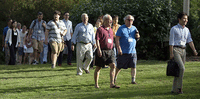
Tim Nilsen, 2015 Cold Spring Harbor Symposium: 21st Century Genetics: Genes at Work. (Photo courtesy of the Cold Spring Harbor Laboratory Library and Archives.)
The news of Tim Nilsen's recent death was received with great sadness by all of us at Cold Spring Harbor Laboratory Press, the publisher of RNA on behalf of The RNA Society.
The relationship between the Society and the Press began in 2003 and has enabled the journal to become a respected, critical information source for the expanding RNA research community worldwide and Society members in particular. The journal has also grown to be a valuable source of revenue for the Society.
This success has been the product of a collegial, collaborative, and enjoyable partnership between the Society leadership and the Cold Spring Harbor publishing team that has prospered during the tenures of three Society CEOs, many Presidents, and several Treasurers. But until 2022, there was one vital, ever-present contributor, the journal's founding Editor-in-Chief, Tim Nilsen.
Being an academic journal editor is a tough job. You are part of the community and yet have to remain detached. You have to know everyone but not show favoritism. You have to be open to advice yet make up your own mind. And you have to have principles and not compromise them when the heat is on. Above all, you have to make judgments, knowing that a certain percentage—often a high percentage—of the recipients of those judgments will disagree with you, often strongly. “The job of an editor,” it has been said, no doubt by someone on the wrong end of a decision, “is to sort the wheat from the chaff, and publish the chaff.” Being an editor is not for the fainthearted, and no-one who knew Tim would ever call him that. So he was an inspired choice as Editor-in-Chief of the newly conceived journal in 1995, and he carried the burden of editorial selection with taste, insight, shrewdness, and distinction until his retirement in 2022. And after that, he continued to serve as Editor of Special Issues.
But editors do more than select papers and from a publisher's perspective, Tim got very high marks. My Production Department colleagues loved the fact that he closed issues on time and kept to the schedule. The Press marketing and advertising teams appreciated his willingness to help with and improve the promotional materials they created. And our finance staff knew that Tim could be relied upon to actually read the journal's balance sheet and come up with sharp, incisive questions about what the numbers meant and how they were arrived at.
Speaking for myself, I much enjoyed long conversations with Tim about science and scientists—often with a glass in hand, starting with our very first meeting in a bar in Madison, Wisconsin—and I remained hugely impressed by his exhaustive knowledge of RNA biology, his commitment to its research community, his bold opinions, and his capacity for sticking with those opinions, even if they were unpopular. All of us at the Press at different times were treated to wonderful glimpses of his life. About his undergraduate career as an English major at Fordham University where, according to Tim, his grades were marginal and he received a BA only out of the kindness of Jesuits. About his interest in biology, and his career in science, being sparked by a copy of Jim Watson's The Double Helix picked up from a sidewalk book sale table. About earning a living after college by delivering cars from the Bronx to the Midwest for a shady dealership. And competitive chess games with all comers in Manhattan parks—a character-building experience for sure.
T.S. Eliot, scalded by editorial rejection, sneered that “…editors are failed writers.” That was not true of Tim. In 2010, he and Don Rio, Manny Ares, and Greg Hannon assembled a valuable manual of RNA bench techniques for Cold Spring Harbor Laboratory Press that showed his skills as a writer. And so did the many highly cited papers he contributed as senior author to major journals.
My Cold Spring Harbor colleagues and I will remember Tim with admiration and affection as the smart, incisive, and entertaining pilot on our journey with the RNA journal for so many years. We mourn his passing and extend our condolences to his family and colleagues, especially his life partner Patricia Maroney and Anne Marie Micenmacher, the administrator of the RNA journal since the beginning and a much valued friend of Tim's for decades.
Footnotes
-
Article is online at http://www.rnajournal.org/cgi/doi/10.1261/rna.080564.124.
This article is distributed exclusively by the RNA Society for the first 12 months after the full-issue publication date (see http://rnajournal.cshlp.org/site/misc/terms.xhtml). After 12 months, it is available under a Creative Commons License (Attribution-NonCommercial 4.0 International), as described at http://creativecommons.org/licenses/by-nc/4.0/.




