


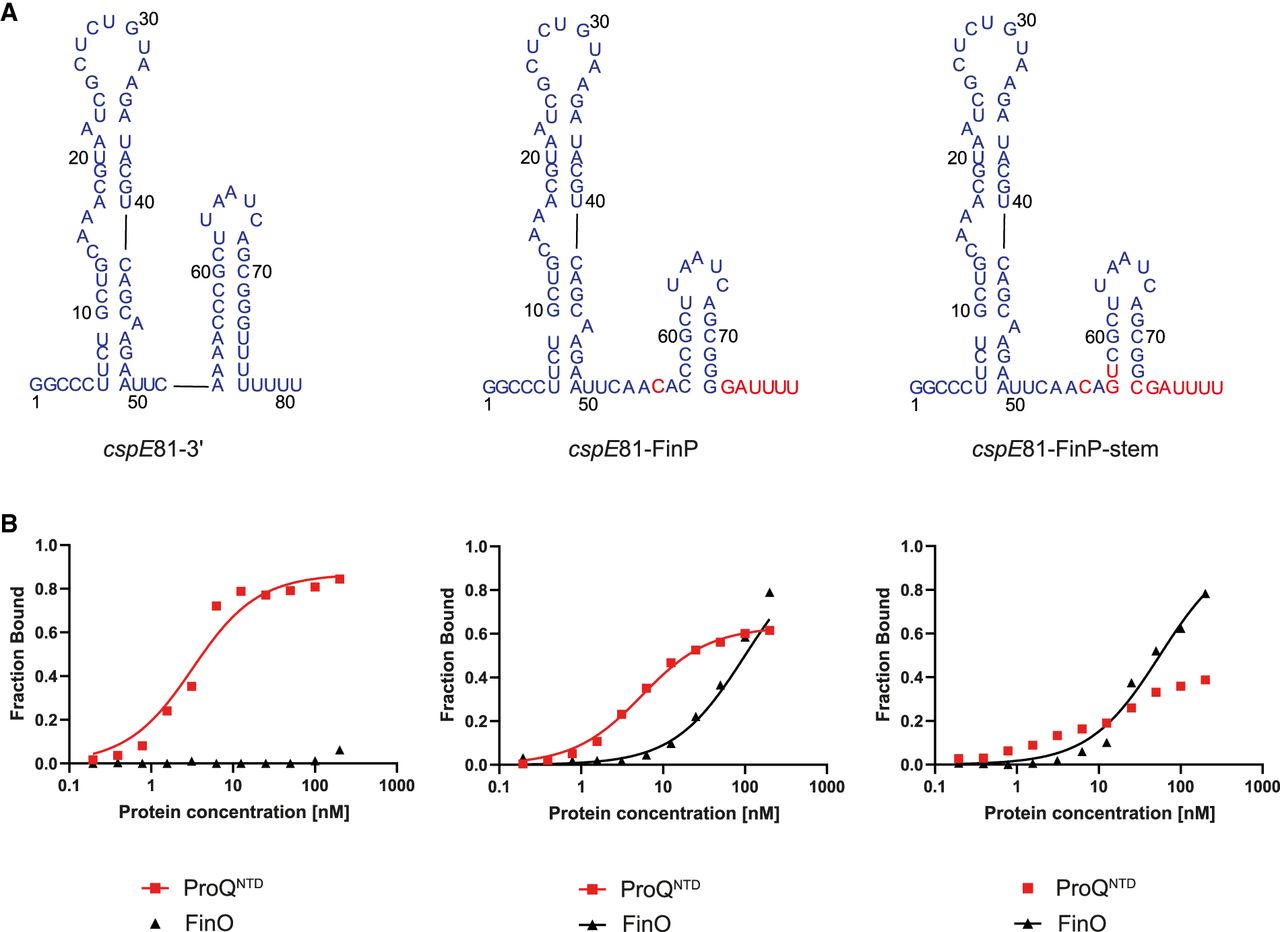
Comparison of cspE81-3′, cspE81-FinP chimera, and cspE81-FinP-stem chimera binding to ProQNTD, and to FinO. (A) Secondary structures of cspE81-3′, cspE81-FinP chimera, and cspE81-FinP-stem chimera, which were predicted using RNAstructure software (Reuter and Mathews 2010). The sequences originating from cspE81-3′ are shown in dark blue font, and the sequences from FinP in red font. The lowercase g denotes guanosine residue added on 5′ ends of RNA molecules to enable T7 RNA polymerase transcription. (B) The respective binding data for ProQNTD and FinO are shown on the graphs below each RNA. The fitting of the quadratic equation into cspE81-3′ data provided a Kd value of 2.7 nM for binding to ProQNTD, while the Kd value for binding to FinO was estimated as higher than 200 nM. The fitting of the quadratic equation into cspE81-FinP data provided a Kd value of 5.0 nM for binding to ProQNTD, and 99 nM for binding to FinO. The fitting of the quadratic equation into cspE81-FinP-stem data provided a Kd value of 55 nM for binding to FinO, while the Kd value for binding to ProQNTD was estimated as higher than 200 nM. Gels corresponding to the data in the plots are shown in Supplemental Figure S13. Average Kd values are shown in Table 1.




