


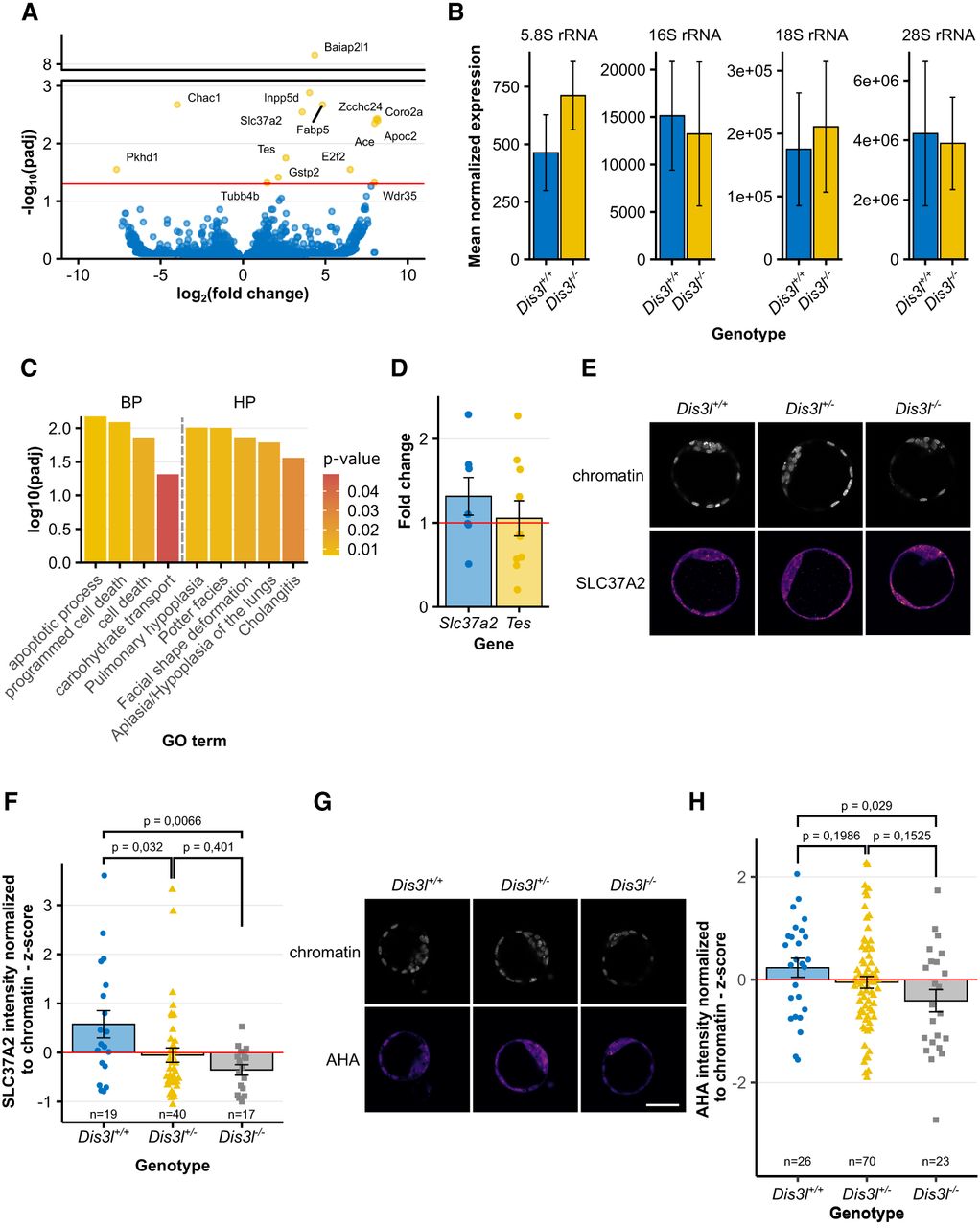
Transcriptome and translation analysis in Dis3l KO blastocysts. (A) Differential expression analysis of RNA-seq results of three Dis3l−/− and three Dis3l+/+ blastocysts. Positive and negative log2(fold change) value means upregulation and downregulation, respectively, of transcript in KO embryos. Red horizontal line marks adjusted P-value of 0.05 with transcripts above it considered significantly changed in KO embryos compared to WT ones. (B) Mean normalized expression of 4 rRNA species with sufficient coverage in RNA-seq of three Dis3l−/− and three Dis3l+/+ blastocysts. No significant changes were identified. Bars represent mean value, and error bars represent SD. (C) Functional enrichment analysis of significantly deregulated transcripts identified in blastocyst RNA-seq. Identified terms are grouped by data source subgroups: BP and HP. (D) Fold change of two of significantly downregulated transcripts identified in blastocyst's RNA-seq of Dis3l−/− embryos, obtained by RT-qPCR. Each data point represents fold change for one KO blastocyst. The horizontal red line marks a fold change of 1, meaning no change. (E) Example of SLC37A2 protein immunofluorescence staining used to measure protein level in blastocysts. (F) Normalized z-score value of SLC37A2 protein level in blastocysts depending on the genotype. Each data point represents one blastocyst. (G) Example of protein synthesis labeling with methionine analog AHA used to determine the amount of newly produced peptides in blastocysts. (H) Normalized z-score value of detected AHA-containing proteins’ levels in blastocysts depending on the genotype. In E and G, each data point represents one blastocyst. Scale bars, 50 µm. Bars represent mean value, and error bars represent SEM.




