


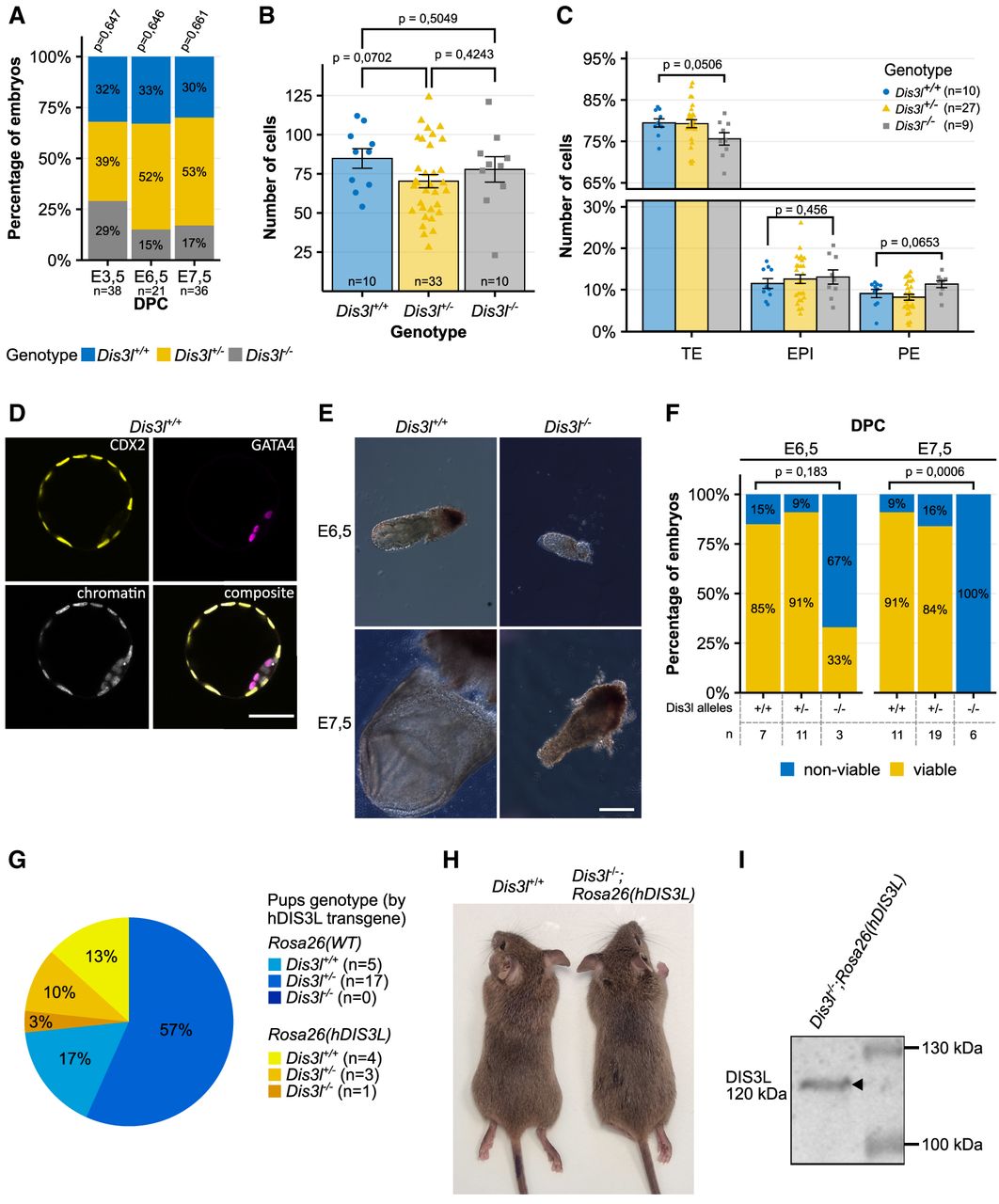
DIS3L KO phenotype in mice embryo. (A) Genotype distribution in embryos of different developmental stages obtained from Dis3l+/− × Dis3l+/− matings. (B) Total cell count of blastocysts in relation to the genotype. (C) Percentage ratio of trophectoderm (TE), epiblast (EPI), and primitive endoderm (PE) in blastocysts in relation to the genotype. (D) Example of Dis3l+/+ embryo staining used to determine the number of differentiated cells in the blastocyst. CDX2 marker of trophectoderm in yellow, GATA4 marker of primitive endoderm in magenta, and chromatin in gray. The number of epiblast cells was determined by subtracting the number of CDX2 and GATA4 positive cells from the total cell number. Scale bar, 50 µm. (E) Example of incorrectly developing Dis3l−/− embryos 6.5 and 7.5 dpc (days post coitum) compared to valid Dis3l+/+ embryos. Scale bar, 200 μm. (F) The ratio of viable to nonviable embryos of different genotypes at 6.5 and 7.5 dpc. (G) Distribution of genotypes of pups born from Dis3l+/−; Rosa26(hDIS3L) × Dis3l+/− matings. In blue scale pups without a transgene, in orange pups with a transgene. N denotes the number of pups of a given genotype born. (H) The only Dis3l−/−; Rosa26(hDIS3L) mice born (right) compared to WT mice (left) of the same sex and age (5 weeks old). (I) Western blot analysis of expression of human Dis3l transgene in Dis3l−/−; Rosa26(hDIS3L) mice tissue. Black bars with kilodalton values on the right mark protein ladder band sizes, protein names with predicted size values on the left mark the target of the used antibody, and black arrowhead marks specific bands detected. In all panels, individual data points represent single blastocysts analyzed, bars represent mean value, and error bars represent SEM.




