


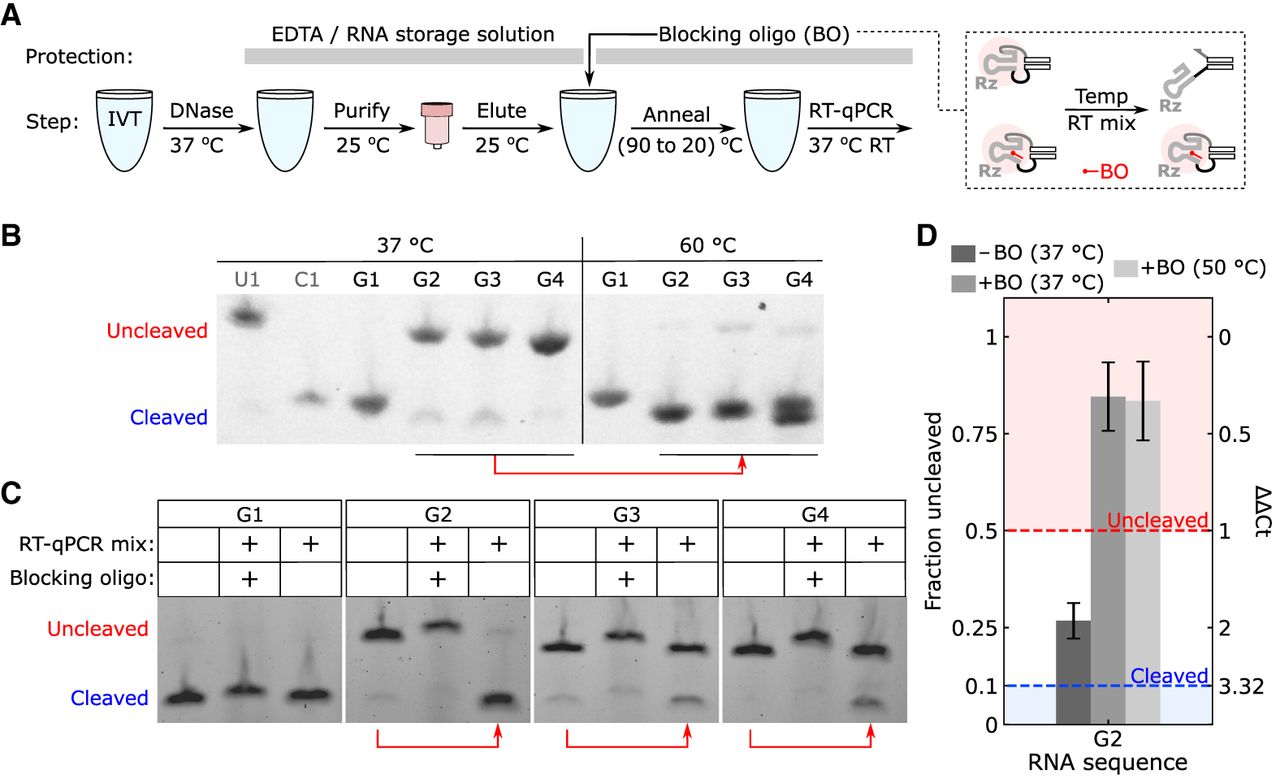
Identifying and preventing ribozyme cleavage during RNA purification and reverse transcription. (A) The workflow for preparing IVT RNA for RT-qPCR cleavage measurements. After DNA digestion, RNA is purified with buffers supplemented with EDTA to prevent cleavage (Materials and Methods). After RNA purification, a blocking oligonucleotide, termed BO, that is partially complementary to the ribozyme is added and annealed prior to RT-qPCR. The BO is designed to hybridize to the ribozyme and prevent it from adopting an active fold (right inset). (B) Denaturing gel electrophoresis results for RNAs after a 15 min incubation at 37°C or 60°C. Prior to this incubation, RNA was prepared by 30 min IVT at 37°C followed by a 30 min DNase I digestion at 37°C. U1 and C1 are uncleaved and cleaved control RNAs for G1, respectively. (C) Denaturing gel electrophoresis results for RNAs after a 10 min incubation at 37°C in RT-qPCR reaction mixture with or without BO. Prior to incubation, the RNAs were purified from IVT reactions and annealed with or without BO (Materials and Methods). In B and C, red arrows below the gel indicate undesired cleavage. G1 and G2 samples were on one gel and G3 and G4 samples were on another gel. The slower mobility of the gates with BO may be due to the transient binding of the oligo to the RNA. (D) RT-qPCR measurements of ribozyme cleavage for G2 RNA with and without BO with reverse transcription conducted at 37°C or 50°C. The ΔΔCt (Equation 2; Materials and Methods) and corresponding fraction uncleaved are labeled on the right and left axes, respectively. Error bars indicate standard deviation from three technical replicates.




