


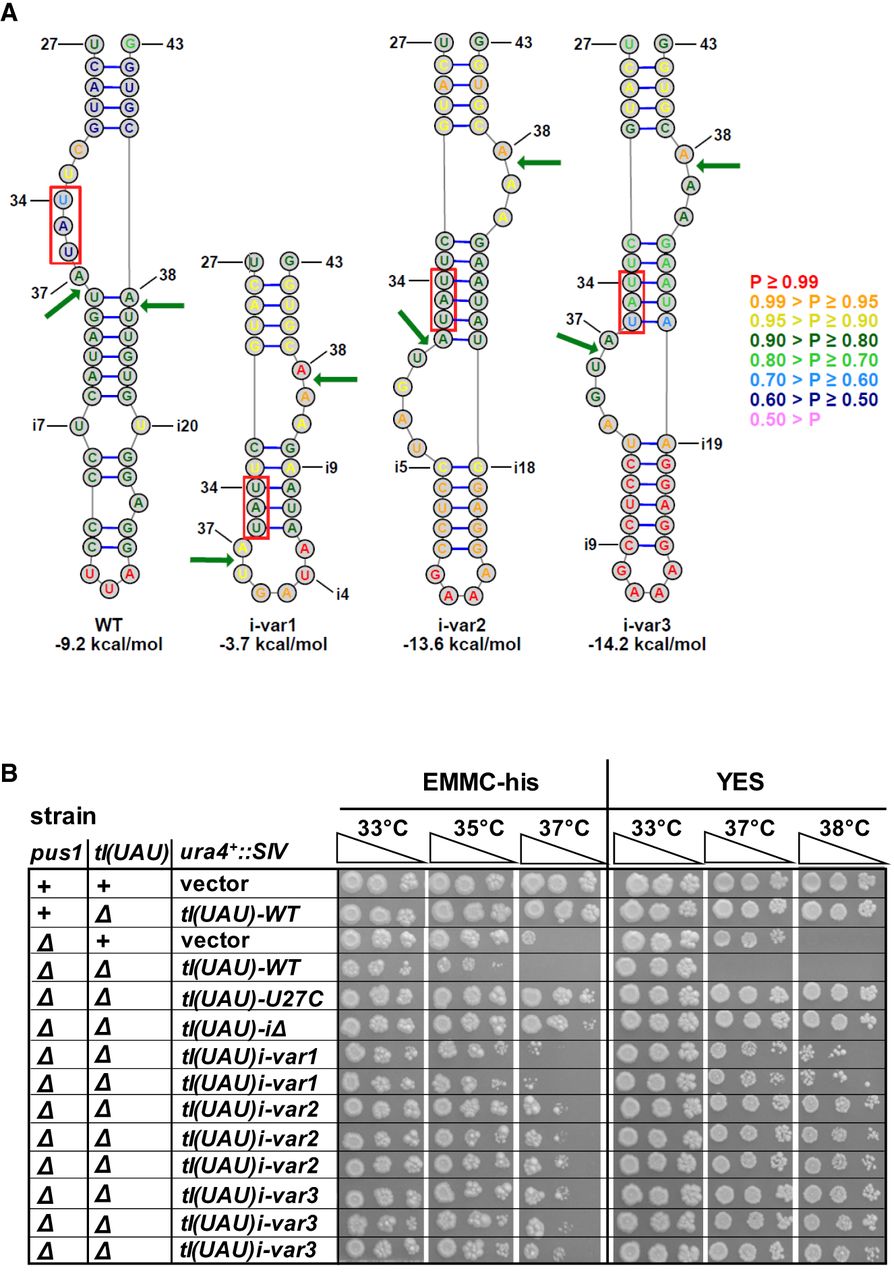
Intron mutations designed to improve pre-tRNAIle(UAU) structure restore growth in a pus1Δ strain. (A) A schematic of the ASL-intron region of WT tRNAIle(UAU), and three variants predicted to have structure compatible with splicing. The schematics indicate nt 27–43 of the tRNA and the intron sequence, which begins one residue after the UAU anticodon (boxed in red). Structures were predicted using the RNAstructure program (https://rna.urmc.rochester.edu/RNAstructureWeb/). Arrows indicate the 5′ and 3′ splice sites that are cleaved by the splicing endonuclease during the first step of splicing. The helix of the BHL motif (i-var1) or the BHB motif (i-var2 and i-var3) is the helix defined by the base pairs involving nt 32 to nt 36 or 37. The legend at the right indicates the probability of each base pair. The numbers at the bottom represent the predicted folding free energy change (kcal/mol) of the oligomer comprising the ASL-intron region of each variant. (B) Growth of S. pombe pus1Δ tI(UAU)-variant strains. S. pombe pus1Δ tI(UAU)-variant strains as indicated were grown overnight in YES media at 30°C, and then cells were serially diluted and spotted as described in Figure 1A.




