


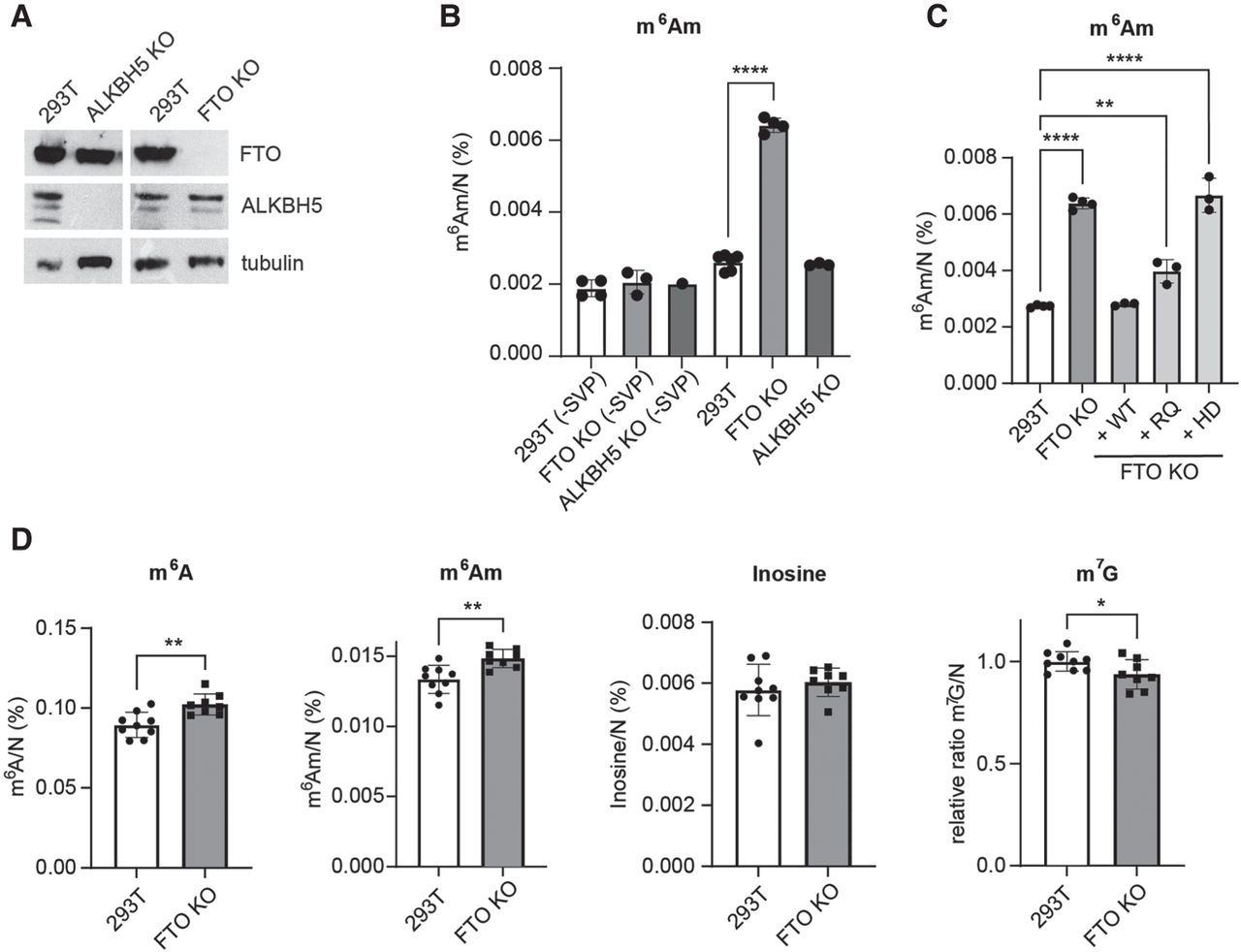
FTO primarily targets cap-associated m6Am in noncoding RNAs. (A) Immunoblot analysis of protein expression in 293T ALKBH5 KO and FTO KO cells. The levels of proteins were detected with specific antibodies listed in Materials and Methods. (B) LC-MS/MS measurements and quantification of relative levels of internal (−SVP) and cap + internal m6Am in total RNA isolated from WT, FTO KO, and ALKBH5 KO 293T cells. One microgram of total RNA was digested with NP1 and with or without SVP, to release or not the cap-linked nucleotide, respectively. In both cases, dephosphorylation with shrimp alkaline phosphatase (SAP) was performed prior to LC-MS/MS analysis (n = 3). (C) Relative levels of m6Am in total RNA digested with NP1 and SVP, isolated from WT, FTO KO, and FTO KO cells with stably integrated forms of FTO WT (wild type), RQ (disease-linked mutant), and HD (catalytically inactive) (n = 3). (D) LC-MS/MS measurements of m6A, m6Am, inosine, and m7G in poly(A) RNA isolated from WT and FTO KO cells (n = 8–9). Data are mean ± SD, one-way ANOVA, multiple comparison using the Tukey test. (*) P < 0.05, (**) P < 0.01, (***) P < 0.001. The levels of nucleoside modifications were normalized to the total molar amount of canonical nucleosides N (N = C + U + G + A). Source data are available online for this figure.




