


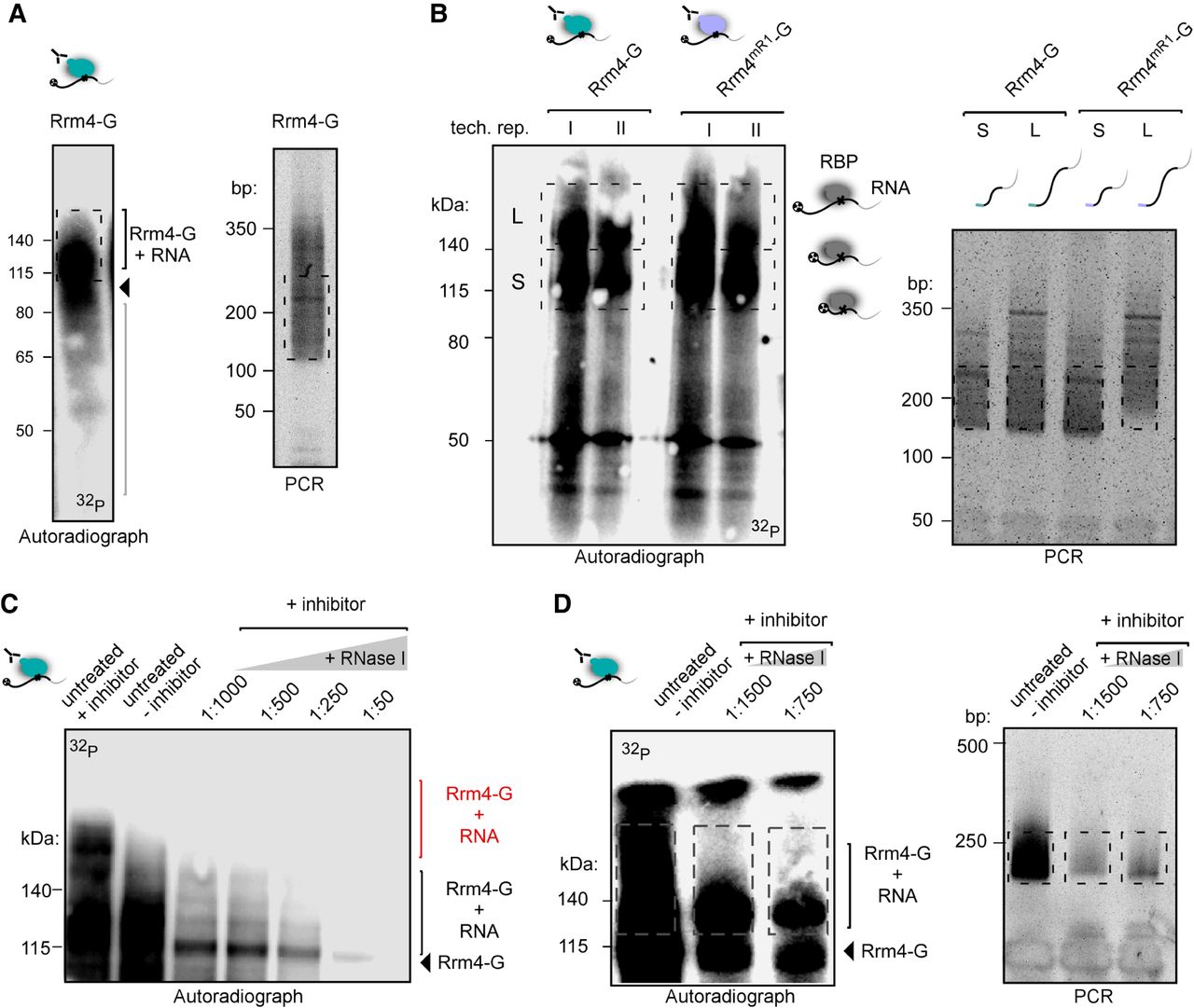
Enhanced RNA integrity. (A) Autoradiograph of Rrm4-G-RNA complex purified with 2 M urea. The optimization-PCR showed “unusually long” >250 bp cDNA products (optimal range is indicated). (B) Autoradiograph of two technical replicates of Rrm4/Rrm4mR1-G. The area of interest was segmented into short (marked as S, 112–140 kDa) and long (marked as L, >140 kDa) RNAs. The respective cDNA libraries (S and L) were used for PCRs. The optimal range of cDNA length is indicated (C) Autoradiograph of the RNase I titration series of Rrm4-G-RNA-complexes (>112 kDa, Rrm4-G full-length band indicated by an arrow, 112 kDa). Indicated in red are Rrm4-G/RNA-complexes exhibiting RNA fragments. The previous protocol procedure (untreated + inhibitor = no RNase I treatment, high amount of RNase inhibitor), internal RNase treatment (untreated, − inhibitor = no RNase inhibitor), and different RNase concentrations (1:1000–1:50 RNase I dilution + inhibitor) were analyzed by autoradiography. The inhibitor was added to the cell lysis buffer to reduce internal RNase activity. The respective RNase I (external) treatment was performed after IP within 1× PNK buffer, which does not include any RNase inhibitors. (D) Autoradiograph and optimization-PCR of Rrm4-G/RNA-complexes under diverse RNase I conditions. The experimental procedure as described in C was repeated with a dilution of 1:750 and 1:1500 RNase I instead, the cDNA library was synthesized, and respective optimization-PCRs were performed. PCR products show cDNA sizes in the expected area (marked).




