


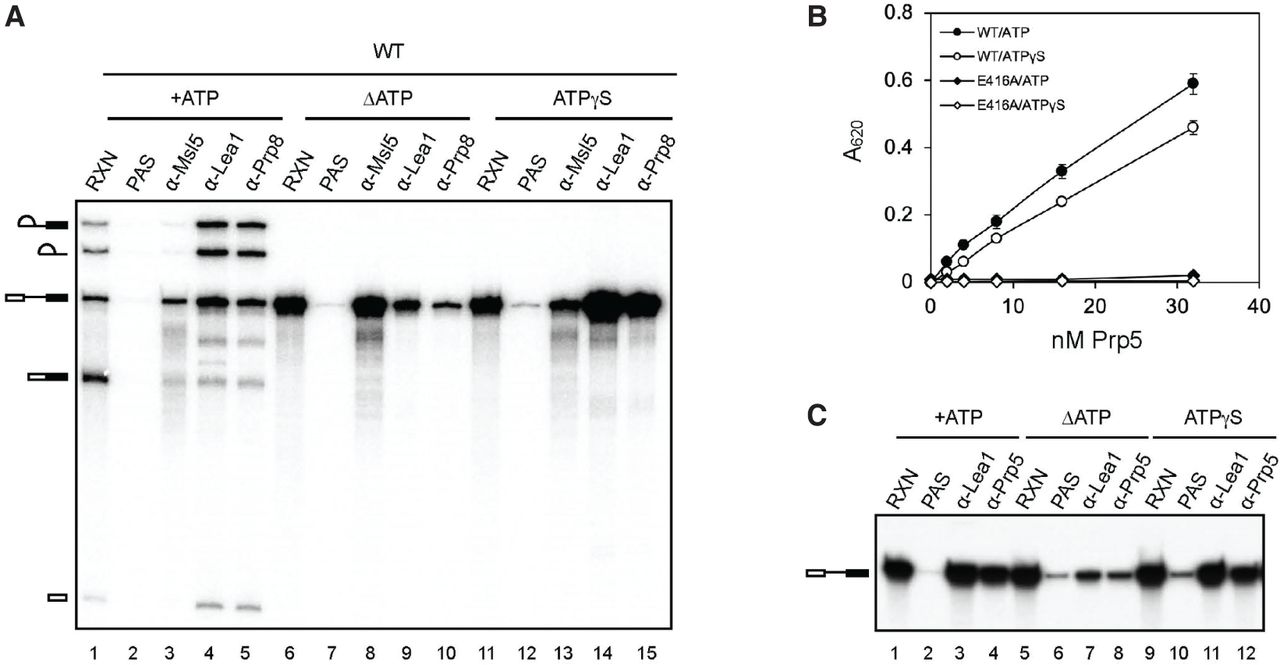
Prp5 is capable of hydrolyzing ATPγS and uses it to promote formation of the Pre-B complex and FIC. (A) Splicing was performed at 25°C for 15 min with wild-type ACT1 pre-mRNA in wild-type extracts preincubated with 10 mM glucose (lanes 6–10), or in the presence of 2 mM ATP (lanes 1–5) or 2 mM ATPγS (lanes 11–15), followed by precipitation with anti-Msl5, anti-Lea1, or anti-Prp8 antibody. RXN, 1/10 of the splicing reaction mixture; PAS, protein A-Sepharose. (B) ATP hydrolysis assays of Prp5 with ATP or ATPγS. Data represent mean values from three independent experiments with standard deviation (SD) indicated. (C) Splicing was performed at 25°C for 15 min with U257G mutant pre-mRNA in Δcus2 extracts preincubated with 10 mM glucose (lanes 5–8), or in the presence of 2 mM ATP (lanes 1–4) or 2 mM ATPγS (lanes 9–12), followed by precipitation with anti-Lea1 or anti-Prp5 antibody. RXN, 1/10 of splicing reaction mixture; PAS, protein A-Sepharose.




