


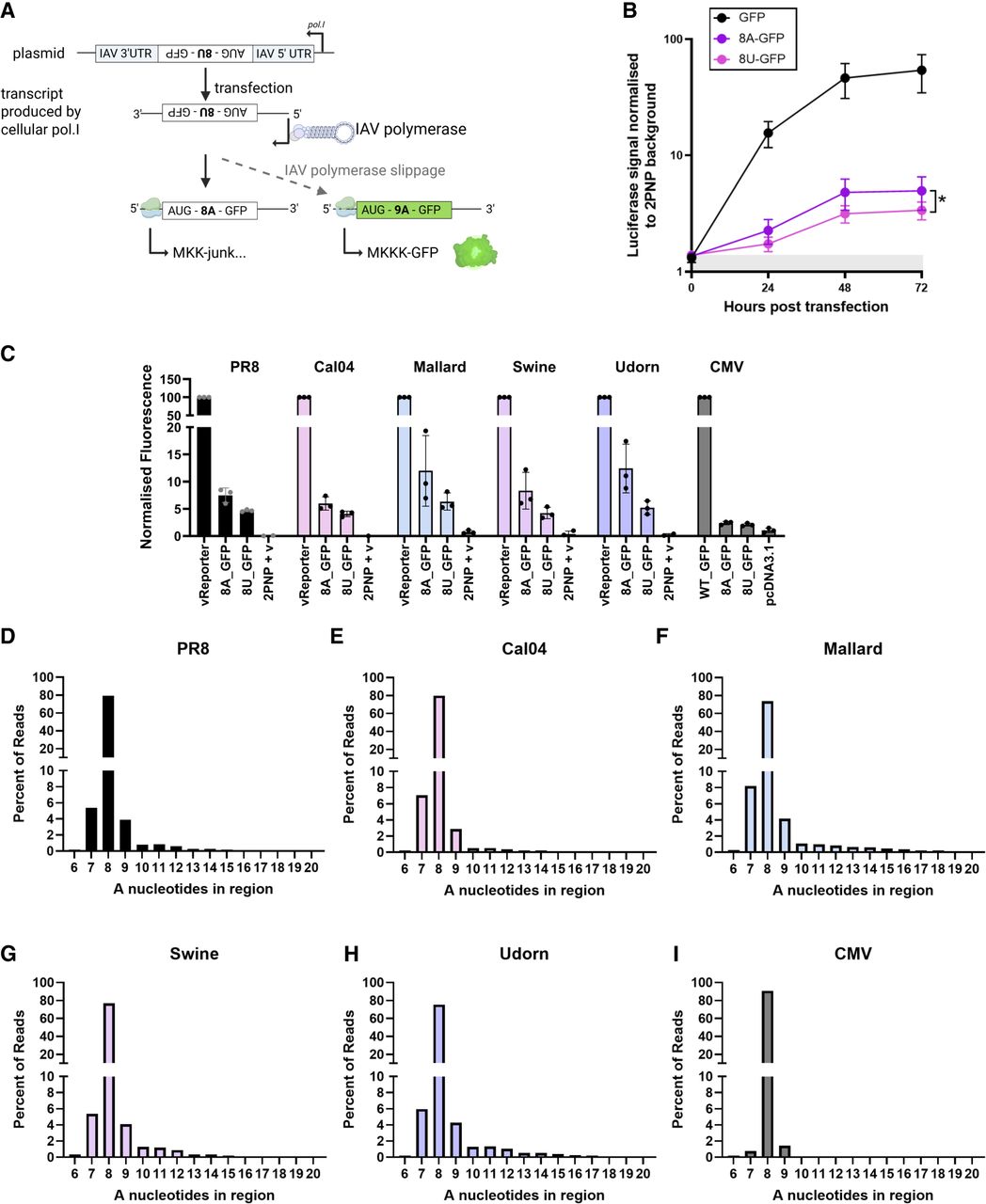
IAV polymerase slippage preferentially occurs on 8U tract over 8A, offering a putative mechanism for the generation of polybasic cleavage sites. (A) Two plasmid constructs were designed to encode the EGFP ORF downstream from an 8-adenosine or 8-uracil tract, flanked by PR8 NS1 segment UTRs that are recognized by the viral polymerase and under an RNA pol.I promoter. These constructs were used in a minigenome assay (together with plasmids that together reconstitute viral polymerase) to determine whether polymerase slippage could be evidenced through reporter gene detection. Due to the incorporation of the 8A/8U tract upstream of the GFP ORF, the ORF is out of frame. Polymerase slippage on the 8A/8U resulting in a single nucleotide insertion will put the GFP ORF in frame and yield GFP signal. (B) GFP signal was read for in-frame GFP, GFP downstream from an 8A oligonucleotide, and GFP downstream from an 8U oligonucleotide, under IAV promoter and polymerase expression (annotations refer to sequence in positive polarity). Fluorescence was read every 24 h and normalized to reporter transfected with incomplete IAV polymerase components (no PA). (C) Relative fluorescence of GFPs encoded downstream from 8A and 8U sequences compared with in-frame GFPs for PR8, Cal04, Mallard, Swine, and Udorn polymerases, and CMV-promoter driven host polymerases. (D–I) To determine whether polymerase slippage occurred for other IAV polymerases, the IAV PR8, Cal04, Mallard, Swine, Udorn, and human CMV polymerases were used to amplify the transcripts containing 8A upstream of the GFP sequence, and amplicon sequencing was performed to determine the extent of polymerase slippage on the 8A sequence.




