


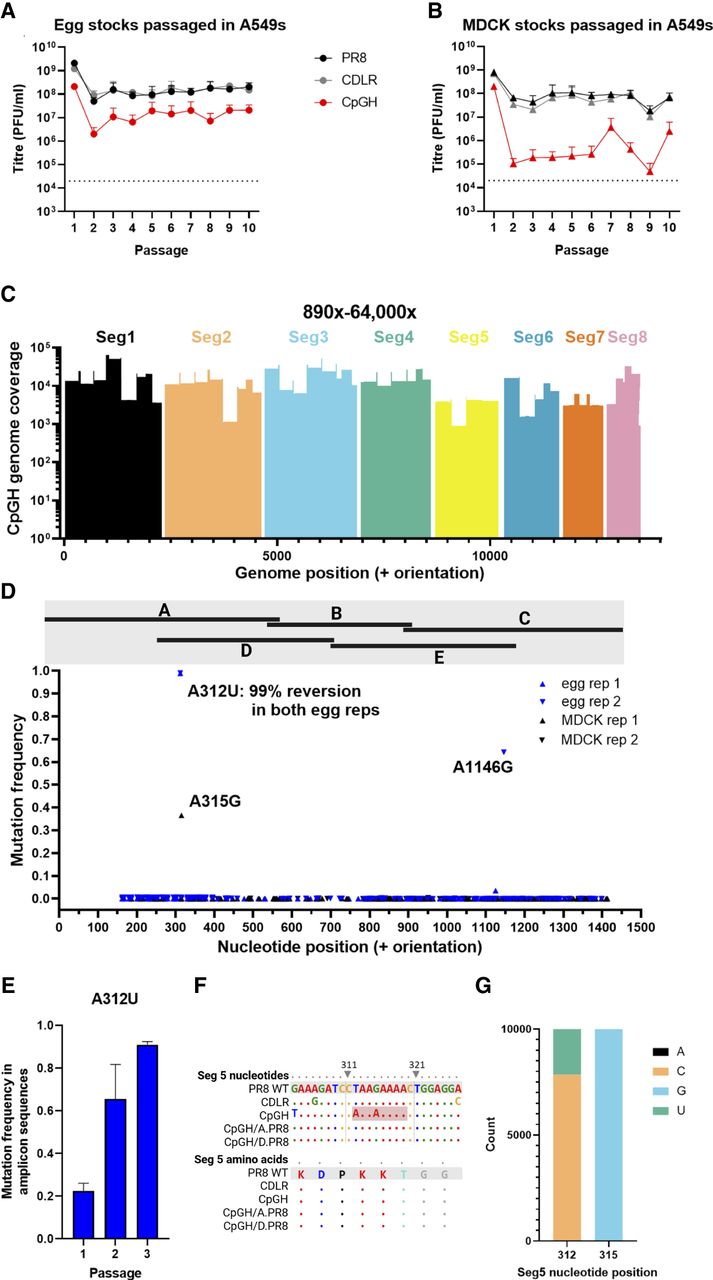
Serial passage of segment 5 CpGH IAV identifies reversion mutations that fall within an 8 nucleotide stretch of adenosines. Virus panel generated from either egg (A) or MDCK (B) rescue was serially passaged 10 times at MOI 0.01 in A549 cells, with virus titered after each passage, for four biological repeats (two with starting inoculum of egg rescue and two of MDCK). At passage 10, virus was deep sequenced. (C) Read depth from deep sequencing of CpGH virus. (D) Mutations occurring exclusively in the CpGH virus were plotted. None of these mutations occurred at CpG sites. Their position relative to fragments A–E (Fig. 4) are indicated by the black bars at the head of the panel. (E) Serially passaged viruses derived from egg rescue were sequenced after 1, 2, and 3 passages; for the CpGH virus, mutation frequency at position 312 is shown. (F) Reversion mutations at positions 312 and 315 corresponded with an 8-adenosine tract introduced exclusively into the CpGH virus. (G) Variability of segment 5 nucleotide positions in nature (10,000 human sequence isolates analyzed over 5 years between 2018 and 2022).




