


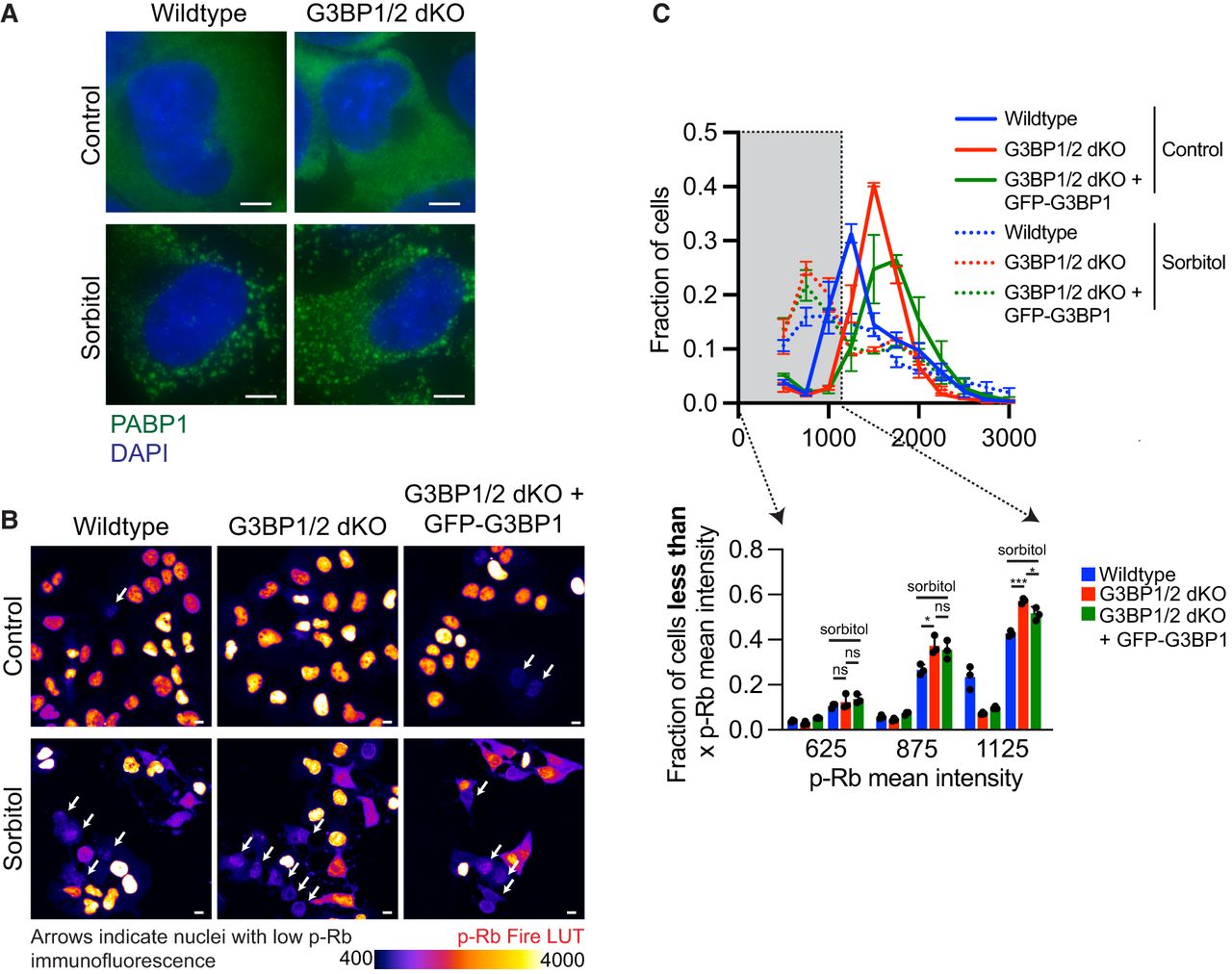
Sorbitol-induced stress granules promote cell-cycle exit in the absence of G3BP1/2. (A) Representative PABP1 immunofluorescence (green channel) and DAPI stain (blue channel) images of wild-type and G3BP1/2 dKO under untreated conditions or treated with 0.5 M sorbitol for 1 h. Scale bar, 5 µm. (B) Representative p-Rb immunofluorescence images of wild-type, G3BP1/2 dKO, and GFP-G3BP1 + G3BP1/2 dKO U-2 OS cells under untreated conditions or treated with 0.5 M sorbitol for 6 h. The immunofluorescence is depicted using Fire LUT to accentuate differences in p-Rb levels between cells. Scale bar, 10 µm. (C, bottom) Bar graph illustrating the fraction of cells with mean p-Rb intensity in the nucleus below specified thresholds (625, 875, and 1125) for wild-type, G3BP1/2 dKO, and GFP-G3BP1 + G3BP1/2 dKO U-2 OS cells from the experiment shown in B. The bar graph is derived from the frequency distribution blot above which represents the fraction of cells categorized based on binned p-Rb mean intensity levels in untreated and 0.5 M 6 h sorbitol-treated wild-type, G3BP1/2 dKO and GFP-G3BP1 + G3BP1/2 dKO U-2 OS cells. Three independent biological replicates were conducted.




