


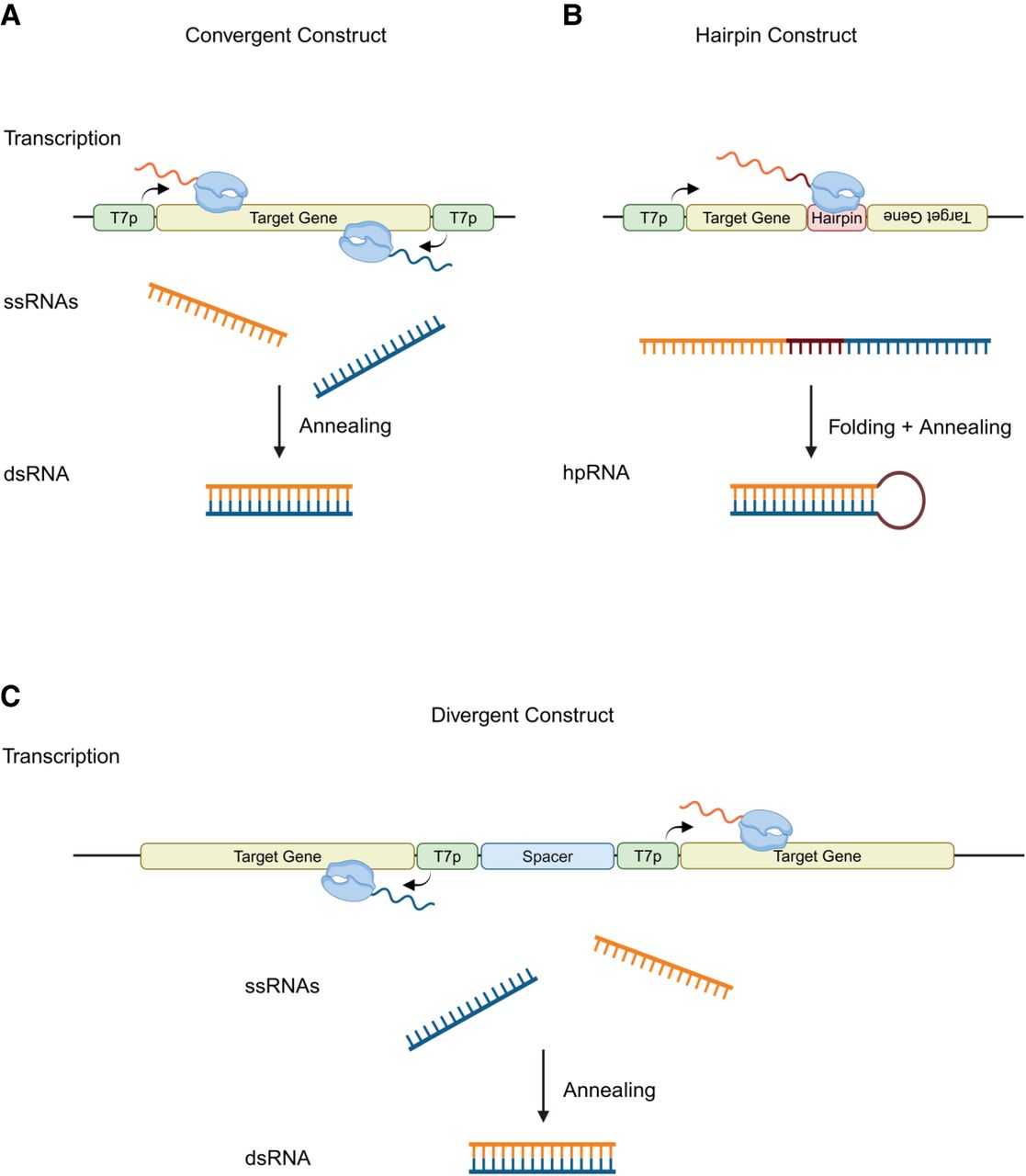
Schematic illustration of DNA templates for the synthesis of dsRNA. Schematics representing three constructs and methods for the synthesis of dsRNA. These include convergent, hairpin, and divergent production. (A) The convergent construct consists of a target gene flanked by two T7 polymerase promoters orientated in opposite directions, leading to simultaneous transcription of both sense and antisense ssRNA of the target sequence, via convergent transcription. ssRNAs then anneal post transcription, leading to the formation of the dsRNA. (B) The hairpin construct consists of a single T7 polymerase promoter upstream of a target gene. Downstream from the target gene a hairpin sequence is located followed by the target gene in a reverse orientation. A single ssRNA is produced, which subsequently folds and anneals to its complementary base pairs, forming the hpRNA. (C) The divergent construct is formed on a target gene flanked by a T7 polymerase promoter downstream orientated in the antisense direction. Next, a spacer region of X bp separates the first T7 polymerase promoter from another T7 polymerase promoter, which is located upstream of a second target gene sequence, orientated in the sense direction. Two ssRNAs are transcribed simultaneously by two diverging T7 polymerase promoters. Post transcription, the ssRNAs anneal to form the target dsRNA. Created in BioRender (Dickman 2025, https://BioRender.com/j93g547).




