


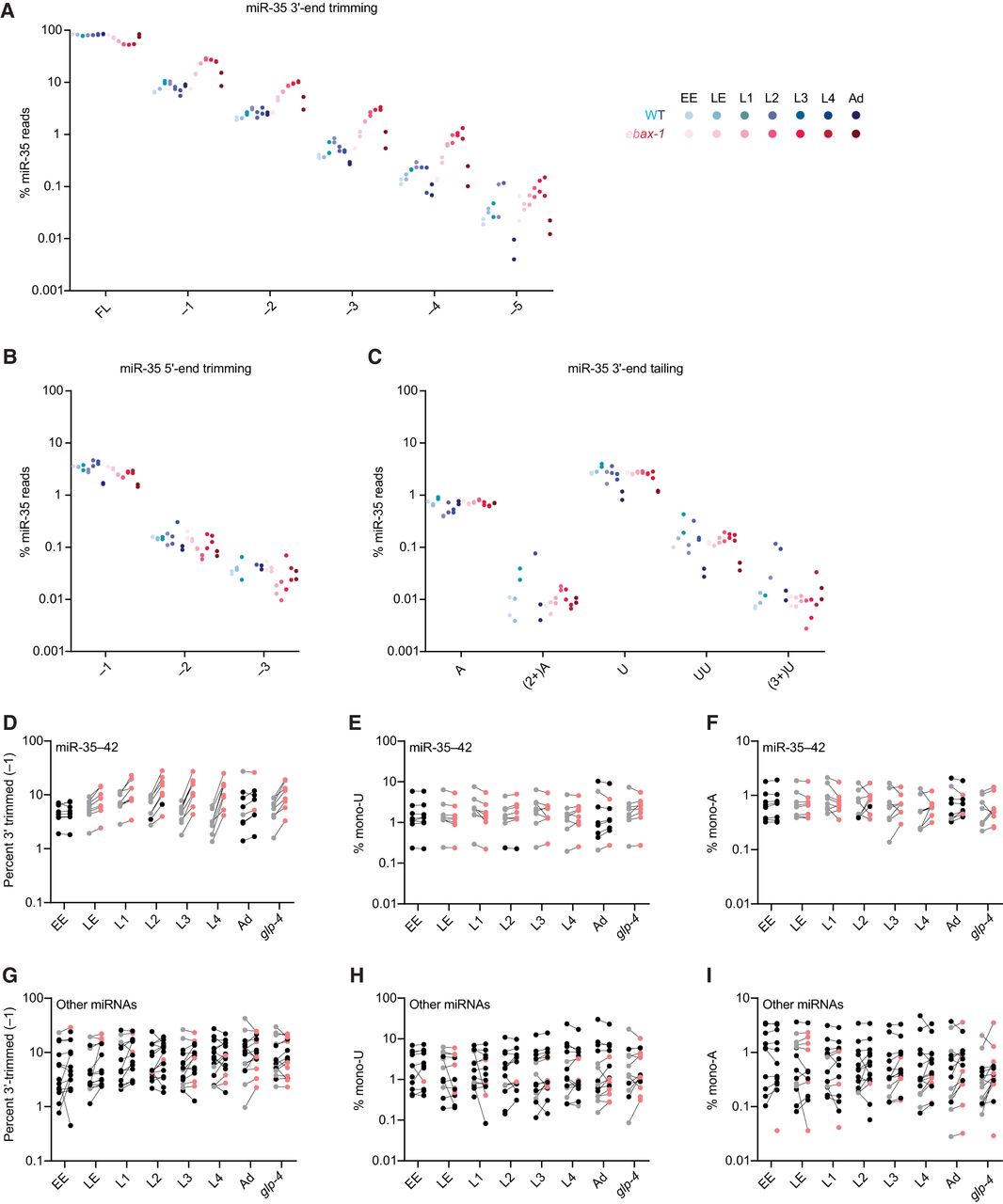
The miR-35–42 miRNAs that accumulate in ebax-1 mutants undergo 3′ trimming. (A–C) The effect of EBAX-1 loss on the abundance of trimmed and tailed isoforms of miR-35 across worm development. Plotted are the percentages of miR-35 sRNA-seq reads that exactly matched full-length (FL) or 3′-trimmed isoforms (A), 5′-trimmed isoforms (B), or 3′ A- or U-tailed isoforms (C), relative to the summed counts of all 14 of these isoforms. Points in blue show wild-type levels of each isoform; points in red indicate levels in ebax-1 mutants, with darker colors denoting later developmental stages, as shown in the key on the right. Values for each of two biological replicates are plotted as separate points. (D) Trimming of the eight miR-35 family members across development. Plotted are the percentages of sRNA-seq reads to miR-35–42 3′-trimmed by 1 nt, calculated as in (A). For miRNAs that were EBAX-1–sensitive at a particular developmental stage, percent trimming is plotted for wild-type (gray points) or ebax-1 mutant worms (red points) at that stage. Black points represent miRNAs that were classified as EBAX-sensitive but not at the indicated developmental stage. (E) Mono-uridylation of miR-35–42, plotted as in (D). (F) Mono-adenylation of miR-35–42, plotted as in (D). (G) Trimming of the 14 EBAX-1–sensitive miRNAs outside the miR-35 family across development, plotted as in (D). (H) Mono-uridylation of the 14 EBAX-1–sensitive miRNAs outside the miR-35 family, plotted as in (D). (I) Mono-adenylation of the 14 EBAX-1–sensitive miRNAs outside the miR-35 family, plotted as in (D).




