


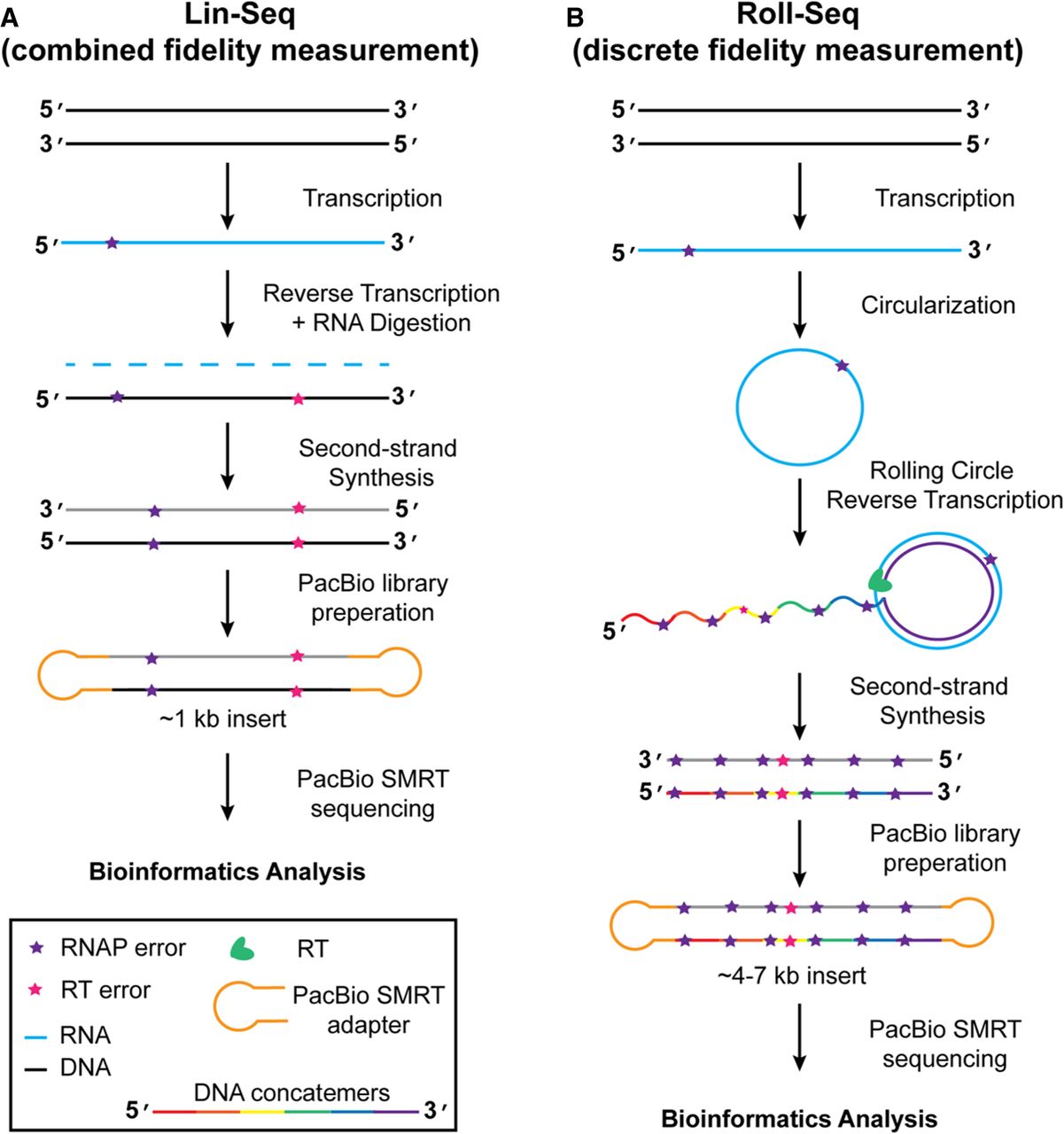
Comparison of linear sequencing and Roll-Seq workflows. (A) Linear sequencing protocol workflow showing the generation of RNA from DNA, and subsequent generation of cDNA followed by second-strand synthesis for input into PacBio preparation. Polymerase errors that arise during transcription (purple star) cannot be distinguished from errors arising during reverse transcription (pink star) during bioinformatic analysis. (B) Roll-Seq workflow. A DNA template, containing coding regions for a Group I ribozyme on 5′ and 3′ ends, is transcribed by an RNA polymerase that will make random errors (purple star). Ribozyme reaction results in the circularization of the RNA. Rolling-circle reverse transcription results in multiple concatemers (rainbow cDNA). Errors originating from transcription (purple star) appear at the same location in every concatemer. Errors from reverse transcription are randomly distributed throughout the cDNA.




