


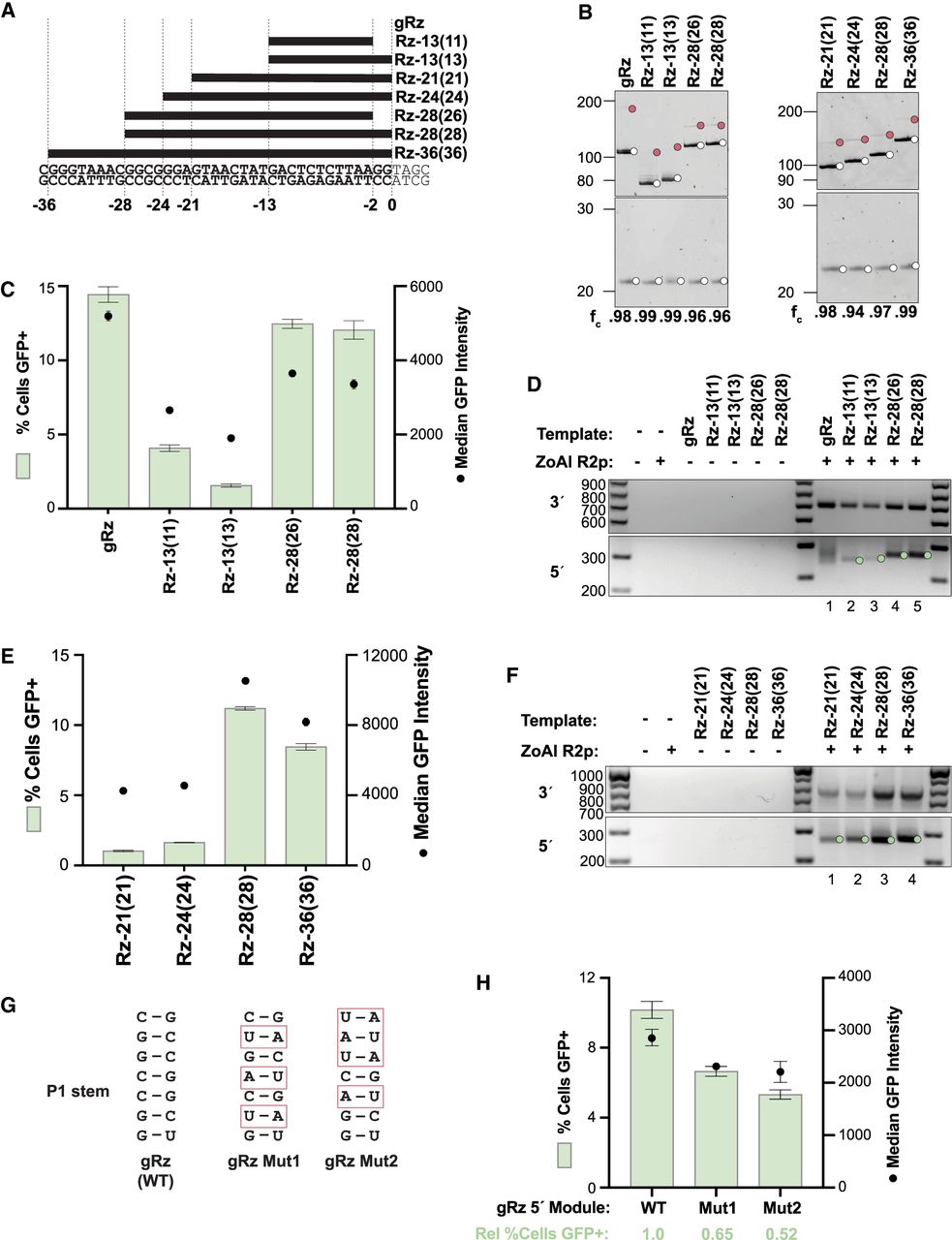
Rz cleavage position in rRNA influences 5′ module function for transgene insertion. (A) HDV and designed HDV-like Rz 5′ modules with variable rRNA lengths and cleavage positions within rRNA. 5′ module sequences are aligned to upstream rDNA. (B) Analysis of cleavage from a PP7 hp leader by HDV and designed HDV-like Rzs with variable cleavage positions. (Left) 5′ module Rzs relevant to C and D. (Right) 5′ module Rzs relevant to E and F. Reaction products were separated by 12% Urea-PAGE. (C) Quantification of insertion efficiency of HDV gRz and designed Rzs with −13 and −28 cleavage positions as determined by flow cytometry. Values indicate mean ± SD, n = 3. (D) PCR amplification of 3′ (top) and 5′ (bottom) rDNA-transgene junctions from gDNA in a representative replicate of the experiment in C. (E) Quantification of insertion efficiency of designed Rzs with −21, −24, −28, and −36 cleavage positions as determined by flow cytometry. Values indicate mean ± SD, n = 3. (F) PCR amplification of 3′ (top) and 5′ (bottom) rDNA-transgene junctions from gDNA in a representative replicate of the experiment in E. (G) Depiction of predicted P1 stem base-pairing for WT HDV gRz and GC-depleted mutants (Mut1 and Mut2) with substituted base pairs boxed in red. (H) Quantification of insertion efficiency of WT and GC-depleted mutant HDV gRzs as determined by flow cytometry. Values indicate mean ± SD, n = 3. Normalized fraction of cells expressing GFP relative to WT is indicated in light green.




