


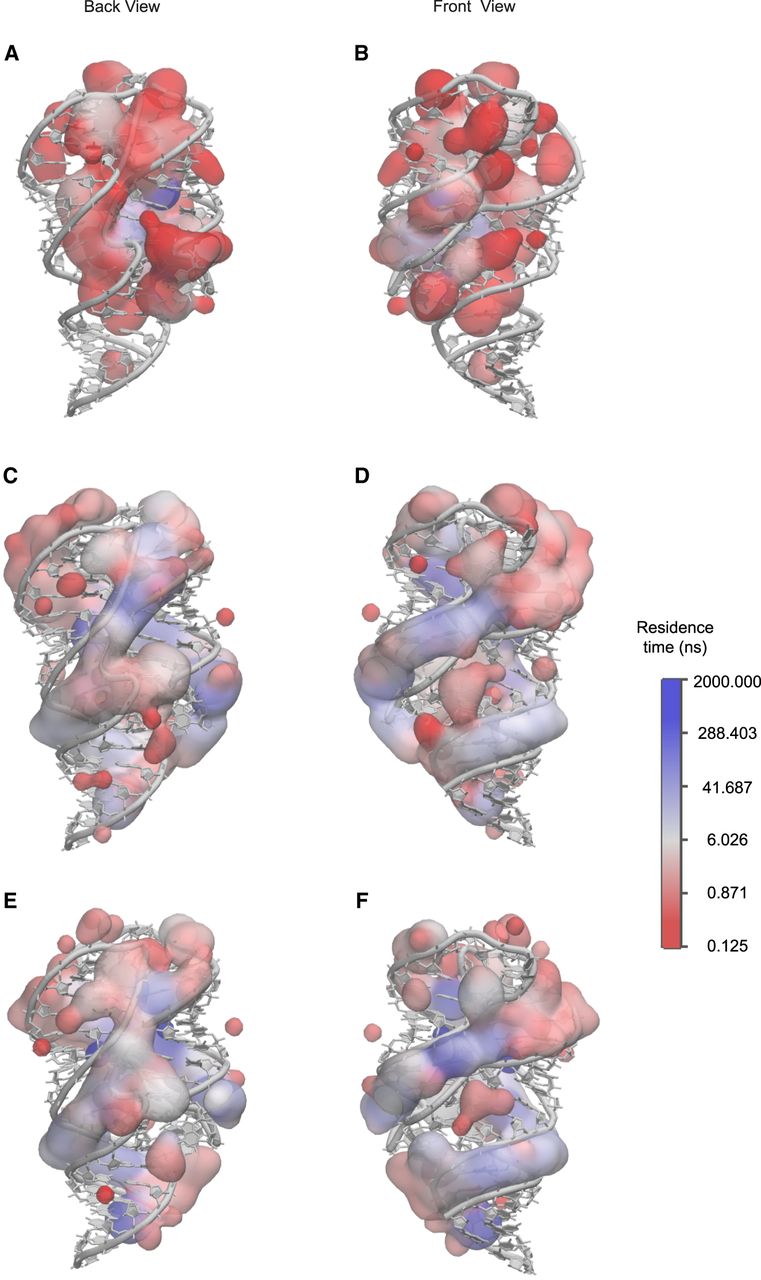
Ion residence time in logarithm scale for one of eight replicas of different conditions at 300 K (see details in Supplemental Movie S21 and the original ion association site distribution and corresponding residence time in Supplemental Movie S22). (A) Back view for K+, with 0 mM Mg2+, dG[+], where ion residence time is much shorter; (B) front view for K+, with 0 mM Mg2+, dG[+], with almost no associated ions in the major groove of P1 helix; (C) back view for Mg2+, with 5 mM Mg2+, dG[−], where the residence time in between P2 and P3 helix is longer; (D) front view for Mg2+, with 5 mM Mg2+, dG[−], with the residence time at the major groove of P1 helix slightly smaller than the case with bound ligand; (E) back view for Mg2+, with 5 mM Mg2+, dG[+], where the residence time of Mg2+ in between P2 and P3 helix is smaller because the cavity has a stronger closing tendency, excluding large-radius ions to nearby region; and (F) front view for Mg2+, with 5 mM Mg2+, dG[+], with longest residence at the major groove of P1 helix.




