


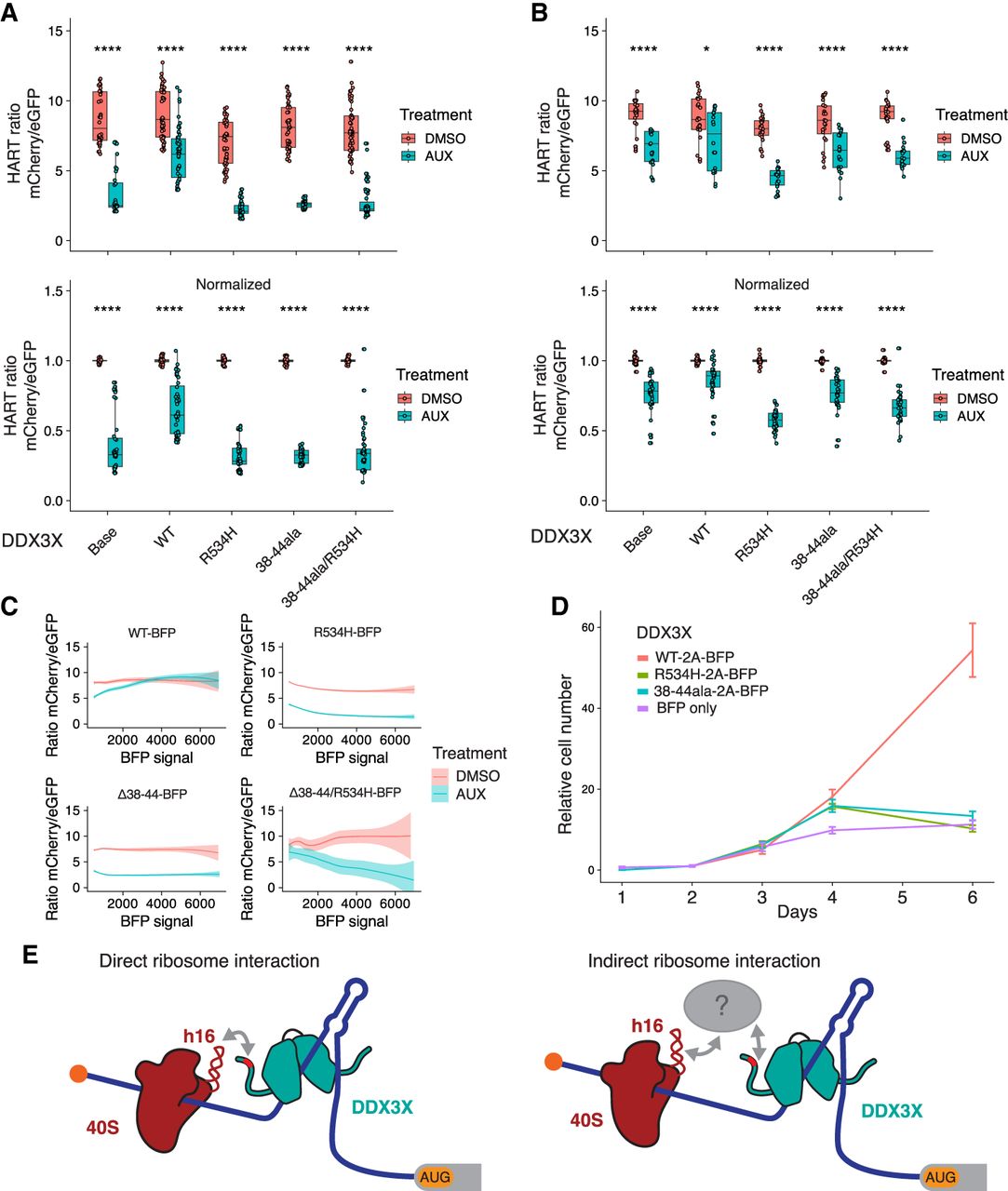
DDX3X 38–44ala cannot rescue translational or cell growth defects caused by the loss of DDX3X. (A,B) HART data for indicated DDX3X mutants. HCT116 degron cells were transduced with the HART-ODC1 (A) or HART-RAC1 (B) construct and different variants of DDX3X-FLAG-BFP, either WT, helicase defective R534H, 38–44ala, or the double mutant R534H/38–44ala. Cells were treated with auxin, which induces loss of the endogenous DDX3X via a degron tag, or DMSO as control. After 48 h flow cytometry was used to measure fluorescence levels, and the HART ratio (mCherry/eGFP) was calculated and presented as an absolute ratio (upper panel) or normalized to DMSO (lower panel). Data were obtained in three separate experiments for a total of 18 replicates. Statistical significance was determined by unpaired t-test: (ns) P > 0.05, (*) P ≤ 0.05, (**) P ≤ 0.01, (***) P ≤ 0.001, (****) P ≤ 0.0001. (C) Relationship between DDX3X-FLAG-BFP levels and HART ratio. Flow cytometry was used to measure eGFP and mCherry levels, which constitute the HART ratio, and BFP, which is a proxy for the level of DDX3X-FLAG-BFP expression. (D) Cell growth curve for DDX3X variants. HCT116 degron cells were transduced with DDX3X WT, R534H, 38–44ala, or BFP control. After auxin was added to degrade endogenous DDX3X, CellTiter-Glo was used to measure cell number and plot cell growth. Data were obtained in two separate experiments for a total of eight replicates. (E) Model of DDX3X function in translation and its relation to the ribosome. The 38–44 residues of DDX3X (shown in red) contribute to its interaction with the translational machinery. Helix 16 has been previously identified as mediating this association, but it is unknown whether this interaction happens directly between DDX3X and the ribosome (left) or via intermediary protein(s) such as the components of the eIF4F complex (shown in gray). Our data show that the association between DDX3X and the translational machinery plays a crucial role in DDX3X's role of unwinding 5′ UTRs to allow ribosome scanning and promote translation of a subset of human mRNAs.




