


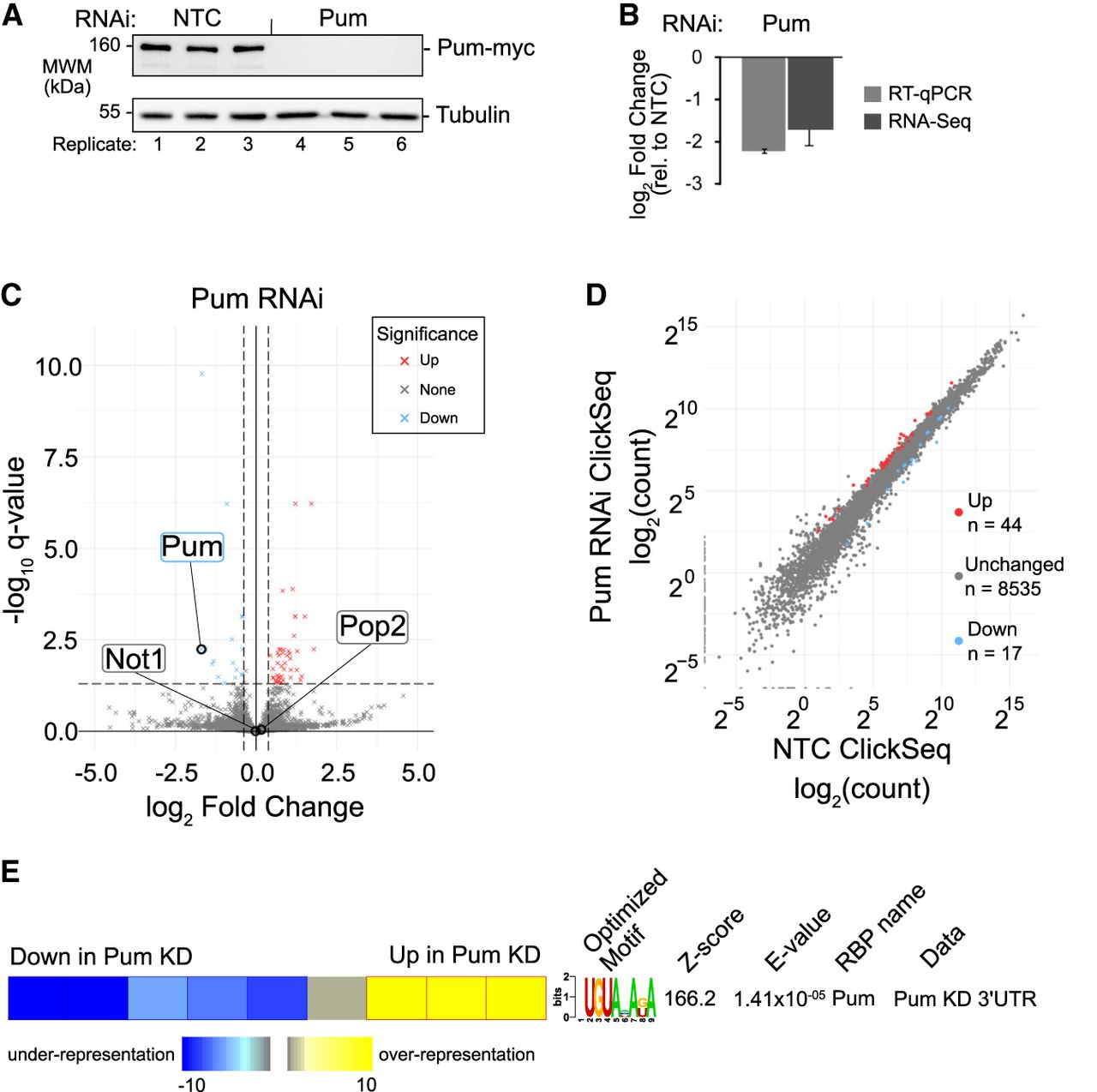
Identification of Pum-regulated transcripts in response to Pum knockdown in Drosophila cells. (A) Western blot of RNAi knockdown of endogenous myc-tagged Pum protein from three biological replicate samples of DL1 Pum-myc cells. RNAi with NTC dsRNA, corresponding to E. coli lacZ, served as a negative control. Western blot of tubulin served as a loading control. (B) RNAi knockdown of Pum mRNA was confirmed by RT-qPCR and RNA-seq. Mean log2 fold change (LFC) values ± standard error of the mean (SEM) are plotted relative to the NTC RNAi condition. n = 3. (C) Volcano plot of statistical significance (q-value) versus mean LFC of RNA levels in Pum RNAi relative to NTC RNAi, measured by RNA-seq. Vertical dashed lines indicate a LFC value of ±log2(1.3). A statistical significance threshold (q-value ≤ 0.05) is shown with a horizontal dashed line. Red or blue markers (×) indicate genes passing both statistical significance and fold change thresholds in positive (Up) or negative (Down) directions, respectively. (D) Plot of mean normalized RNA-seq read counts per kilobase of Pum RNAi versus NTC. Significantly up-regulated and down-regulated genes are highlighted. (E) Identification of RNA sequence motifs significantly correlated with changes in transcript abundance, analyzed using the finding informative regulatory element (FIRE) algorithm. Target RNAs were sorted into nine equally populated bins, in order of significant-weighted log fold change values (i.e., the Wald statistic). The enrichment or depletion of the identified motif in each bin is shown with the blue–yellow color scale. Significant enrichment is observed for a motif that is highly identical to the documented Pum-binding site, the PRE, in transcripts that are strongly up-regulated by knockdown of Pum (Up in Pum KD). The Z-score output by FIRE indicates the information content of the optimized motif. The E-value output by TOMTOM indicates how confidently the motif matched with a known RBP.




