


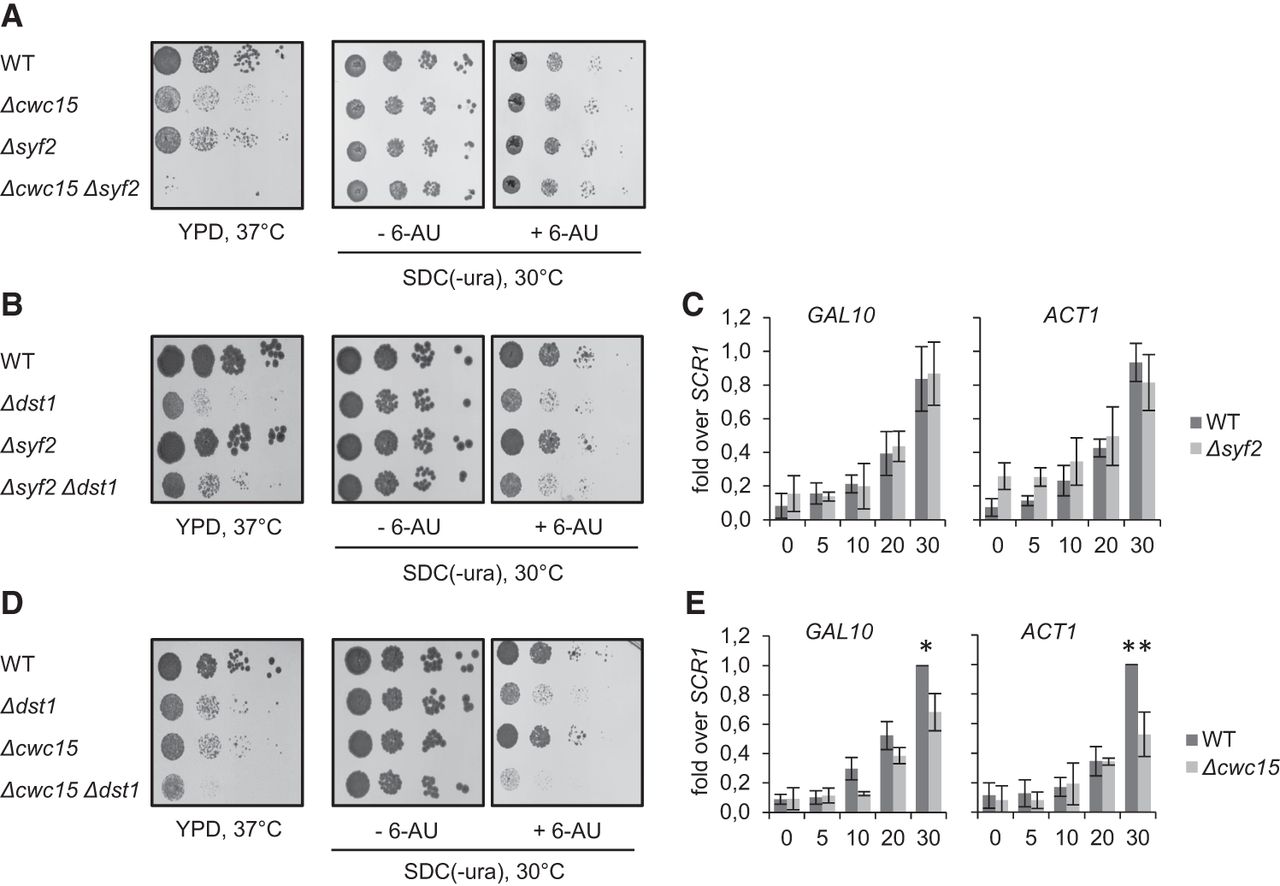
Cwc15 activity is needed for full transcriptional activity. (A) CWC15 and SYF2 interact genetically. Δcwc15 and Δsyf2 are synthetically lethal at 37°C. Tenfold serial dilutions WT, Δcwc15, Δsyf2, and Δcwc15 Δsyf2 cells were spotted on YPD plates and incubated for 3 d at 37°C (left panel) and on SDC(-ura) plates containing solvent (−6-AU) or 75 μg/mL 6-AU (+6-AU) and incubated for 2–3 d at 30°C (right panel). (B) Deletion of SYF2 does not cause a temperature-sensitive phenotype and does not interact genetically with Δdst1. Dot spots of WT, Δsyf2, Δdst1, and Δdst1 Δsyf2 cells as described in A. (C) Syf2 is not needed mRNA synthesis in vivo. Expression of the endogenous, intronless GAL10 gene and the plasmid-encoded, intron-containing ACT1 gene driven by the GAL10 promoter was induced for 5, 10, 20, and 30 min by the addition of galactose. Total RNA was extracted and the amount of GAL10 and ACT1 mRNA was determined by primer extension. The amount of GAL10 and ACT1 mRNA at the different time points of three independent experiments in WT and Δsyf2 cells was quantified and normalized to the levels of the RNAPIII transcript SCR1. (D) Deletion of CWC15 causes a temperature-sensitive phenotype and is synthetically sick with Δdst1 both at 37°C and on 6-AU plates. Dot spots of WT, Δcwc15, Δdst1, and Δdst1 Δcwc15 cells grown under the conditions described for A. (E) Cwc15 is required for efficient mRNA synthesis in vivo. Experiment as in C.




