


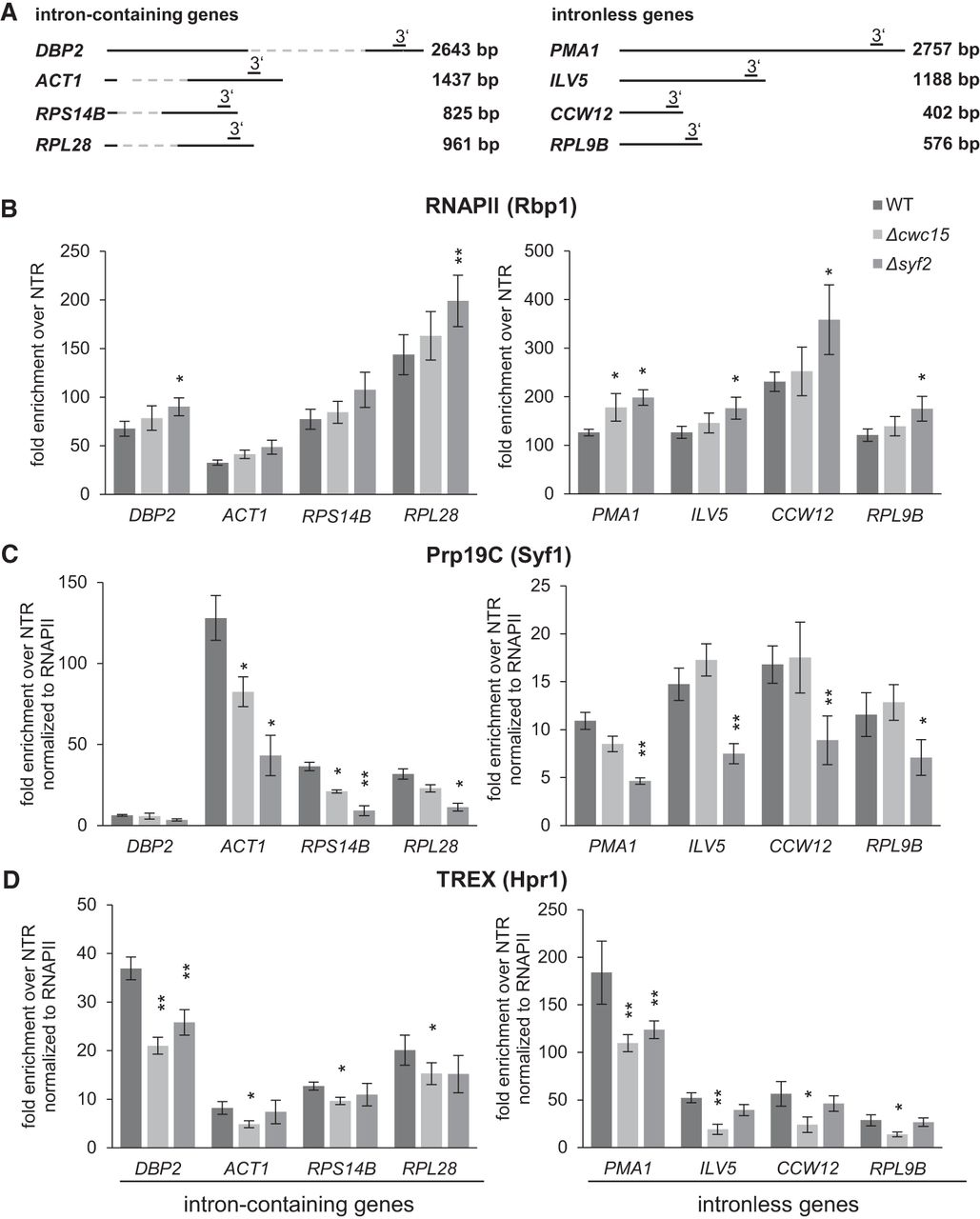
Syf2 functions in Prp19C occupancy, and Cwc15 functions in TREX occupancy. (A) Scheme of four exemplary intron-containing genes (DBP2, ACT1, RPS14B, and RPL28) and four exemplary intronless genes (PMA1, ILV5, CCW12, and RPL9B) used for ChIP experiments. Open reading frames (ORFs) are represented by solid lines and introns by hatched lines. The bars above the genes indicate the positions of the primer pairs used for analysis by quantitative PCR. (B) RNAPII occupancy increases in Δsyf2 cells both at intron-containing and intronless genes. The occupancy of the RNAPII component Rpb1 was assessed in WT, Δcwc15, and Δsyf2 mutant cells by ChIP experiments at the four intron-containing (left panel) and the four intronless (right panel) genes depicted in A. (C) Prp19C occupancy decreases in Δsyf2 mutant cells at intron-containing genes. The occupancy of Prp19C was assessed by ChIP of Syf1-TAP normalized to the occupancy of RNAPII. (D) TREX occupancy decreases in Δcwc15 cells. The occupancy of TREX was assessed by ChIP of Hpr1-TAP normalized to the occupancy of RNAPII. Of note, total levels of Hpr1-TAP decrease in Δcwc15 and Δsyf2 cells. However, as the amount of beads is limiting in the ChIP protocol used, this should not influence the result. Moreover, Hpr1-TAP occupancy in Δsyf2 cells is only decreased at some genes.




