


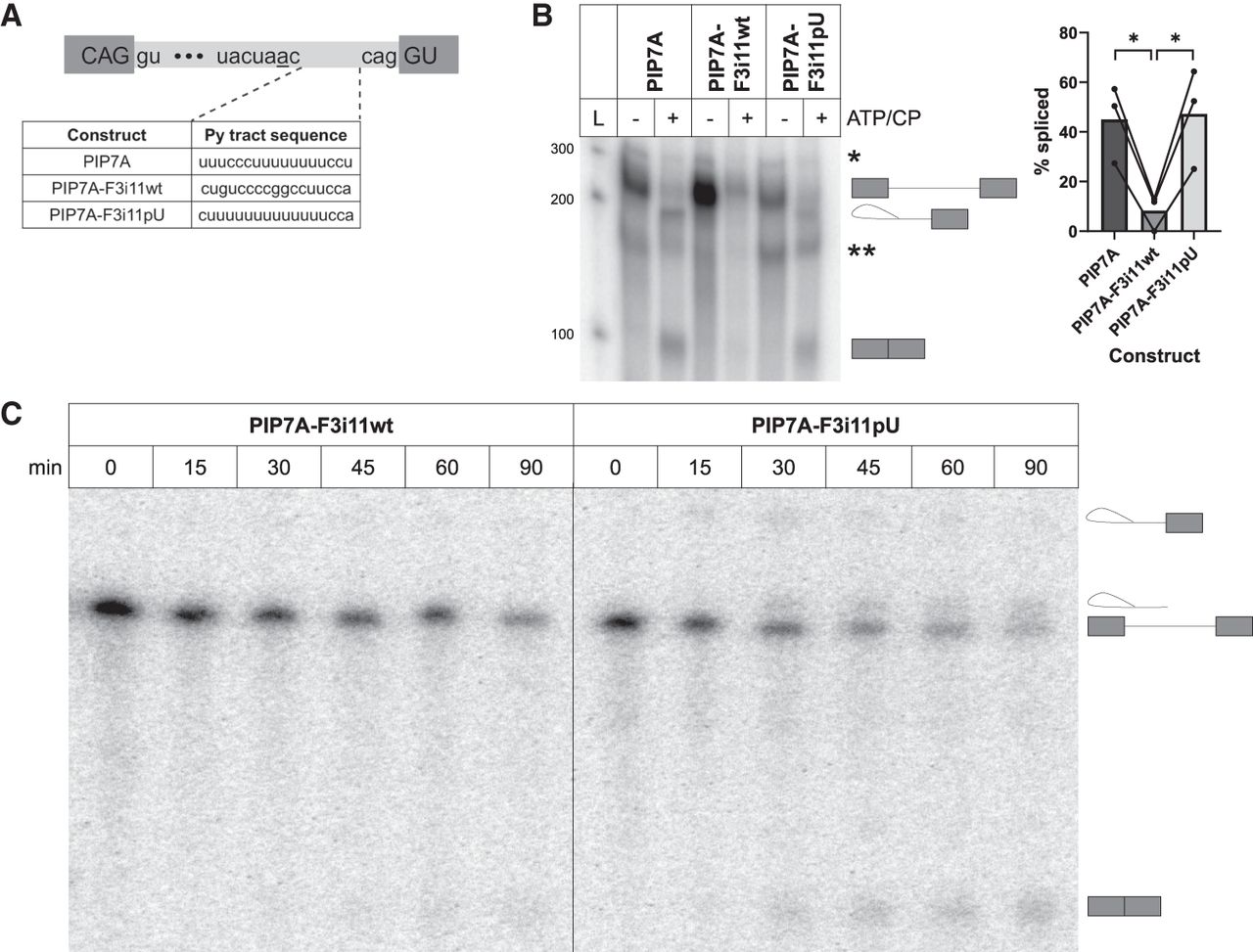
C-rich/U-poor polypyrimidine tract of FOXP3 intron 11 weakens the splicing efficiency of a robust splicing substrate. (A) Schematic diagram of PIP7A-based splicing substrates. The sequence of all three constructs remains the same except the PIP7A py tract sequence (20 nt upstream of the 3′SS) is replaced with that of FOXP3 intron 11 (PIP7A-F3i11wt) or a U-rich mutant (PIP7A-F3i11pU) (created with BioRender). (B) IVS of PIP7A-based splicing substrates. The first lane is the ladder (L) with its respective sizes on the left. Depicted on the gel are splicing intermediates from top to bottom: (*) represents a by-product of T7 RNA synthesis; unspliced substrate; intron lariat intermediate; (**) represents a by-product of T7 RNA synthesis; spliced product. Quantification of % spliced is shown on the right and calculated as (spliced/[spliced + unspliced]) × 100. Each bar represents the average ± SD of three independent experiments using three different nuclear extract preparations; (*) P < 0.05, Student's t-test. (C) IVS time course of PIP7A-F3i11wt and PIP7A-F3i11pU substrates. Depicted on the gel are splicing intermediates from top to bottom: intron lariat intermediate; intron lariat; unspliced substrate; and spliced product.




