


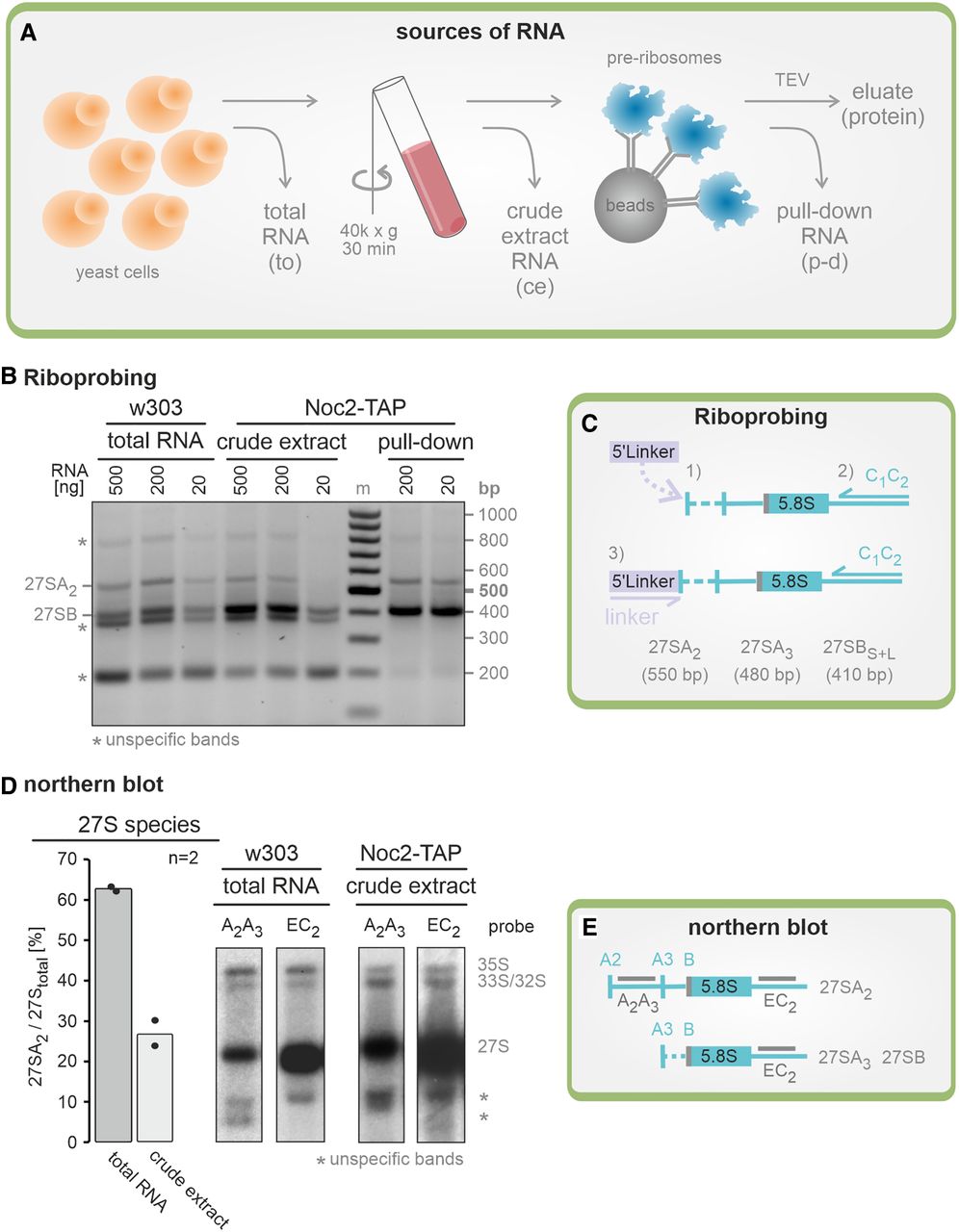
Small amounts of different RNA isolates allow discrimination of 27S pre-rRNA species. (A) Different sources for RNA isolation were tested with the Riboprobing workflow: total cellular RNA, RNA from crude extracts, and RNA from pre-ribosome pull-downs. (B) 1.5% agarose gel separating the products of the Riboprobing workflow. Different initial RNA amounts were analyzed by Riboprobing. For pull-down samples, 20 ng of RNA was used, whereas total RNA and crude extract RNA samples required at least 200 ng for a reliable detection of 27SA2 and 27SB pre-rRNA. (m) 100-bp ladder (Thermo Fisher). (C) Riboprobing workflow scheme for B with the expected length of the different 27S pre-rRNA species. (D) Comparison of 27Stotal (detected by EC2 probe) to 27SA2 (detected by A2A3 probe) pre-rRNA signals in total RNA and crude extract RNA samples. The X-ray films were exposed to show roughly the same intensities for the 35S/32S pre-rRNA. After quantification of the signals and normalizing the 27S pre-rRNA species to the 35S pre-rRNA, the proportion of 27SA2 pre-rRNA in the 27Stotal pre-rRNA was calculated and expressed in %. (E) Binding positions of probes used for 27S pre-rRNA species detection by northern blotting.




