


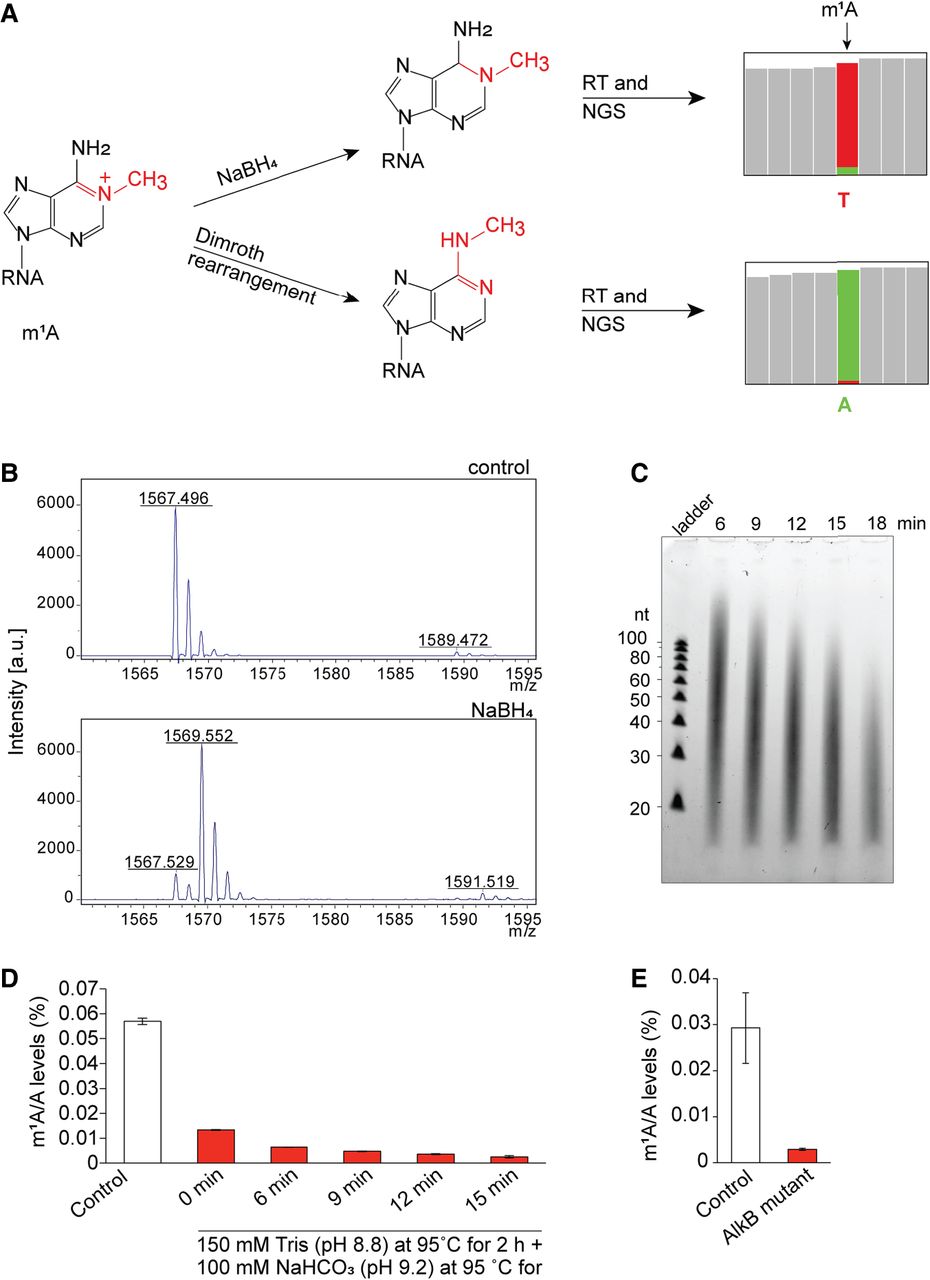
Development of red-m1A-seq. (A) NaBH4 reduction of m1A may improve mutation rate and readthrough rate during RT. The modified site could be read as “T” in next-generation sequencing (NGS). Dimroth rearrangement converts m1A to m6A, and thus m1A is read as “A” in NGS. (B) MALDI-TOF-MS spectra of m1A-containing 5-mer oligonucleotide untreated (control; m/z = 1567) and treated with 0.1 M NaBH4 for 1 h at room temperature. (C) TBE-UREA gel of HeLa poly(A)+ RNA treated with 150 mM Tris-HCl (pH 8.8) at 95°C for 2 h, followed by an additional treatment with 100 mM NaHCO3 (pH 9.2) at 95°C for 6, 9, 12, 15, or 18 min, respectively. (D) LC–MS/MS showing m1A/A levels in HeLa poly(A)+ RNA under different alkaline conditions. HeLa poly(A)+ RNA was treated with 150 mM Tris (pH 8.8) at 95°C for 2 h, followed by additional treatment with 100 mM NaHCO3 (pH 9.2) at 95°C for 6, 9, 12, or 15 min, respectively. (E) LC–MS/MS showing m1A/A levels in HeLa poly(A)+ RNA upon treatment with AlkB mutant.




