


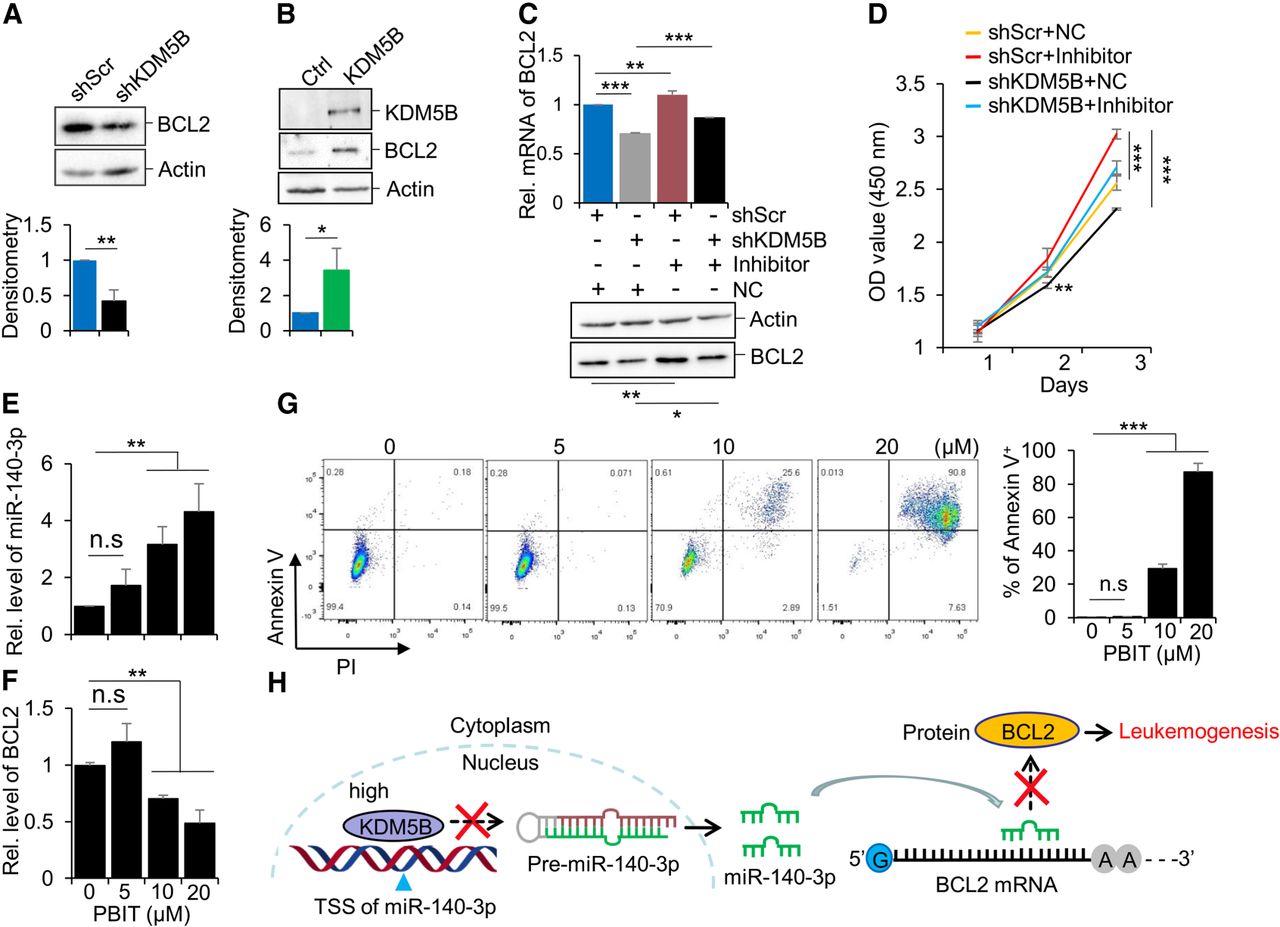
The miR-140-3p inhibitor can alleviate KDM5B silencing-induced proliferation reduction. (A,B) The level of BCL2 was assessed in MOLM-13 cells with KDM5B silencing (A) or KDM5B overexpression (B). (C) miR-140-3p inhibitor and NC were transfected into control (shScr) and KDM5B KD MOLM-13 cells, respectively. BCL2 expression was measured by RT-qPCR (top) and western blotting (bottom). (D) CCK8 assay to measure the proliferation of the cells treated in (C). (E,F) MOLM-13 cells were treated with vehicle (DMSO) and increasing doses of PBIT. The mRNA levels of miR-140-3p (E) and BCL2 (F) were measured by RT-qPCR, and the cell apoptosis (G) was measured by Annexin V staining, respectively. Quantification from two (C) and three (A–C, E–G) biological repeats. (H) A model for the role of KDM5B in promoting leukemogenesis through miR-140-3p/BCL2 axis in AML cells. A high level of KDM5B inhibits the generation of miR-140-3p, which turns off its attenuation effect on BCL2, subsequently promoting the tumorigenesis of AML. Data represent the mean + SD (A–C, E–G) or ±SD (D). (*) P < 0.05, (**) P < 0.01, and (***) P < 0.001, by Student's t-test (A,B,E–G) and one-factor ANOVA with a post hoc t-test (C,D).




