


Tribute to Yoshiro Shimura (1932–2023)
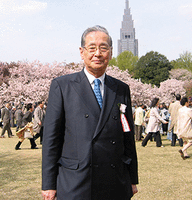
Yoshiro Shimura. (Photo courtesy of Mrs. Sachiko Shimura.)
On September 27, 2023, Dr. Yoshiro Shimura died of old age in Kyoto, Japan. He was born and grew up in Yamanashi prefecture, near Tokyo. He entered the Department of Botany at Kyoto University and received an MS degree in plant physiology. He then moved to Rutgers University in New Jersey and obtained his PhD in microbiology and molecular biology under the supervision of Professor Henry J. Vogel (Shimura and Vogel 1966). Following that, Dr. Shimura moved to the Johns Hopkins University School of Medicine as a postdoctoral fellow in the laboratory of Dr. Daniel Nathans, where he began studying RNA science, which became his life's work. His first major work was an analysis of the protein synthesis of MS2 RNA phage in vitro and in vivo (Shimura et al. 1967). He also determined the genetic map of the MS2 phage genome (Shimura et al. 1968). This was a basis for the genetic mapping of the SV40 virus genome determined by Dr. Nathans, which was awarded a Nobel Prize in Physiology or Medicine in 1978. Dr. Shimura mentioned in his autobiography that Dr. Nathans often said, “Do not choose the theme that someone else can work”; meaning that originality is important for scientists. As a graduate student, I was also told by Dr. Shimura to do original science.
After four years in Dr. Nathan's lab, Dr. Shimura returned to Japan and joined the Department of Biophysics, Faculty of Science, Kyoto University as an associate professor in Professor Haruo Ozeki's lab. In this new position, he started to work on the molecular genetics of tRNA. He used Escherichia coli nonsense suppressor tyrosine tRNA and found the mutation in the fourth nucleotide of this tRNA from the CCA end, which changes its specificity from tyrosine to glutamine (Shimura et al. 1972). This work contributed to opening the field of “tRNA identity,” defining how tRNA-aminoacyl tRNA synthetases recognize and charge only their cognate tRNAs. Dr. Shimura then moved his focus to tRNA biogenesis. He utilized molecular genetics with E. coli to isolate mutant cells defective in tRNA synthesis at high temperature (Sakano et al. 1974). Those mutants did not produce mature tRNAs; rather, they accumulated tRNA precursors. It turned out that RNase P, which removes 5′ extra sequences of tRNA, was inactivated in those mutant E. coli cells at high temperature. Together with Dr. Sidney Altman's group, it seems to me that the results from Dr. Shimura's group helped pioneer the “RNA processing” field (Sakano and Shimura 1975, 1978; Reed et al. 1982).
After a long period of scientific competition with Dr. Altman's group on RNase P, Dr. Shimura shifted his interest to mRNA processing. His group first established an in vitro splicing assay system by using a substrate pre-mRNA derived from the chicken δ-crystallin gene and HeLa cell nuclear extracts (Ohno et al. 1985; Sakamoto et al. 1987). This substrate is spliced very efficiently in vitro, and it is still used in several splicing laboratories around the world. By taking advantage of this in vitro system and microinjection into Xenopus laevis oocytes, his group demonstrated that the cap structure at the 5′ terminus of pre-mRNA promotes excision of the first intron (Ohno et al. 1987; Inoue et al. 1989). As a candidate of the mediator of this phenomenon, Dr. Shimura's group biochemically purified a nuclear cap-binding protein from HeLa cell nuclear extracts (Ohno et al. 1990). Dr. Iain Mattaj's group in EMBL and his group simultaneously isolated cDNA for this protein, and it was demonstrated that the nuclear cap-binding activity consists of two protein subunits (Izaurralde et al. 1992, 1994; Kataoka et al. 1994, 1995). In addition to this finding, his group also contributed to the basic mechanism of mRNA splicing by showing that U6 snRNA was crosslinked near the 5′ splice site, suggesting that U6 snRNA confers a catalytic activity in the spliceosome (Sawa and Shimura 1992).
Dr. Shimura's group also contributed to unveiling the mechanism for the regulation of alternative splicing. By analyzing the sex determination cascade of Drosophila melanogaster somatic cells, they demonstrated that the female Sex-lethal protein affects 3′ splice site selection of transformer pre-mRNA to produce a full-length transformer protein and, in turn, that the transformer activates female type doublesex pre-mRNA splicing in the presence of transformer-2 (Inoue et al. 1990, 1992; Hoshijima et al. 1991; Sakamoto et al. 1992). Dr. Shimura's group also tried to analyze the alternative RNA processing mechanism of immunoglobulin μ chain mRNA. They demonstrated that the purine-rich sequence in a membrane-type-specific M2 exon could promote the excision of the upstream intron (Watakabe et al. 1993). They also found similar sequences in several exons of other genes and named it an “exon recognition sequence,” which is now called as “exonic splicing enhancer” (Watakabe et al. 1993). In recognition of his extensive contributions to RNA biology, Dr. Shimura became the first president of the RNA Society of Japan, which was established in 1999.
At Kyoto University, Dr. Shimura was a calm but passionate teacher for undergraduate students. I learned the words “mRNA splicing” from his lectures, and these words are still an important keyword for my scientific “lifework.” Dr. Shimura was an excellent scientist, and at the same time he was a great mentor for his trainees. In his laboratory, Dr. Shimura was very strict about science, but he was gentle and patient. He did not force graduate students to obey his ideas; rather, he gave them time to think through their ideas thoroughly and waited until they brought their own ideas to him. This training was very helpful for me to consider and make my own conclusions for scientific discussion. Dr. Shimura was also an adjunct professor at the National Institute for Basic Biology (Okazaki, Japan) from 1989 to 1994. He trained many scientists in plant biology by introducing Arabidopsis thaliana as a model organism (Okada et al. 1989, 1991; Okada and Shimura 1990). After leaving Kyoto University, he kept contributing to Japanese science through his positions of Director of the Biomolecular Engineering Research Institute (1996–2002), Director of the Japan Society for the Promotion of Science Liaison Office (Stockholm, 2001–2004), President of the National Institute of Natural Sciences (2004–2010), Vice Director of the International Institute for Advanced Studies (2009–2013), and Director of the International Institute for Advanced Studies (2013–2015). He was also an Editorial member of RNA for the first two years (1995–1996) of the journal.
Dr. Shimura's enthusiasm for RNA biology has been passed to many Japanese RNA scientists in subsequent scientific generations. His motto, “Do original science. Do not follow other people” is still alive in the hearts of Japanese RNA scientists, including me. His knowledge and passion for science will be missed. At the same time, his death is a loss to the Japanese RNA community and to his friends and colleagues all over the world. However, as RNA scientists, we will certainly carry on his scientific spirit.
—Naoyuki Kataoka
Department of Animal Resource Sciences Graduate School of Agriculture and Life Sciences The University of Tokyo, Tokyo 113-8657, Japan
It is always sad to learn of the death of a friend, and so it was to hear recently that Yoshiro Shimura had passed away. He died at the end of September this year at the age of 90. He remained active in science leadership until 2015, so it is paradoxical to remember that in 1996 I attended a “retirement” symposium organized in his honor, when he stepped down as Head of the Department of Biophysics at the University of Kyoto. Like many others, I had known about and followed Yoshiro's science for many years prior to that, but in fact it was only at the symposium that I realized how broad his research had been. It was also the first time we met in person.
Yoshiro studied Botany at the University of Kyoto before moving to Rutgers University (with Henry Vogel) to learn microbiology and molecular biology during his PhD. It was, however, his postdoc with Dan Nathans at Johns Hopkins that set him firmly on track for a career in research. There, he started working with the MS2 RNA phage and became fascinated by RNA metabolism and function. On returning to Japan in 1967, he started his lab by applying genetics to the analysis of tRNA production, in particular tRNA processing. This continued for three years in Osaka before he returned to the University of Kyoto to join the Department of Biophysics, where he would remain till the end of his university career. The E. coli mutations he identified that interfered with pre-tRNA processing led him to the study of the processing activities, including RNase P.
Moving from pre-tRNA processing to pre-mRNA processing was a natural next step for the Shimura lab, which by this time had considerable expertise in biochemistry as well as genetics. One of their first observations was that the removal of cap-proximal introns was affected by the presence of the cap structure. This set them off on a hunt for the cap-binding factors involved. In parallel, my laboratory had become interested in nuclear cap-binding proteins because we had evidence that they played a role in the export from the nucleus of U snRNA precursors. In 1994, both groups successfully cloned CBP80 and CBP20, the two components of the nuclear cap-binding complex (CBC), and between us we demonstrated that CBC played roles in both pre-mRNA splicing and in U snRNA nuclear export. Further study in the Shimura lab identified factors involved in mRNA export, like the HRH1 helicase which extracted the processed pre-mRNA from the spliceosome.
But in terms of RNA processing, his focus moved more and more toward splicing regulation and its biological consequences. In Drosophila, Shimura was an important contributor to the study of the role of alternative, sex-specific splicing in sex determination in flies, including the role of the Sex-lethal protein, whereas in mammals he elucidated aspects of the regulation of production of alternative forms of IgM mRNA. All these studies were accompanied by parallel investigations of basic mechanisms in splicing and in spliceosome assembly.
Soon after promotion from associate to full professor at Kyoto University, Yoshiro took up a second position as an adjunct professor at the National Institute of Basic Biology (NIBB) in Okazaki. Like the other National Institutes of Natural Sciences (NINS) in Japan, the role of NIBB is to support a mix of intramural research groups and act as host to top researchers from the university system. This provides the university professor with the possibility to pursue research with a certain level of secure funding and no teaching or administrative commitment. It was a system Yoshiro greatly appreciated and he took advantage of it in a particular way, to return to his undergraduate roots and study fascinating problems in plant biology, making use of his accumulated experience in molecular and genetic methods.
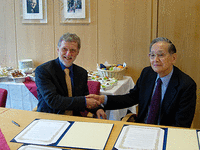
Yoshiro Shimura and Iain Mattaj shaking hands at the EMBL in Heidelberg in 1995, on the occasion of the signing of an agreement between NINS and EMBL that included the joint organization of training courses in advanced methods, PhD student exchanges, and the organization of joint PhD student symposia. (Photo courtesy of the National Institutes of Natural Sciences [NINS], Japan.)
From the late eighties, his group, over a period of roughly 12 years, published a large number of papers on Arabidopsis signaling, differentiation, and development. Many of these were focused on understanding the development and function of the root system, a field to which his group became major contributors. This position ended soon before his professorship at Kyoto came to an end, although he made use of his emeritus status to continue publishing work with Arabidopsis for some years.
Yoshiro had at least four “post-retirement” positions, but here I will mention only two. From 2004 to 2010, Yoshiro occupied one of the most important leadership positions in Japanese research, that of President of the National Institutes of Natural Sciences. As I said above, NINS was an institution from which Yoshiro's own research had benefited, and it was one whose aims he completely supported. Despite the fact that it took him and Sachiko away from their beloved Kyoto to Tokyo, he stayed in the position for six or seven years, doing everything he could to internationalize the different NINS institutes and to further improve the quality of the research supported by the organization.
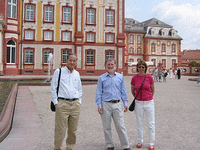
Strolling around baroque Schloss Bruchsal, south of Heidelberg. (Photo courtesy of Iain Mattaj.)
Prior to that, from 2000 to 2004 he was the Director of the Japan Society for the Promotion of Science (JSPS) liaison office in Stockholm, Sweden. His being in Europe gave us the chance to meet several times and cemented both our friendship and that of his wife, Sachiko, with mine. They were delightful companions, mixing more traditional Japanese characteristics like commitment to work and family with very relaxed, westernized humor and a love of haute cuisine. On one of these occasions, I asked Yoshiro what his job in Stockholm actually consisted of. Uncharacteristically, he took some time before deciding to respond, but eventually said, “You know, Japan produces a lot of excellent science, but we don't have very many Nobel Prize winners.” I have no idea how and whether he might have exercised persuasion, but I note there were four awards to Japanese scientists during his tenure in Sweden and three more soon after (from a historic total of 25 science laureates to date).
—Iain Mattaj
Visitor at the Human Technopole Foundation 20157 Milan, Italy




