


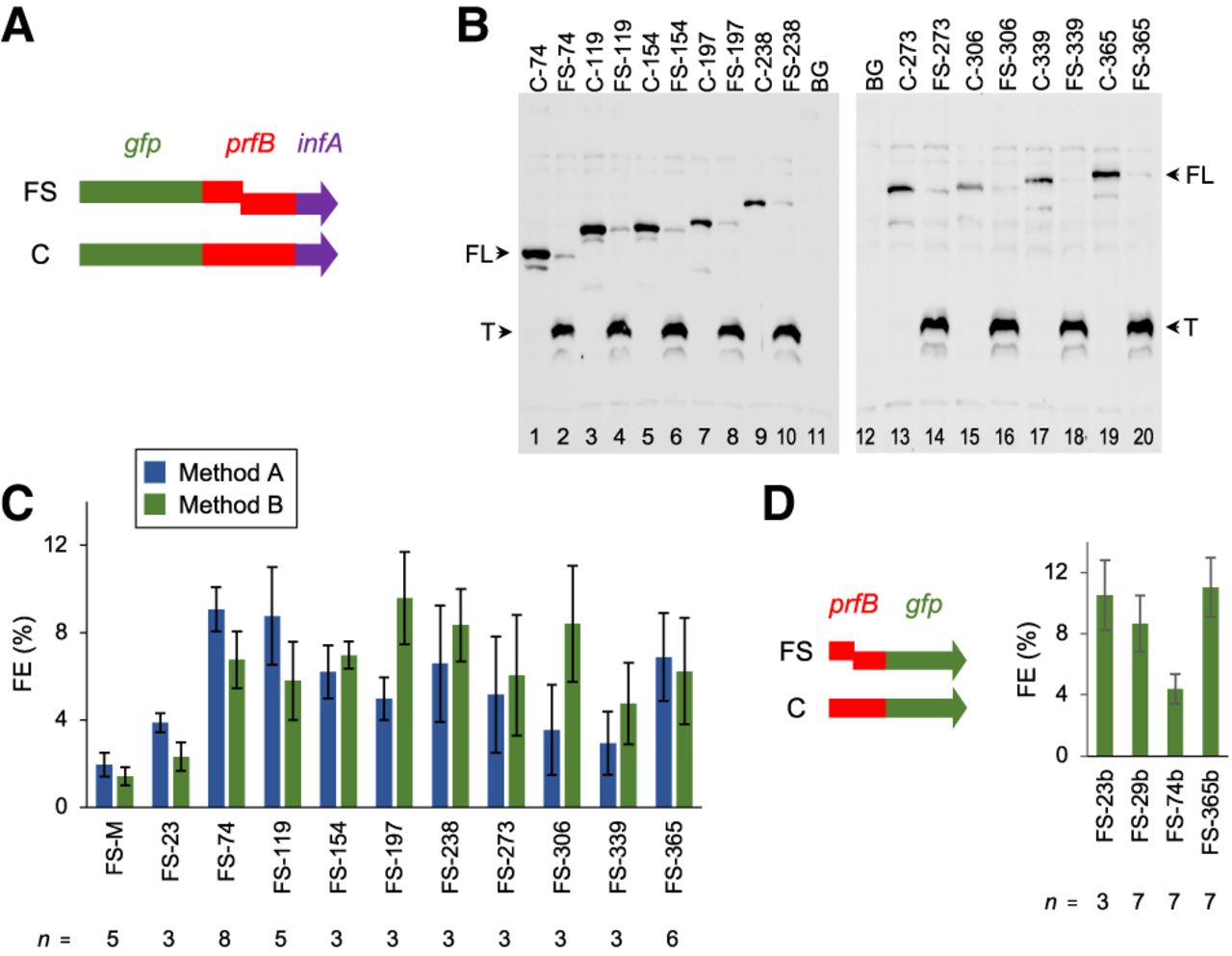
Measuring prfB frameshifting in F. johnsoniae. (A) To quantify frameshifting, DNA of prfB (various lengths) was cloned between gfp and infA, such that the production of FL fusion protein depends on frameshifting. For each frameshift-containing (FS) construct made, a corresponding in-frame control (C) construct was also made. These C constructs carry a single base pair deletion that converts the slippery sequence CUUU to the codon CUU. Numbered constructs include all codons upstream of the frameshift site and are named based on the downstream-most codon of prfB. Construct “FS-M” is the only exception and contains only codons 17–23 of prfB. (B) Examples of western blots using anti-GFP antibodies to detect truncated (T) and FL products of the fusion constructs. Lysate from untransformed F. johnsoniae was loaded in adjacent lanes (11,12) to assess background (BG). (C) The efficiency of frameshifting on mRNA from various FS constructs (as indicated), estimated by two methods, is shown. With method A (blue bars), FE was calculated as FE = FLFS/(FLFS + TFS) × 100%, where FLFS and TFS correspond to the full-length and truncated products from a given FS construct. With method B (green bars), FE = FLFS/FLC × 100%, where FLFS represents the full-length product from the FS construct, and FLC represents the same product from the corresponding in-frame C construct. (D) Another reporter system, involving prfB–gfp fusions, was also used to measure frameshifting, and method B was used for quantification. Data represent the mean ± SEM. The number of biological replicates (n) is indicated below the bars, and the raw data are given in Supplemental Table S1.




