


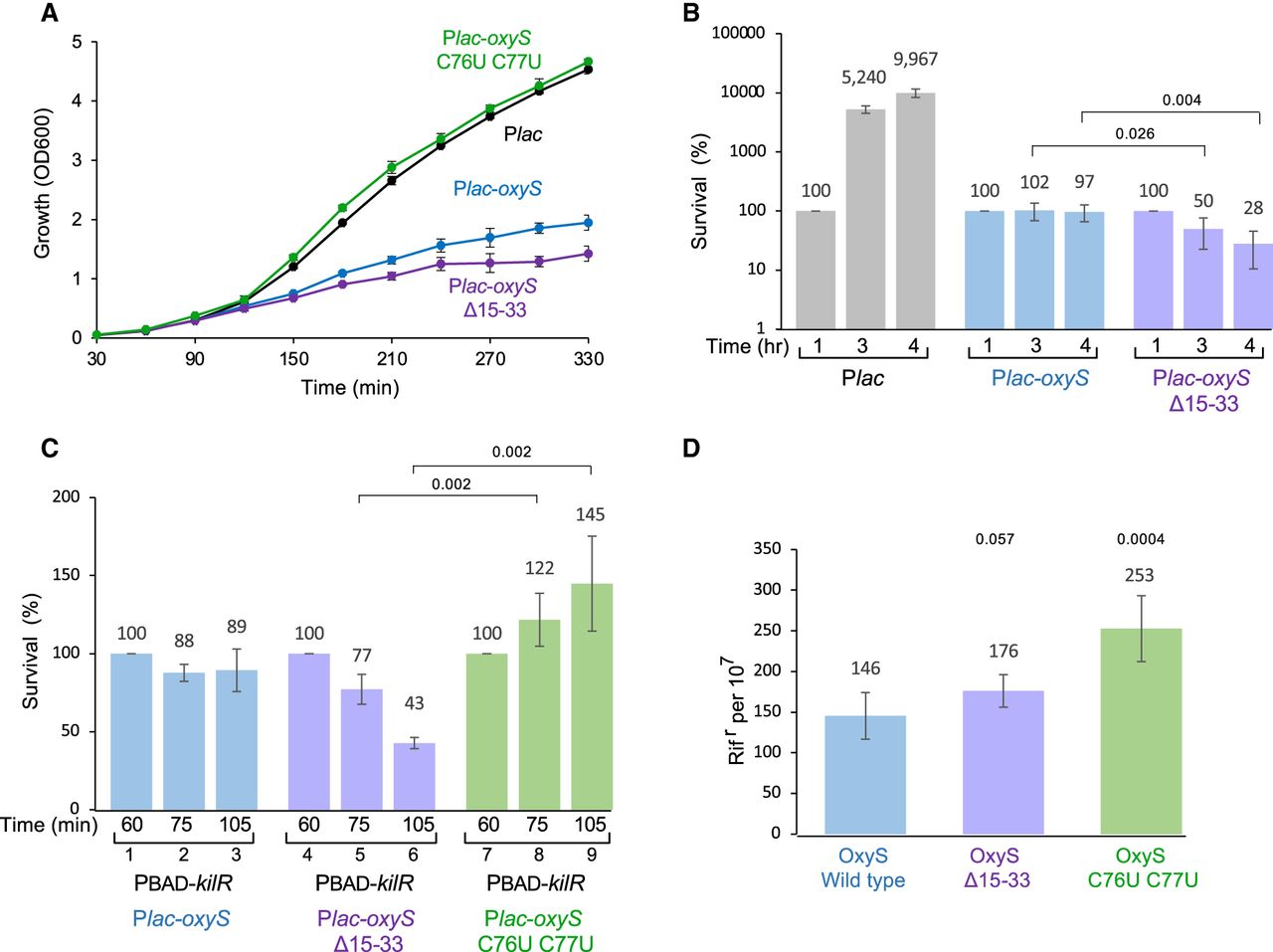
Simultaneous inhibition of cell division and cell elongation by OxyS promotes cell recovery. (A) E. coli (MG1655 mal::lacIq) carrying Plac-oxyS wild-type and mutants were treated with 1 mM IPTG at dilution, growth (OD600) was measured as indicated. (B) Cultures (MG1655 mal::lacIq) carrying control and OxyS plasmids, and a chromosomally encoded wild-type short (ΔP2)P1 mepS transcript that was constructed using the scarless mutations methodology, were treated with IPTG (1 mM) at dilution; CFU was determined 1, 2, and 4 h after dilution. (C) Cultures (MG1655 mal::lacIq) carrying PBAD-kilR and OxyS plasmids were treated with arabinose (0.2%) and IPTG (1 mM) at dilution; CFU was determined as indicated in the figure. Results are displayed as mean of five biological experiments ± standard deviation. (D) Cultures of wild-type OxyS and two chromosomally encoded OxyS mutants (Δ15–33 and C76U C77U) were treated with 0.2 mM of H2O2 for 30 min to induce OxyS expression and then exposed to 10 mM H2O2 to induce mutations. CFU and rifampicin resistant cells were monitored after 18 h of growth. Results are displayed as mean of six biological experiments ± standard deviation.




