


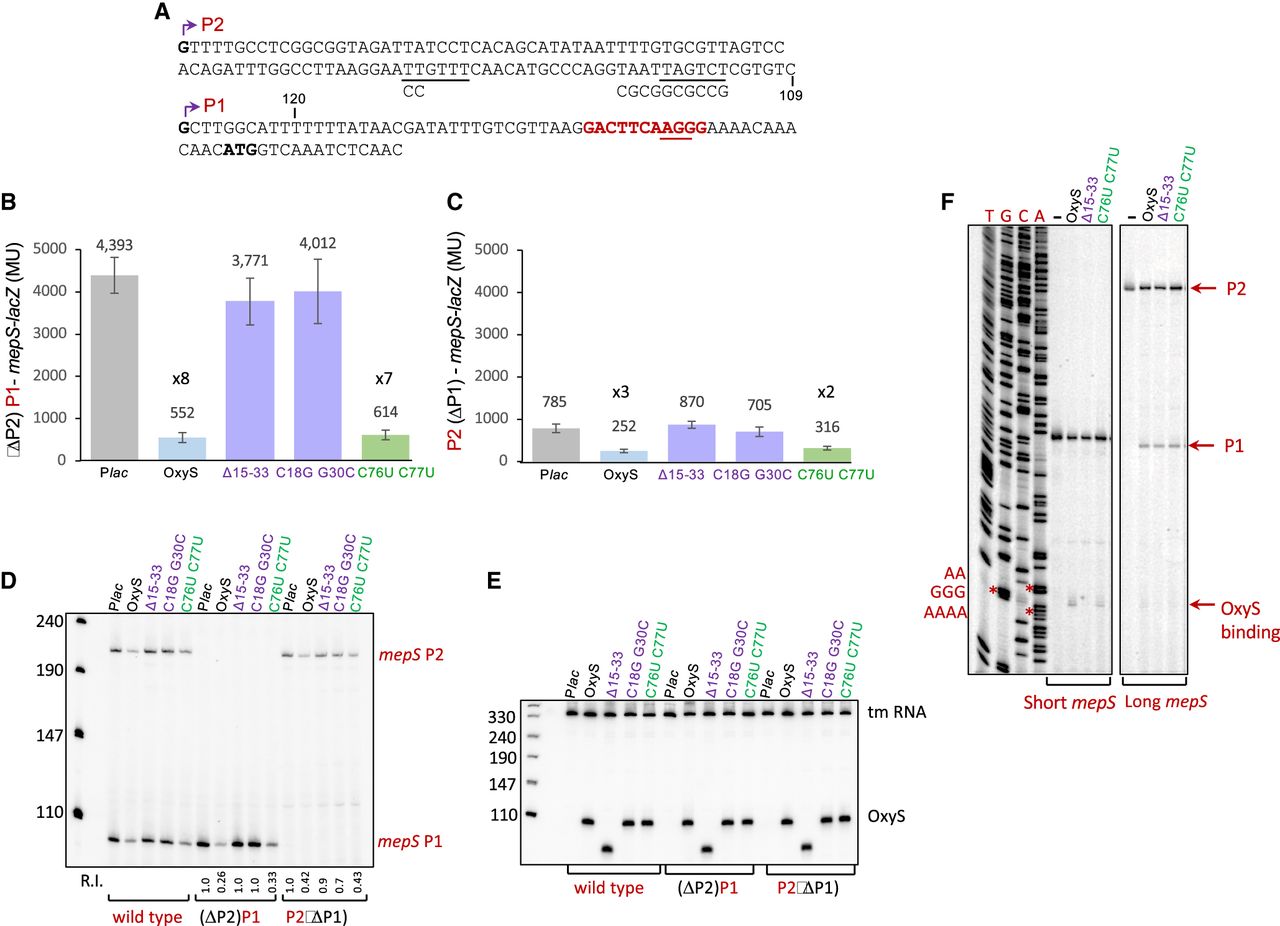
Short mepS transcript is responsive to OxyS regulation. (A) mepS is transcribed from two promoters P2 and P1 producing long and short mRNAs. To inactivate the downstream promoter P1, the sites −10 and −35 (underlined) were mutated as shown beneath the sequence. The initiation codon (bold) and the Shine–Dalgarno sequence of mepS (underlined, red) are indicated. The sequence in mepS that can bind OxyS is in red. (B,C) OxyS affects the expression of short mepS mRNA (lacZ assays). Cultures (MG1655 mal::lacIq ΔlacZ::Tn10) carrying (ΔP2)P1-mepS-lacZ and P2(ΔP1)-mepS-lacZ (pSC101*) translational fusions and Plac-oxyS wild-type and mutants were treated with IPTG (1 mM) at OD600 of 0.1–0.2. β-Galactosidase activity was measured 60 min after treatment. Results are displayed as mean of four to five biological experiments ± standard deviation. (D) OxyS-mepS RNA interaction in vivo. Cultures (MG1655 mal::lacIq) carrying OxyS plasmids and chromosomally encoded wild-type full-length, short [(ΔP2)P1], and long [P2(ΔP1)] mepS transcripts were treated with IPTG (1 mM) at OD600 of 0.2–0.3 for 30 min. The cDNA products generated by primer extension using 30 µg of total RNA and end-labeled mepS-specific primer 3412 were analyzed in 6% acrylamide 8 M urea-sequencing gel alongside with pUC19-MspI labeled marker. (RI) Relative intensity. Band intensities were determined by the ImageLab program. mepS mRNA levels were normalized to tm RNA loading control. mepS/Plac was used as a 100% reference. (E) In vivo RNA samples (10 µg) as in D were separated using 6% urea-polyacrylamide gels (northern blot). The membranes were probed with end-labeled OxyS (3708) and tm RNA (1912) specific primers. tm RNA serves as a loading control. (F) OxyS-mepS RNA binding in vitro. In vitro synthesized (0.05 pmol) short (139 nt) and long (248 nt) mepS mRNAs incubated with and without (5 pmol) synthesized OxyS RNAs (173 nt wild-type and 158 nt Δ15–33) at 25°C for 15 min. Primer extension was carried out for 7.5 min at 37°C using end-labeled mepS-specific primer (3740). The products were analyzed in 6% acrylamide 8 M urea-sequencing gel alongside with sequencing reactions.




