


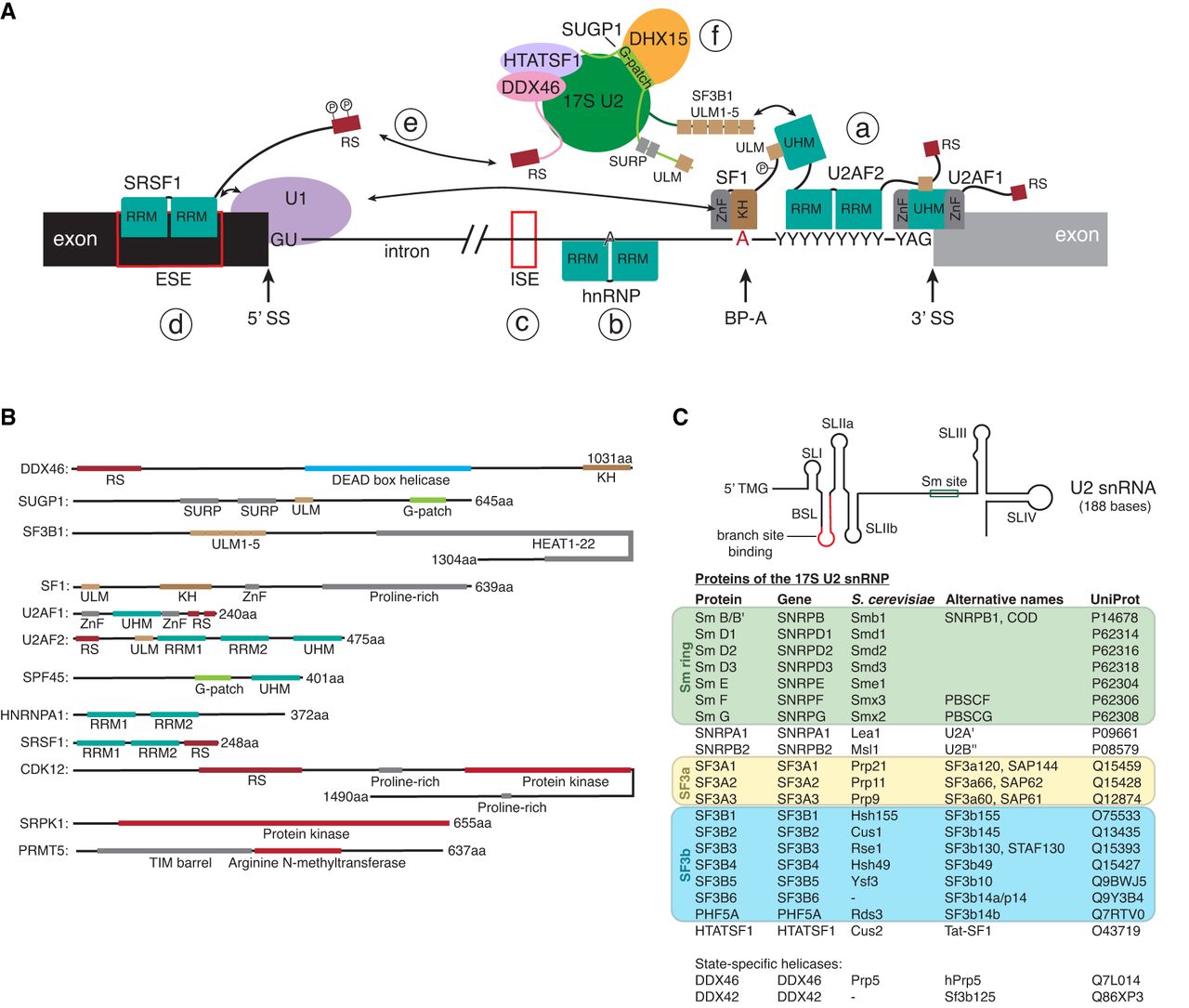
Components of the U2 snRNP and splicing factors involved in BS recognition. (A) Example components of the complex network of splicing factors involved in recognizing splice sites. (a) On most 3′ SS, the U2AF heterodimer and SF1 are the pioneering splicing factors (Ruskin et al. 1988; Zamore and Green 1989). These identify 3′ SS, BS, and the PPT, and recruit the 17S U2 snRNP, at least in part through the interaction of its UHM domains with the SF3B1 ULM motifs (Galardi et al. 2022). UHM-ULM interactions bring components of the splicing machinery together and are regulated by phosphorylation (Wang et al. 2013). (b) hnRNPs bind pre-mRNA and regulate splicing by blocking possible splice sites, recruiting splicing factors, or changing the structure of the pre-mRNA (Jones et al. 2022). (c) Intronic splicing enhancers (ISE) or (d) exonic splicing enhancers (ESE) can recruit proteins that enhance splicing. For example, the SRSF1 RRM domains bind ESE sequences while binding the U1 snRNP component SNRNP70 (U1-70K), recruiting it to 5′ SS on the pre-mRNA (Cho et al. 2011). The 5′ SS allows mismatches when base-pairing to U1 snRNP in every position, except the GU dinucleotide (Roca et al. 2013). (e) RS domain proteins (including SR proteins) form a network of protein–protein interactions that is regulated by phosphorylation. For example, the N-terminal RS domain of DDX46 is implicated in bridging U1 and U2 snRNP (Xu et al. 2004). (f) SUGP1 recruits DHX15 to the U2 snRNP and activates it through its G-patch domain (Zhang et al. 2023). SUGP1 also contains ULM and SURP domains, which are protein–protein interaction domains found only in splicing factors (Nameki et al. 2022). (B) Domain architecture of selected splicing factors that regulate BS selection. (C) The secondary structure and protein components of the 17S U2 snRNP. Depicted here are the components of the 17S U2 snRNP before they are bound to pre-mRNA. Not listed is Sm N, a substoichiometric component of the U2 snRNP that may replace Sm B/B’ in the U2 snRNP in certain tissues causing alternative splicing (Lee et al. 2014).




