


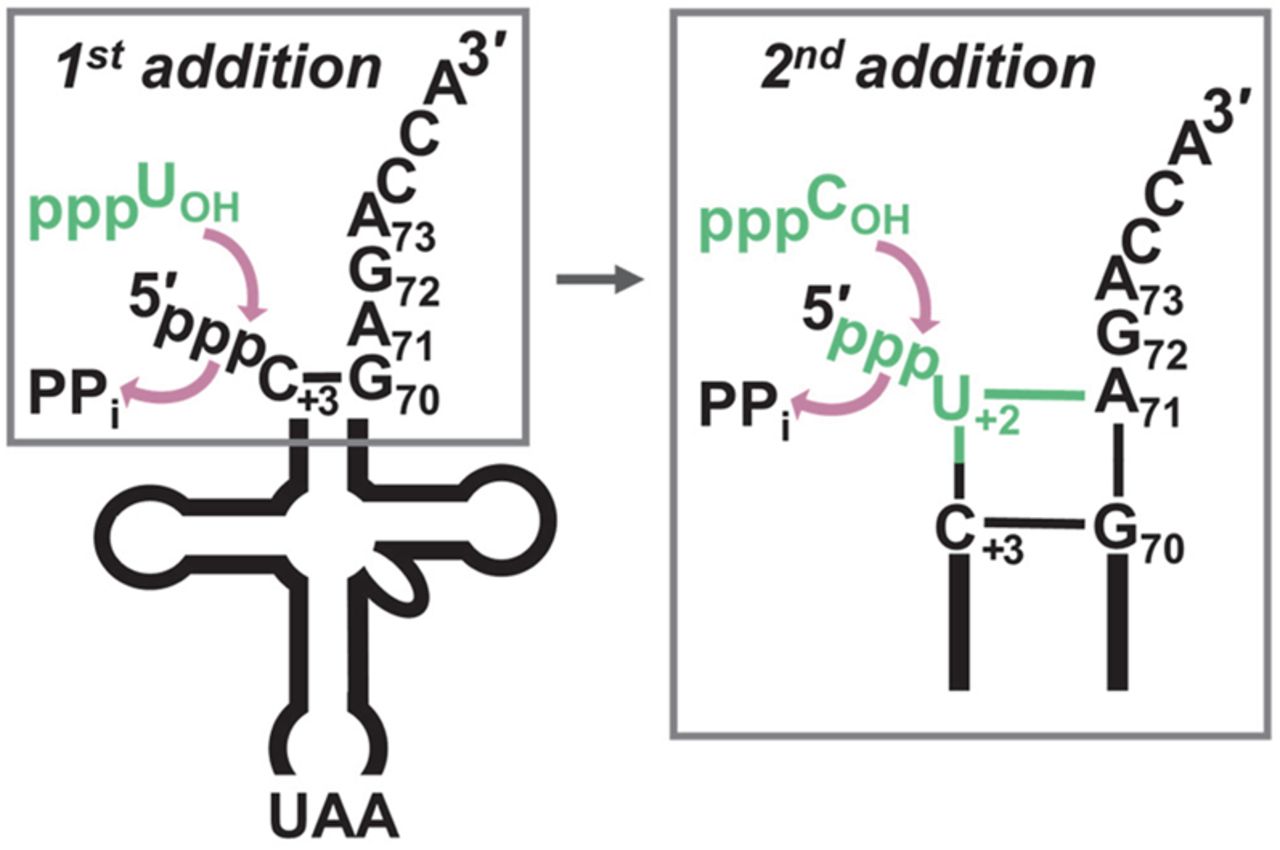
3′–5′ polymerase activity is used to repair mitochondrial tRNA. A schematic of tRNA 5′-end repair during mitochondrial tRNA editing in protozoa. The D. discoideum mitochondrial tRNALeu substrate shown in the diagram corresponds to an intermediate generated during 5′-editing that is missing nucleotides U+2 and C+1 from its 5′-end. In D. discoideum, DdiTLP3 uses the A71 and G72 nucleotides of the tRNA 3′-acceptor stem as a template for selection and incorporation of U+2 and C+1, respectively, via Watson–Crick dependent 3′–5′ polymerase activity. In the box showing the first (U+2) nucleotide addition, the 3′-OH of an incoming UTP (green) performs a nucleophilic attack on the α-phosphate of the 5′-triphosphorylated end of the truncated RNA. Likewise, during the second (C+1) addition, an incoming CTP uses its 3′-OH to attack the α-phosphate of the added U+2 nucleotide, thus restoring the fully base-paired aminoacyl-acceptor stem on the tRNA that is required for translation.




