


The Catalyst: RNA and the Quest to Unlock Life's Deepest Secrets, by Thomas R. Cech. 2024. W.W. Norton & Company
- thoru.pederson{at}umassmed.edu
In 1972, a pair of mathematicians published a way of depicting the socioeconomic profiles of various nations according to six variables, ranging from agriculture to the tempo of construction (Fig. 1; Herman and Montroll 1972). I came across this paper at the time, and the authors’ clever imagery stuck with me. (They termed these diagrams “snowflakes.”) I have subsequently thought that such a plot could be used to describe books on science. One vector's length would represent the degree of accuracy, another would be the writing clarity, another would be the engagement of the guild and yet another the degree of engagement of a broader audience, and so forth. Tom Cech's “The Catalyst” would be an asymmetric snowflake, in which the nodes of accuracy and clarity would be long extensions, as would the one scaled for engagement of the guild. The node of “broader appeal” would have a good length too though envisioned “broader audiences” are heterogeneous. That said, there is admirable pedagogy in this book and many places where a reader would not need to be a biologist, or even a scientist to learn a great deal. I found myself thinking of an intellectual holding the book in her apartment in the literary stratosphere of Manhattan's West End Avenue. She might have bought it because she had been hearing about DNA for many years, but lately also about RNA and wondered “What is that stuff and what is all the commotion?” A reader coming to the book from that portal or analogous/orthologous ones, will not be disappointed. And as to “all the commotion”, the author may have discovered something many do, that publishers typically take control of titling a book. Thus, although the title implies a singular focus on ribozymes, to the author's credit he has undertaken the complete RNA landscape (and this is indeed conveyed in the book's subtitle).
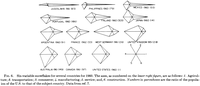
The “snowflake” diagrams of various countries, from Herman and Montroll (1972). The figure and its caption are reproduced here with permission of the Proceedings of the National Academy of Sciences.
Cech opens with a very brief initial chapter that focuses on the discoveries of messenger RNA and the genetic code, written with particular pedagogical skill that even the likes of that Manhattan reader could readily absorb. Then, the story jumps 16 years ahead to the experiments at Cold Spring Harbor and MIT that revealed the existence of the adenovirus mRNA tripartite leader. Fair enough, but it might have been contextually useful, for at least some readers, to have been told about the longstanding puzzle of giant transcripts in eukaryotes and the subsequently revealed enigma of their 5′ caps and 3′ poly(A) being conserved in mRNA. In any case, the description of the adeno experiments is very clearly done. “Bombshell” though this was (as Jim Watson stated right after the Cold Spring Harbor talks by Rich Roberts and Phil Sharp), it did not portend in at least most observers’ minds that another bombshell would in due course be revealed, and this is where, in Chapter 3, Cech's story really takes off. His description of how he came to Tetrahymena is very engaging as are the clearly presented experiments that led his laboratory to the breakthrough of the 26S pre-rRNA intron's self-splicing.
In parallel, Cech describes the work of Sidney Altman on RNase P very thoroughly. This was such a different story as to the biochemistry and met with much more resistance than the self-splicing Tetrahymena intron. Some have speculated that this was because this ribonucleoprotein enzyme was not centered on mRNA, which I have always regarded as a silly notion. The fact is that Altman had discovered the enzyme's substrate, a 5′ leader on a pre-tRNA, when a postdoc and had diligently pursued this ever since. Although Cech's description of the RNase P work is very accurate, there was a backstory. At a thesis committee meeting of the Altman student working on the purification of RNase P, who reported continuing lack of success, a member of the committee suggested that the enzyme's behavior in certain columns might be due to a copurifying RNA. This proved to be the case, and the RNA component was soon found to be essential for RNase P activity, and then later, was discovered to have catalytic activity on its own, leading to the shared Nobel Prize in Chemistry by Cech and Altman. In hindsight, one can imagine the courage it took for that pretenured committee member to suggest something that had been missed. Cech's accurate and generous description of the RNase P saga includes the very important role of Altman's collaboration and communication with the laboratory of Norman Pace.
From here, Cech goes on to a very comprehensive description of the pioneering work of Harry Noller and specifically the ribosome's peptidyl transferase center, followed by a chapter on RNA origins. The book concludes with chapters on the discovery of RNA interference and the advent of RNA therapeutics, including mRNA transfection. On the latter, he astutely covers some of the earliest work, notably by Robert Malone, that many authors describing this field omit.
Cech also describes the discovery of the small nuclear RNAs and their subsequently revealed roles in pre-mRNA splicing. In duly applauding the breakthrough work of Joan Steitz, I always like to suggest that authors call out the fact that while Michael Lerner's discovery in Steitz's lab that certain patient sera reacted with snRNPs was huge, Joan had a “prepared mind” as the saying goes. She had already, well before, sought antibodies to hnRNP proteins during a sabbatical and, as always should be emphasized, was already presciently on the right track.
The book includes a section of meticulous notes and Cech is to be applauded for doing this—something professional historians do as mandatory, but scientist authors often do not. The illustrations are very well done, as is the index. As to that “accuracy” node on the snowflake, I found only a single error, one so minor that I report it only to demonstrate that I indeed read the book. In describing the discovery of the mouse β-globin introns and their transcription into the β-globin pre-mRNA, the author puts the investigators at Harvard, whereas they were at the NIH.
One ponders what books should be aligned with this one head-to-head. There are two obvious ones. In Gene Machine, Venki Ramakrishnan presents an elegantly written account of the ribosome (Ramakrishnan 2018). He had the challenge of explaining X-ray diffraction inter alia and did so wonderfully. But he also wrote entirely autobiographically, whereas Cech seems to have deliberately avoided doing so. I had wanted him to mention his PhD mentor John Hearst, whose work using psoralen crosslinking was a powerful tool Cech acquired at Berkeley and that he also deployed in his postdoc with Mary-Lou Pardue at MIT. I also thought he might have mentioned, at least en passant, his leading role in the creation of the RNA Society. But I know what he would say if pressed on this—it would be “Sure, but I really wanted to keep the focus on RNA.” A similarity between this book and Ramakrishnan's is that both authors wrote moving perspectives on their philosophies of science, neither more eloquent than the other, just a bit different as to style.
The other book to be considered of course is James Darnell's magisterial one (Darnell 2011). When I read and then reviewed it (Pederson 2011), I came to appreciate the amazing breadth of Darnell's erudition, extending well beyond his primary research, including the book's closing chapter on RNA's pre-biotic and early biological eras. Cech's chapter on this is also very good but not as detailed as Darnell's. But in fairness, Darnell was writing on RNA in extenso, whereas Cech has written about key discoveries, and has included a handsome account of how both pre-biotic events and biological evolution may have shaped RNA chemistry. In aligning these three books, one should bear in mind the authors’ different perspectives—Darnell as a virologist/cell biologist, Ramakrishnan as a structural biologist, Cech foundationally as a chemist.
Throughout the book, Cech describes key advances in an unbiased and generous way that is typical for him. I loved his description of a visit to Joe Gall's lab, where he saw Tetrahymena swimming. This Grinnell College chemistry major had by then got wind of what exceptional biological creatures could do to help him grapple with his new love, RNA. Of course, Gall by this time was already famous for his insightful choices of just the right biological material for the problem at hand.
Tom Cech's book radiates an almost child-like fascination with the joy of discovery, as he always has come across to all who know and admire him. We can ponder if he is himself a catalyst, having written this wonderful book. I would contend he is not, because I suspect he has been changed. And all to our good fortune. When snowflakes fall in Boulder next season, there will be one with his name on it, whatever its shape.
Footnotes
-
Article is online at http://www.rnajournal.org/cgi/doi/10.1261/rna.080173.124.
-
Freely available online through the RNA Open Access option.
This article, published in RNA, is available under a Creative Commons License (Attribution-NonCommercial 4.0 International), as described at http://creativecommons.org/licenses/by-nc/4.0/.




