


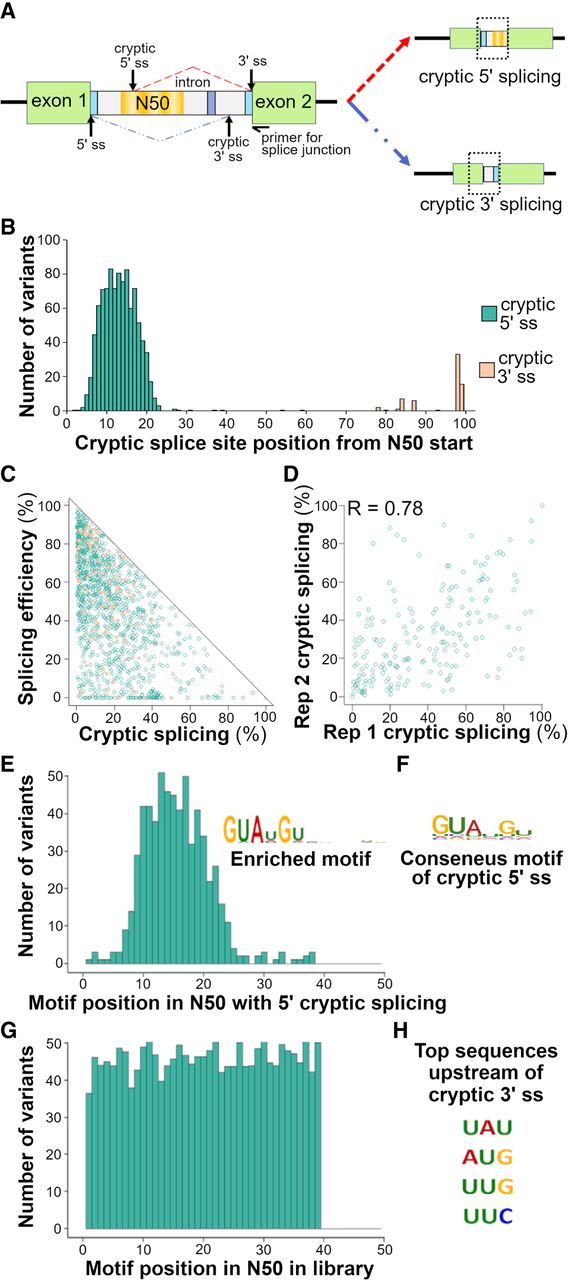
Overview and sequencing analysis of cryptically spliced N50 variants. (A) Diagram of the different types of splicing in library variants. Cryptic 5′ and 3′ splicing are depicted by a red dashed line and a blue dash-dot line, respectively. Splicing at a cryptic 5′ or 3′ splice site (ss) results in the inclusion of the 5′ or 3′ end of the intron, correspondingly. The sequencing primer to identify the differentially spliced variants anneals to the junction between the intron and the second exon. (B,C) Results for the average of both replicates. (B) The number of 5′ and 3′ cryptically spliced variants at each position of the N50. (C) The splicing efficiency versus the portion of cryptically spliced transcripts in 5′ and 3′ cryptically spliced variants. (D) Portion of cryptic splicing per variant found in both independent biological replicates of the intron library (n = 237). Pearson's correlation coefficient is denoted by R. (E) The significantly enriched sequence motif among the 5′ cryptically spliced variants is listed, P-value <0.05. (F) The consensus motif of the actual cryptic 5′ splice sites identified in the library. (E,G) The number of variants containing the enriched motif at each starting position found in 5′ cryptically spliced variants with (E) only 5′ cryptically spliced variants or (G) the entire library. (H) The four most common sites used for 3′ cryptic splicing among the intron variants.




