


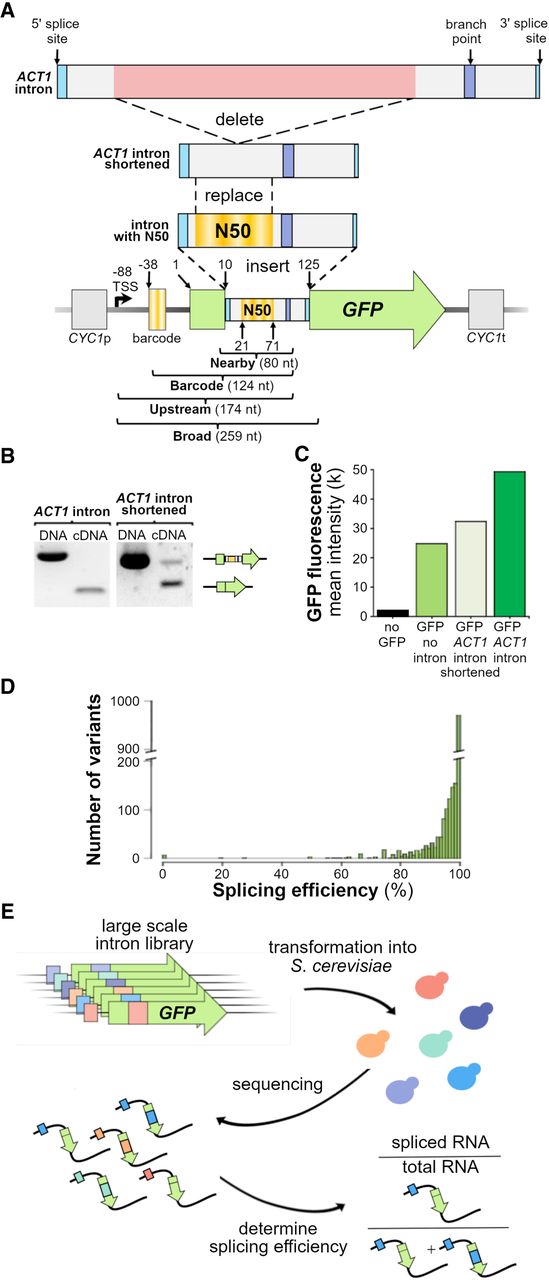
Experimental design and analysis of splicing in controls. (A) Design of constructs. The background for the library was created by removing the centermost nucleotides between the 5′ splice site and branchpoint sequences of the native S. cerevisiae ACT1 intron. A random 50-nt (N50) sequence replaces bases 12 to 61 of the intron between the 5′ splice site and the branchpoint of the shortened ACT1 intron. The intron variants were inserted into the GFP gene 10 nt downstream from the start codon with a unique barcode added 38 nt upstream of the GFP coding sequence, which was under control of the CYC1 promoter and terminator. Numbers indicate the location relative to the GFP open reading frame start site. The different sequence contexts used for analysis are the “nearby” context spanning from 15 bases upstream to 15 bases downstream from the N50 (80 bases total), the “barcode” context spanning from the start of the barcode through 15 bases downstream from the N50 (124 bases total), the “upstream” context spanning from the transcriptional start site (TSS) through 15 bases downstream from the N50 (174 bases total), and a “broad” context spanning from the transcriptional start site through 15 bases downstream from the intron (259 bases total). (B) Analysis of splicing of the full-length and shortened ACT1 introns by semiquantitative RT-PCR using RNA from exponentially growing liquid yeast cultures. PCR using DNA (left) and cDNA (right), unspliced (upper band) and spliced (lower band). (C) Expression analysis determined by GFP intensity measured via flow cytometry using cells containing plasmids with GFP and either no intron, the full-length, or the shortened ACT1 intron and cells without GFP. (D) Splicing of the shortened ACT1 intron paired with 1905 unique barcode variants as assayed by sequencing. (E) Experimental workflow. The N50 intron library was transformed into yeast and RNA was isolated. The splicing efficiency, or the ratio of spliced versus total transcripts, was measured using targeted sequencing of the intron, and variants were identified by their unique barcode.




