Insertional editing in isolated Physarum mitochondria is linked to RNA synthesis.
Abstract
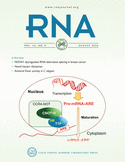
The mitochondrial RNAs of Physarum polycephalum are edited efficiently by nucleotide insertion both in vivo and in isolated mitochondria. Our recent studies have demonstrated that nucleotide addition can occur within 14-22 nt of the 3' end of a nascent RNA, suggesting that insertional editing may be linked to transcription. To investigate the relationship between these processes, we have examined the effects of nucleotide concentration on templated and nontemplated nucleotide addition in isolated mitochondria. At very low CTP concentrations, transcription and editing proceed with high fidelity, but the efficiency of cytidine insertional editing decreases. Insertion of single uridine and dinucleotides is not diminished under conditions that yield unedited or partially edited C insertion sites, indicating that editing events occur independently of one another. Moreover, analysis of partially edited RNA demonstrates that single nucleotides can be added at dinucleotide insertion sites. Importantly, pulse-chase experiments indicate that nontemplated nucleotides are not inserted into previously synthesized RNA once editing conditions are restored, although RNA downstream of the unedited region is edited efficiently. This result indicates that insertional editing cannot occur posttranscriptionally under these conditions, and suggests that there is only a small "window of opportunity" in which nucleotide insertion can occur. Our data are consistent with an editing activity that functions in a strictly 5' to 3' direction and adds nucleotides at, or close to, the 3' end of nascent RNA in association with the transcription complex. Several possible models for the mechanism of insertional editing in Physarum are discussed.