


Walter Keller (1938–2023): a tribute from his mentees
- Dirk Bohmann,
- Mary O'Connell,
- David Frendewey,
- André Gerber,
- Nouria Hernandez,
- Angela Krämer,
- Lionel Minvielle-Sebastia,
- Peter Shaw,
- Elmar Wahle and
- Mihaela Zavolan
- Corresponding author: angela.kraemer{at}unige.ch
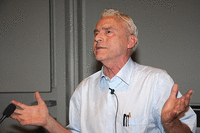
Walter Keller. (Photo courtesy of the Biozentrum, University of Basel.)
On the 30th of March 2023, the RNA field lost one of its pioneers, Walter Keller, Professor Emeritus at the Biozentrum, University of Basel. Walter's exemplary and rigorous biochemistry work provided crucial tools for studying the entire life cycle of RNA. His dedication to the pursuit of robust evidence was inspiring for many, and helped drive forward several fields of research.
Walter Keller graduated from the Medical Academy in Düsseldorf in 1962 as a medical doctor. At the time, it was not at all apparent that a path existed from clinical practice to the peaks of scientific research, yet probing through human pathology and genetics, inspired by serendipitous scientific encounters, Walter created a trail of scientific discoveries that changed the way we think of how cells control gene expression through transcriptional and post-transcriptional events.
The formative years of Walter's research career were undoubtedly those spent at the Cold Spring Harbor Laboratory (from 1969 to 1976), where he interacted and collaborated with eminent scientists like Phil Sharp, Joe Sambrook, Rich Roberts, and James Watson. During that time, before the introduction of recombinant DNA technology, he established himself as a brilliant and creative biochemist. His publications from this period, many of them with him as the sole author, addressed some of the burning questions of the burgeoning field of molecular biology and presaged some of his later contributions that illuminated the mechanisms and regulation of mRNA transcription and the role of chromatin in the process. RNA polymerases had been purified from animal tissues in the labs of Bob Roeder, William Rutter, Pierre Chambon, and others. Walter's noteworthy contribution to the field was the purification of RNA polymerases from HeLa cells, which became the standard starting material for countless biochemical studies on transcription and other processes.
In his 1973 paper reporting the purification and characterization of RNA polymerases I and II, Walter also described other activities that are required for efficient RNA synthesis in vitro, discoveries that pioneered the mushrooming field of transcription factor research. Another seminal contribution came from Walter's work on DNA topology. Using the circular SV40 genome as a model, he developed an elegant, yet simple electrophoretic method to distinguish the different topological forms of this DNA circle, which are characterized by incremental changes in helicity, or the number of helical and superhelical turns. His work established that one nucleosome would introduce one negative helical turn into DNA, a foundational finding for the nascent field of epigenetics. Walter's supercoiling gels found another application as an assay to track, purify, and characterize topoisomerase activity, which, as Francis Crick pointed out in What Mad Pursuit: A Personal View of Scientific Discovery, solved a vexing question arising from the Watson–Crick model, namely, how cells manage to replicate their chromosomes without generating a tangled mess of DNA strands.
Upon moving back to Germany in 1976 and setting up shop at the University of Heidelberg, Walter continued to investigate the relationship between RNA polymerase and chromatin in gene regulation. Using in vitro transcription systems, he showed that nucleosomes had an inhibitory effect on mRNA production and that transcriptional enhancers, which had been discovered by Walter Schaffner and others a few years earlier, could stimulate transcription in vitro in a process requiring the binding of transacting proteins, i.e., transcription factors, to specific DNA sequence elements.
Shortly after Walter's return to Germany, a monumental discovery was made in the labs of Phil Sharp and Rich Roberts: Eukaryotic protein-coding genes were not contiguously encoded in the genome, but interspersed with noncoding sequences. These had to be removed from primary transcripts (pre-mRNAs) and the coding sequences joined in a process termed splicing, for which the machinery was unknown. Walter was greatly intrigued by this unexpected phenomenon and wanted to apply his biochemical acumen to identifying the “enzyme(s)” that catalyzed this new type of RNA processing. He thus returned to the Sambrook group at CSHL for a short sabbatical to search for the splicing enzyme. Unfortunately, pre-mRNA splicing proved to be a thornier problem than the other nucleic acid enzymology Walter had studied, and his diligent work with Ashley Dunn ended in frustration. However, after taking up a new position at the German Cancer Research Center in Heidelberg in 1980, his renewed efforts on splicing paid off. At the 1983 Cold Spring Harbor RNA Processing Meeting, Walter's lab, along with several others, announced that they had achieved accurate and efficient splicing uncoupled from transcription in HeLa cell extracts. This major technological breakthrough opened up the field to a rich flood of discoveries on the mechanism of pre-mRNA splicing over the next decade. Walter's lab took advantage of their new in vitro splicing system with defined pre-mRNA substrates made by in vitro transcription to begin the purification of protein factors required for splicing. In addition, using targeted RNA degradation by RNase H in the presence of antisense DNA oligonucleotides, the lab established the requirement of the U1 snRNP in a fruitful collaboration with Reinhard Lührmann's lab. This assay was later used by other labs to demonstrate the roles of additional snRNPs in the reaction. Related lines of experimentation led to the discovery of the spliceosome and the roles of conserved pre-mRNA sequence elements and snRNPs in its stepwise assembly and catalytic activity. These were exciting and competitive times for Walter's relatively small group. Yet in 1987, he set off on a new adventure, this time at the Biozentrum of the University of Basel, where he spent the rest of his career.
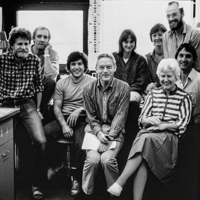
Walter's lab in Heidelberg around 1985. (Unknown photographer.)
In Basel, the seeds of a new research direction started to germinate: While working with the in vitro splicing system, Walter's group realized that the same extracts were active in the cleavage and polyadenylation reactions that form the 3′ ends of mRNAs. HeLa cell nuclear extracts generated on a large scale were now fractionated by classical column chromatography to purify factors involved in the endonucleolytic cleavage of the RNA downstream from the main signal, AAUAAA, and the subsequent addition of a poly(A) tail to the upstream cleavage product. Even during the first fractionation step, essential processing factors were separated from each other and, after further purification, up to five different fractions had to be recombined for cleavage to occur. Reconstitution of the polyadenylation of a “precleaved” substrate RNA proved simpler, requiring just two factors, one of them being the enzyme poly(A) polymerase (PAP). Reconstitution of cleavage and/or polyadenylation was used as assays to track the processing factors during consecutive chromatographic steps. In the end, sufficiently pure preparations for cDNA isolation were obtained. At the time, this was considerably more difficult and time-consuming than it is today.
In Basel, Walter also started to use baker's yeast as an experimental system, which turned out to be extremely useful. In short order, yeast PAP was purified, its gene was cloned, and pap mutants were generated. From synthetically lethal combinations with other known mutants, new proteins involved in 3′ end processing started to emerge. The functional characterization of mammalian and yeast factors followed. In the mammalian system, for example, the cleavage and polyadenylation specificity factor (CPSF) turned out to be responsible for specific binding to AAUAAA, while the cleavage stimulation factor (CstF) was found to bind essential U-rich elements downstream from the cleavage site. Forays into high-throughput technologies for crosslinking and immunoprecipitation (CLIP) that emerged around 2010 revealed that 3′ end processing factors like the mammalian cleavage factor I (CFIm), which binds UGUA elements upstream of the polyadenylation signal, and CstF are not merely constitutive participants in the reaction but also help choose between alternative poly(A) sites.
Walter's collaboration with structural biologist Sylvie Doublié resulted in one of the first crystal structures of PAP. He also contributed to the functional analysis of related enzymes, the so-called noncanonical poly(A) polymerases. A beautiful biochemical study from his group demonstrated the role of yeast Trf4p and Trf5p in oligo(A) tagging and degradation of structurally unstable tRNAs.
Walter's trail of discovery also touched on RNA modifications. Following the identification of a protein that unwound dsRNA by the Weintraub and Melton labs in 1987, Walter became interested in characterizing this activity. A large effort in the early 1990s led to the discovery, purification, and cloning of adenosine deaminase acting on RNA 1 (ADAR1) and its homolog, ADAR2. A search for homologs of mammalian ADARs in the yeast genome revealed a potential ortholog comprising the ADAR deaminase domain, which a collaboration with the Grosjean lab demonstrated to be Tad1p/ADAT1, an enzyme responsible for adenosine-to-inosine editing in tRNAs. Two additional enzymes (ADAT2/3) were identified by reverse genetics and found to form a heterodimer, which deaminated adenosines at the wobble position of tRNAs. Homologs in E. coli and human were also identified. As such, Walter's work uncovered a “superfamily” of RNA modification/editing enzymes and suggested an evolutionary link between the editing of pre-mRNAs and tRNA modification.
These foundational discoveries in RNA biology were and still are carried forward by Walter's former lab members and by many others. After his official retirement in 2008, he continued to gather funding to pursue innovative research from the Emeritus “lounge” of the Biozentrum. He was elected a member of the Academia Europaea and of the European Molecular Biology Organization (EMBO) in 1989. In 1998 he received the Louis-Jeantet-Prize for Medicine, and in 2007 the RNA Society Lifetime Achievement Award.
Although Walter's passion in life was his science, he was also an avid musician, enthusiastically playing the bassoon not only in orchestras, but also for his colleagues, at thesis defenses, and parties. His image of a kind and generous mentor is forever etched in our memories.
MEMORIES
I joined Walter's group in Heinz Schaller's Department of Microbiology in the autumn of 1978 as a newly minted physiology
and biochemistry graduate. I had come to Heidelberg to be with the love of my life and maybe this was the reason why Walter
hired me—he had his romantic side—because until that time I had carelessly evaded nucleic acid biochemistry, from which the
field of molecular biology was beginning to emerge, and had little relevant experience.
Walter was already a master in the field and opened the door to this fascinating new discipline for me. My steep learning
curve began in a fortuitously timed practical class, an almost intimate affair with maybe a dozen students. Walter's approach
was direct and hands-on; I recall a heated discussion on the use of kettles rather than microwave ovens for melting agarose.
The merits of his case aside, I learnt that Walter was meticulous about the design and consistent execution of experiments.
In the ensuing months and years, Walter encouraged my exploration of his RNA-centric world. I blotted my way from north to
south and then west using DNA tumor viruses as vehicles. I learnt how to clone and sequence DNA (Maxam and Gilbert—oof), all
as part of Walter's quest to reproduce accurate transcription and splicing in vitro. The journey was mind-blowing.
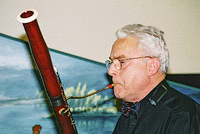
Walter playing the bassoon. (Photo courtesy of the Biozentrum, University of Basel.)
In 1980, the move, on foot, to the DKFZ allowed Walter to expand his group and highlighted for me another of his talents,
an ability to hire astutely. These developments ultimately led to his breakthrough contributions in the field of pre-mRNA
splicing. Many fond memories hark back to that time with Walter and the colleagues who became warm friends. In retrospect,
it was a great environment in which to spend my formative years.
A particular recollection from that time is of Walter's fascination with what he called “ze killer experiment” and he certainly
came up with knockout examples. And although he retained his palatinate accent, Walter's English was never less than eloquent,
and his papers were written with exemplary clarity. My dislike of split infinitives and hanging participles probably stems
from Walter.
Beyond the science, Walter was a keen and competent musician. While in Heidelberg, he sang in a choir and played the bassoon
in an orchestra (and practiced on the occasional evening in his office adjacent to the lab). Characteristically, his approach
to music was also meticulous: When he agreed to play at Dirk Bohmann's farewell party, he refused to riff on a twelve-bar
blues and persuaded me to write out his solos note for note, which he played on the night with gusto.
—Peter Shaw
End of August 1982. Walter sends me to the DNA tumor virus meeting in Cold Spring Harbor to present results which, I think,
show correct cleavage at the 3′ splice site of a globin intron in vitro. The audience is not convinced and their questions make me realize that I am missing
a key control. Upon my return, I quickly show that I have been indeed studying an artifact. Thus, two years into my thesis,
with no results to show for it, I start again, from a clean slate, to try to reproduce pre-mRNA splicing in vitro. But by
then, I know how to do an experiment and things move fast.
Early 1983. I have left my tiny lab in the back of Walter's office to go develop an X-ray film at the end of the long hallway,
on the fourth floor of the German Cancer Research Center in Heidelberg. At the time, this takes close to 10 min as it involves
dipping the X-ray film in developer solution for a few minutes, then water, then fixing solution, and in water again for the
final rinse. Walter has seen me leave the lab… When I emerge from the dark room, he is in the hallway, so nervous that he is continuously swaying from his heels to the ball
of his feet. I take the still dripping wet film and start to slant it to reveal even the faintest signal, but there is no
need; the signal, telling us that we have obtained accurate splicing of pre-mRNA, uncoupled from transcription, in cellular
extracts, is loud and clear, present in the lanes where it should be and absent in those where it should not be. Had Walter
been less shy, he would have hugged me: Instead, he starts walking right and left at full speed changing direction as abruptly
as the insects that walk on water.
December 1983. I am about to leave to spend Christmas at home in Switzerland and then cross the Atlantic Ocean for a post-doc
at Yale University. Walter has often relayed to me his admiration of unconventional brilliant people: Albert Einstein, who,
he tells me, could not be bothered with things as trivial as wearing socks, or, from personal experience, James Watson, the
eccentric Director of Cold Spring Harbor. So “for the plane,” Walter hands me a copy of Jim's irreverent book, The Double Helix… Probably not completely by chance that I ended up going to Cold Spring Harbor after my post-doc!
End of 2004. I am just back in Switzerland, at the University of Lausanne. I receive a three-word message from Walter, who
has been in Basel for many years. “Welcome home Nouria.” And I know that Walter keeps track of his students!
So thank you Walter, thank you immensely, for having been my “Doktorvater,” my thesis father, for teaching me how to become
a scientist, for introducing me to the scientific community and, above all, for your contagious excitement of discovery and
life in general.
—Nouria Hernandez
My first interaction with Walter Keller occurred in late 1982, when I visited him at the German Cancer Research Center in
Heidelberg and asked if he would consider taking me on as a graduate student. He advised: “I would not recommend joining this
lab. Nothing works.” This response encapsulates to me a key trait of Walter's personality: humility with a sense of wry humor
under the surface. I would not be writing this if it hadn't been the only time when I ignored Walter's advice and joined the
Keller lab. It was certainly a good decision. The time as a graduate student was one of the best in my life. Initiated into
the art of biochemistry and in vitro transcription by Alain Sergeant and coached in protein fractionation by Angela Krämer,
I became enraptured by the science. The scientific and social interactions with other members of the department and the Heidelberg
research community at the time were rewarding and a lot of fun. I loved the community of the lab with joint attendance at
scientific meetings, many outings, and weeklong ski trips. A special memory was Walter's musical performance on his beloved
bassoon together with Pete Shaw's rock ’n’ roll band at my farewell party from the lab.
—Dirk Bohmann
I started my scientific career as a summer student in Walter's lab at the German Cancer Research Center in Heidelberg, working
under the supervision of back then PhD student, Nouria Hernandez. I actually chose his lab, because he has been the only professor
you met at a jazz concert. Somehow, I ignited his interest in me, since he offered me a Diploma project about the sequential
or simultaneous in vitro splicing of two introns. While finishing this project, Walter proposed a PhD project to me: to establish
an in vitro model of mRNA 3′ processing and to study its enzymatic components. This was what I did, of course, with the help of many dear colleagues in
the lab, spending most of my time in the cold room, occasionally with Walter smoking his pipe. Sometimes Walter has been very
remote, hard to contact, working with doors shut. On the other hand, Walter has been very close, inspecting our lab books
late at night and leaving post-its with sometimes philosophical comments in Latin, but also close to me as a person and my
young family. To get his attention, we used to wet an autoradiograph and hang it up to dry, and Walter, when passing by, would
have a look. This is how I learned to be passionate about science. The other main lessons I learned from him, sometimes the
hard way, included to ask important questions, to never ignore unexpected bands on your gels, to always include the proper
controls, and never to trust any correlations. Walter has been a role model in many things, too many to be mentioned here;
for example, I learned a lot about the esthetics of an experiment yet also of life in general. In the middle of my PhD studies,
Walter moved from Heidelberg to the Biocenter in Basel, most of the lab members followed, and I spent an additional two years
in the lab in Basel. Walter then has been an incredible mentor over all those years, visiting me and my family in San Francisco
and in Vienna, and it is not a coincidence that I ended up in Basel again. Walter has been “the” RNA aficionado, yet we should
not forget his playing the bassoon and his wide knowledge about humanity, literature and art. Several books he gave me are
still on my shelf. Farewell, Walter!
—Gerhard Christofori
I was a biology diploma student in Walter's lab at the DKFZ in Heidelberg from 1981 to 1984. After that, I continued work
for my PhD thesis (1985–1988) supervised by David Frendewey on mRNA splicing consensus sequences. In 1987 Walter and many
other lab members moved to Basel to the Biozentrum. I stayed in an almost empty lab in Heidelberg to finish my thesis. Several
times I visited Walter in Basel to talk about my final experiments and thesis defense. The environment that Walter had created
was outstanding both scientifically and personally. Although we worked hard and often long hours, we also found enough time
for relaxing by doing sports at the “DKFZ-Wiese” and having parties together with colleagues from Walter's and other labs.
I remember some unforgettable lab parties as well as the fantastic skiing week together with Walter and other lab members
in March 1986 in Saas Fee. I am glad to have known Walter personally and I feel immensely lucky to have been a part of his
lab in Heidelberg.
—Georgia Lahr
I first met Walter in the late 1970s in Heidelberg, when he provided me with calf thymus RNA polymerase II to compare its
subunits to those of insect polymerases I had purified while working on my PhD, and Walter was the expert at my thesis defense.
After returning from the US in 1983 and starting a second post-doc in the German Cancer Research Center, Walter successfully
enticed me away to his lab five months later to purify a splicing “enzyme” after he and Nouria Hernandez had established an
in vitro splicing system. Carting my lab belongings along the corridor to Walter's lab was the best move I made in my scientific
career. The lab atmosphere was exceptional with some people still working on transcription, but splicing quickly took over.
Although Walter could spend hours secluded in his office, reading the newest editions of Nature, Science, Cell and others or being on the phone to get the latest rumors about splicing from overseas, he was always ready to check our
results. He had a nose for the timing when we would have our films developed and appeared in the lab for lengthy discussions.
I very much appreciated these, about all kinds of possible and impossible scenarios of how splicing might work—not only in
the lab, but also after work with other group members in one of the lovely pubs in Heidelberg with a glass of wine. At these
occasions, Walter could also easily be prompted to tell us about the “old times,” whether it was his discussions about the
newly discovered splicing with CSH colleagues at a drawing board in the corridor next to the labs or his sailing adventures
in the Long Island Sound. Walter gave a lot of freedom to his lab members, but nevertheless often secretly tried to check
on us, only to be betrayed by the smell of tobacco from his beloved pipe—especially noticeable in the cold room, where he
certainly made sure I was operating the FPLC correctly. There are many more fond memories.
I am extremely thankful to Walter for all I learnt while I was in his lab, both in Heidelberg and in Basel, and for his generosity
handing the splicing work in his lab to me and my small group, himself focusing on 3′ end formation/polyadenylation and RNA editing. Without him, I would not have moved to Switzerland, where he kept supporting
me, and I owe my later career to him. We became good friends, not only discussing science during hour-long phone calls once
I left his lab, but also interacting on outside-the-lab issues. Walter, his wife, and I remained in contact enjoying the German-type
“Kaffee und Kuchen” at his house in Basel or days out in the foothills of the Black Forest for lunch or dinner. I am deeply
saddened by this death.
—Angela Krämer
I took a post-doc position in Walter's lab because of a coup d’état.
I first met Walter in 1983 in my last year of a three year post-doc with Dieter Söll at Yale, where I worked on tRNA processing.
A chance introduction to Witek Filopowicz when he visited Yale presented me with an opportunity to do a second post-doc in
Europe, when he offered me a position in the new lab he was about to establish at the Friedrich Miescher Institute in Basel.
Witek was planning to move to Basel after a return to Poland for his student Magda Konarska's PhD defense. We agreed to meet
at the Cold Spring Harbor RNA Processing meeting in May to finalize the details for my move to his lab. When I arrived at
the conference, Witek was nowhere to be found. By the spring of 1983, General Jaruzelski, who had taken over the Polish government
in late 1981, had enacted strict restrictions on personal freedoms and travel. Witek was stuck in Poland, and it was unclear
when he would be able to leave.
Dieter was at the meeting, and I told him what happened to Witek. Knowing that I was six months from unemployment, Dieter
asked me if there was anything at the conference that had caught my fancy. I said that in vitro splicing of pre-mRNA was very
exciting. Dieter, always the biochemist, particularly liked the presentation by Nouria Hernandez from Walter's lab because
she had shown pH and salt optima for the splicing reaction. Dieter saw Walter in the bar and went over to talk with him. After
a little while, he motioned for me to come over and introduced me to Walter. After a very brief chat, Walter offered me a
position as a visiting scientist starting in January 1984. I would stay for three years.
The best of the three was 1985. Experiments I was doing to try to figure out why ATP was required for the splicing reaction
and what was going on during the long lag time before products appeared, revealed that the pre-mRNA was assembled stepwise
into a series of complexes, culminating in a very large complex in which the splicing reaction took place. I had discovered
the spliceosome, but Walter and I did not call it that. I presented a poster on my results at the RNA Processing Meeting that
May in Rome, where the Abelson and Sharp labs gave talks on their spliceosome work. After my poster, Walter came up to me
and said that Ben Lewin, the editor of Cell, had told him that if we got him a manuscript in a few weeks, he would publish it in the July issue. Alas, that is how things
worked in those days.
When we returned to Heidelberg, Walter and I started an around-the-clock schedule to get all the data and the manuscript ready
for publication. I came into the lab early in the morning, did splicing reactions, ran gradients, collected fractions, and
set aside those that needed to be analyzed by gel electrophoresis for Walter, who came to the lab in the evening and worked
into the night running the gels and putting them on film. The next morning, I developed the films and started the process
all over again. My fondest memories of this time are the phone calls with Walter to discuss the results while he was at evening
choir practice. Having discussions of scientific experiments with the sounds of choral singing and instruments in the background
was to me, as a young American, a wonderfully European combination of the ancient and the modern. Our frantic work paid off
with a paper in the July issue of Cell side-by-side with Paula Grabowski's spliceosome work from the Sharp lab. It's these memories of doing science with Walter
in beautiful old Heidelberg along with his rich repertoire of entertaining stories, mostly from his time at Cold Spring Harbor,
that I will always cherish.
—David Frendewey
I am writing to express my sadness at learning of the passing of Professor Walter Keller. Walter gave me the remarkable opportunity
of allowing me to work in his lab in Heidelberg as a lab assistant for two years (1985–87). I was in my early twenties and
didn't quite know what I wanted to do. I was preceded by a school friend, Trevor Dale, who suggested I contact him upon his
departure. Walter's act of generosity was even more remarkable given that I came with a degree in Brewing and Microbiology
and had little biochemistry knowledge. It was a learning experience to say the least. I began my studies under the tutelage
of Dirk Bohmann, working on transcription enhancers. Later, with Gerhard Christofori, I focused on the identification of a
polyadenylation complex observed following the incubation of labeled mRNA with nuclear extract, painstakingly purified from
HeLa cells by Marion Frick. I have happy memories of Walter walking with great purpose down the long DKFZ corridors or in
lab meetings talking animatedly about flow-through columns while puffing on his pipe. He encouraged me to read, which I did.
Intellectually, I also benefited hugely from interactions with Angela Krämer, David Frendewey in the lab, and also Pamela
Cowin (Franke lab), Francis Stewart (Schütz lab), and Iain Mattaj (EMBL). I also had the pleasure of overlapping briefly with
Pete Shaw, Thomas Baier, Vladka Lucianic, and Clemens Suter in Walter's lab. For me, these were halcyon days and the lessons
learned stayed with me. Perhaps the most important lesson from day one was that I loved science. This simple conclusion followed
entirely from the supportive environment of the lab, which was engendered by Walter. When Walter's lab moved to Basel, I subsequently
returned to the UK to do a DPhil (PhD) in the lab of Nick Proudfoot at the University of Oxford. The rest of my scientific
career has followed from the formative experience and remarkable opportunity gifted to me by Walter. It was a great privilege
to have known Walter, and I owe him a huge debt of gratitude.
—Timothy Humphrey
I joined Walter as a staff scientist as soon as he moved from Heidelberg to Basel, and so I first helped to set up his lab.
For two months he was sitting in his office, smoking his tobacco pipe and probably working on some manuscript. As soon as
the moving trucks arrived from Germany, loaded with several 70°C freezers full with purified splicing factors and whatnot,
the lab became a bee's nest. Many of his students and post-docs from Heidelberg wanted to continue their work and moved to
Basel. In the months to come, HeLa cells were grown by the kilos, and calf thymus was ground up to purify and characterize
hitherto unknown splicing—and very soon cleavage—and polyadenylation factors. Students spent day and night in the cold-room
to collect aliquots and freeze them away for activity assays. Soon, publications followed, one after the other; it was a busy
but successful time. Walter was rather relaxed; from time to time he would suggest new projects but he was mostly standing
in the background. He gave people a lot of freedom, which certainly increased everyone's enthusiasm. As for myself, I was
able to learn a lot from the other lab members, which finally led to several publications.
Thank you, Walter, for giving me the opportunity to spend over 20 years in your lab. We became very good friends.
—Georges Martin
Walter was, by any standard, a highly successful scientist and a colorful personality. However, what distinguishes him in
my personal memory is his unusual generosity toward the younger scientists in his lab. I joined his group in 1988, having
completed a post-doc in the US. Walter had just moved from Heidelberg to Basel. His lab had recently begun to work on 3′ end processing of mammalian mRNA precursors, and I got involved in purifying and characterizing the protein factors carrying
out the reactions of RNA cleavage and polyadenylation. Before I actually arrived in Basel for my first day in the lab, Walter
and I had never met! Discussing my move to his lab by phone and fax (email did not yet exist), we had come to a loose agreement
that I would stay in his lab for an extended period of time. I expected to be able to develop some degree of independence
and was planning to obtain the “Habilitation,” the traditional qualification that would allow me to apply for tenured faculty
positions. This was the academic career path still widely used in Germany and other countries at the time. Walter fulfilled
my expectations in the most generous manner: When I submitted my first paper from his lab, it had only my name on it! Other
papers on which I was the only or the corresponding author followed. After about four years in the Keller lab, I obtained
a career development award that enabled me to apply for my first grant and become formally independent. Walter hosted me,
providing lab space for my first two graduate students and myself, as well as access to all lab equipment, and he supported
me with a technician. He had previously done the same for Angela Krämer.
Like many of his former coworkers, I stayed in touch with Walter scientifically and personally until the end. It was a particular
pleasure to publish two more papers with him as late as 2014 and 2018, 23 years after I left his lab.
I have always felt deeply indebted to Walter for the way in which he supported my transition to independence, and I just hope
that my attempts to let him know were adequate. So I will say it one more time: Thank you, Walter.
Although Walter could be shy, more often he was very entertaining. He rose to peak form when he told stories like the one
about his newly acquired sailing boat, which, being pulled on a trailer with mast erect, got caught in the holding ropes of
the big chimney in Cold Spring Harbor and brought the entire construction down. As a more modest illustration of his sense
of humor, here is my wife's favorite memory of Walter: Not too long after we had moved to Giessen, Germany, Walter came to
visit and stayed at our house overnight. At breakfast, he skillfully fished out and ate the one piece of stale bread from
the basket, quipping “If it wasn't for father, we'd need to get a pig.”
—Elmar Wahle
I was a graduate student in Walter's lab from 1989 to 1992. The interview for joining his lab was short. He asked me if I
was a member of a carnival music band, which are popular in Basel. Luckily, I denied and obtained the position. The question
reflected Walter's humor although he eventually mentioned that some people wasted too much time with such activities outside
the lab. I felt amazingly privileged to learn from him and the other lab members how to generate enzymatically active extracts
and purify proteins by following their activity. Walter was overwhelmed with passion for our experiments. Our notebooks did
not withstand his curiosity. I remember a Saturday, when he called me late at night to share his excitement after he had discovered
in my lab-book that we eventually succeeded in generating biochemically active recombinant yeast poly(A) polymerase. His encouragement
and support for our work were contagious and made us feel that we do and should do something important. I will always be indebted
to Walter for his awesome mentorship while being in his lab and thereafter.
—Joachim Lingner
Having Walter as a postdoctoral mentor was a great privilege. The people in his group admired him not only for his scientific
prowess but also for being a very caring man—you knew he always had your back. This was evident in his generosity, as when
postdoctoral fellows left his group to become independent, he often encouraged them to continue working on the same project
that they had while in his group. Walter was aware of every experiment that was happening in his lab. After spending weeks
purifying a protein, you were not surprised that Walter, who had not bothered you during this interval, would suddenly appear
just as you were developing the silver stain gel of the final column. He would gently take the developing protein gel from
your hands, and puffed his pipe with satisfaction as he watched the protein bands appear. We became superstitious that his
pipe produced magic smoke that enhanced the bands on the gel and worried if he did not turn up. Walter had a great sense of
humor, and would have a twinkle in his eye as he recounted one of his many tales. He was a gifted raconteur; often we would
prompt him to tell us about his boating adventures in Cold Spring Harbor, despite having heard it numerous times. His delivery
would always have us laughing in stitches. I have many wonderful memories of Walter but I think the one that is most precious
to me is the day I told him I was pregnant with our first child. I had just accepted a Group Leader position before becoming
pregnant so I expected Walter to chide me for my bad timing. So, with trepidation I went to his office with my news. Instead,
Walter greeted my news with a huge smile and told me “About time.” Walter's positive response had a huge impact on me as he
gave me the belief that everything would work out well as if he thought it was a good idea to have a child at this point in
my life, then it was. The stress I had suddenly disappeared.
Walter, you may be gone but you will never be forgotten.
—Mary A. O'Connell
I will be forever grateful for my time as a PhD student in Walter's lab, not only because he, as external PhD supervisor,
offered me a position in his own lab at a time when I was miserable elsewhere, but also for creating a lab environment that
allowed me to tinker and try to get at the issue we all were interested in. His passion for science, his hovering presence
over all of us, and the time he spent with us when required, taught me what I think is the best kind of mentorship. I admired
Walter's humor and passion, not only for science, but also for culture and his bassoon. Shortly after joining the lab, I dragged
my parents to a concert of his in Weil. The day after, he told me in the elevator of the Biozentrum that he was so impressed
by them that he offered me the collegial German “Du,” still special at the time.
With Walter's support often in the background, I have learned not to give up easily and to grab opportunities when they arise,
something that was only possible due to the great and mutually supportive atmosphere we had together with Mary, Joachim, Silke,
Elmar, Silvia, and Pascal, to name a few. I also loved the ad hoc–type lab meetings where everyone who wanted could present
their latest gels or autorads—I remember at least one time when I made him upset: I had just cloned the yeast homolog of what
was the CPSF 73 kDa subunit and given it the name Nbi1. After the lab meeting, Walter came to me in private and asked what
the name stood for. He was not amused at all by my answer: “No better idea 1.”
I always was aware of how fortunate I was to do my PhD in Walter's lab, but I only realized retrospectively how critical it
was for the rest of my life.
Walter, you will be missed, but never forgotten!
—Andreas Jenny
In 1991, Joachim Lingner in Walter's lab had purified and cloned the yeast PAP gene, the first ever identified protein involved
in 3′ processing, and generated mutants of it. I moved to Basel in 1993, and this was actually the starting point of what turned
out to be a great scientific adventure for me, a pioneering work in the polyadenylation field. In room 275, the so-called
“ageing lab,” located next to Walter's office, where the more senior post-docs Mary, Silvia, and myself shared space and time
with Katrin and Pascal, two brilliant PhD students, nothing was impossible! We could freely conduct our own research under
the enthusiastic gaze of Walter. Work was tough sometimes, but advice from fantastic coworkers such as Elmar and Pascal helped
me to get some essential knowledge in biochemistry that I missed as a trained geneticist and molecular biologist. Besides,
lunches at the cafeteria, the “Hefeweizen Bier mit Pommes-frites” breaks when columns were running, or the TGIF parties were
also moments we could sometimes share with Walter, showing us that we were a group, if not to say a family. Publications followed
this hard work, and I remember Walter's famous joke “published but already wrong,” in reference to the competing field we
were working in, telling us indirectly that the story never ended. I didn't learn only biochemistry with Walter, but also
to trust myself, as he was confident enough to let people present their data at conferences. He even sent me once instead
of himself to a meeting in the US, to the surprise and despite the apprehension of the organizers! I unfortunately had to
face bad health problems during the last years I was in Basel. At every moment, every minute, I could count on Walter's support
to me and my family. His generosity has been as robust as his empathy. I feel like I haven't thanked him enough for that.
Thank you Walter, I didn't simply learn how to become a scientist with you, but also to try to be an honest man. We'll all
miss you.
—Lionel Minvielle-Sebastia
I was very glad to join Walter's lab as a graduate student in the mid-90s although I had little clue about RNA. Walter had
a great talent to bring people together with different backgrounds and create an inspiring and welcoming atmosphere. For instance,
I had the great opportunity to work at the start with Mary O'Connell who was a native English speaker, giving me the opportunity
to improve my “Swiss” English while I was helping her prepare liters of buffers for enzyme purification in the cold room.
Walter also understood how to promote our curiosity and leave us the freedom to direct our research into new angles, though
keeping the key question in mind. In my case, I started working on the editing of a human brain receptor and ended up with
tRNA modifications in yeast. Working with Walter was a huge pleasure and an adventurous journey with an inspiring mentor.
His rigorous research approach and humor remains stone-backed and will never be forgotten. Thank you, Walter!
—André Gerber
Walter was one of the kindest people I've ever had the pleasure of meeting. I joined his lab as a senior post-doc back in
2004 and was immediately struck by his trust, enthusiasm, and support. Not only was he a brilliant scientist with a wealth
of knowledge and stories from the early days of molecular biology, but he also had a great sense of humor. I'll always remember
the long hours spent pipetting while listening to his fascinating tales. It's a shame that Walter never managed to write his
memoirs into a book because his stories were truly captivating. I heard people remembering him as the man with a pipe, but
he quit smoking by the time I arrived in Basel. For me, it's his humor and charm that stand out. Even during stressful competitions
or late-night manuscript submissions, Walter never lost his sense of humor and we always found time to laugh. I feel incredibly
privileged to have spent four years in Walter's lab and I miss him dearly. He was an exceptional person who made a lasting
impact on my life.
—Stepanka Vanacova
I was one of the “last batch” of Walter's PhD students, graduating in 2006. I feel a deep sense of gratitude that Walter was
part of my path. Throughout my years in his lab, he allowed us a great deal of freedom and independence to engage in research
topics of our interest, while at the same time his office door was always open. In his office, I found an empathetic mentor
generously offering advice and support. This was also the place where he hid away a stash of chocolates to give away as little
“bribes.”
I remember Walter as a man of strong scientific integrity and I am thankful for the important and lasting influence he has
had on my scientific path. But most of all, I am thankful that he was my “Doktorvater” in more than just the academic sense.
I always knew that he genuinely cared about our well-being and that we could count on his support. For me, that was his greatest
gift. Thank you Walter.
—Andrea Kyburz Kooznetsoff
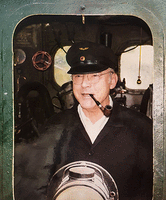
Walter driving a steam train on his 60th birthday. (Photo courtesy of Angela Krämer.)
I first met Walter when I moved to the Biozentrum Basel to start as an assistant professor. There were a lot of things I had
to figure out and not a lot of guidelines. There was also a huge gulf between the traditional molecular biology approaches
that were established at the place and my computational ones. Walter's never-ending curiosity and interest in new methods,
theories, and fields meant that he became the one whose ear I could once in a while get to bounce ideas and ask for feedback.
The development of CLIP provided the spark for what became a very enriching collaboration. With Georges working out new experimental
methods, Andreas and myself the computational analyses, and Walter worrying about alternatives we may have missed, there were
a few years of intense work to characterize the binding and regulatory functions of 3′ end processing factors transcriptome-wide. With his help I set up the lab, where he would come for group meetings, hailing
the winter season with Grättimänli from his favorite bakery. My children were included in the head count for this treat, as
Walter often marveled how I manage to keep family and work in balance and encouraged me to keep going. Some of his lab members
have become my very cherished collaborators, and protocols and tips from these times are in my lab's folklore. Sadly, Walter's
genuineness as a human being, his kindness and his deadpan humor are now to live only in memory. We miss you, Walter!
—Mihaela Zavolan




