


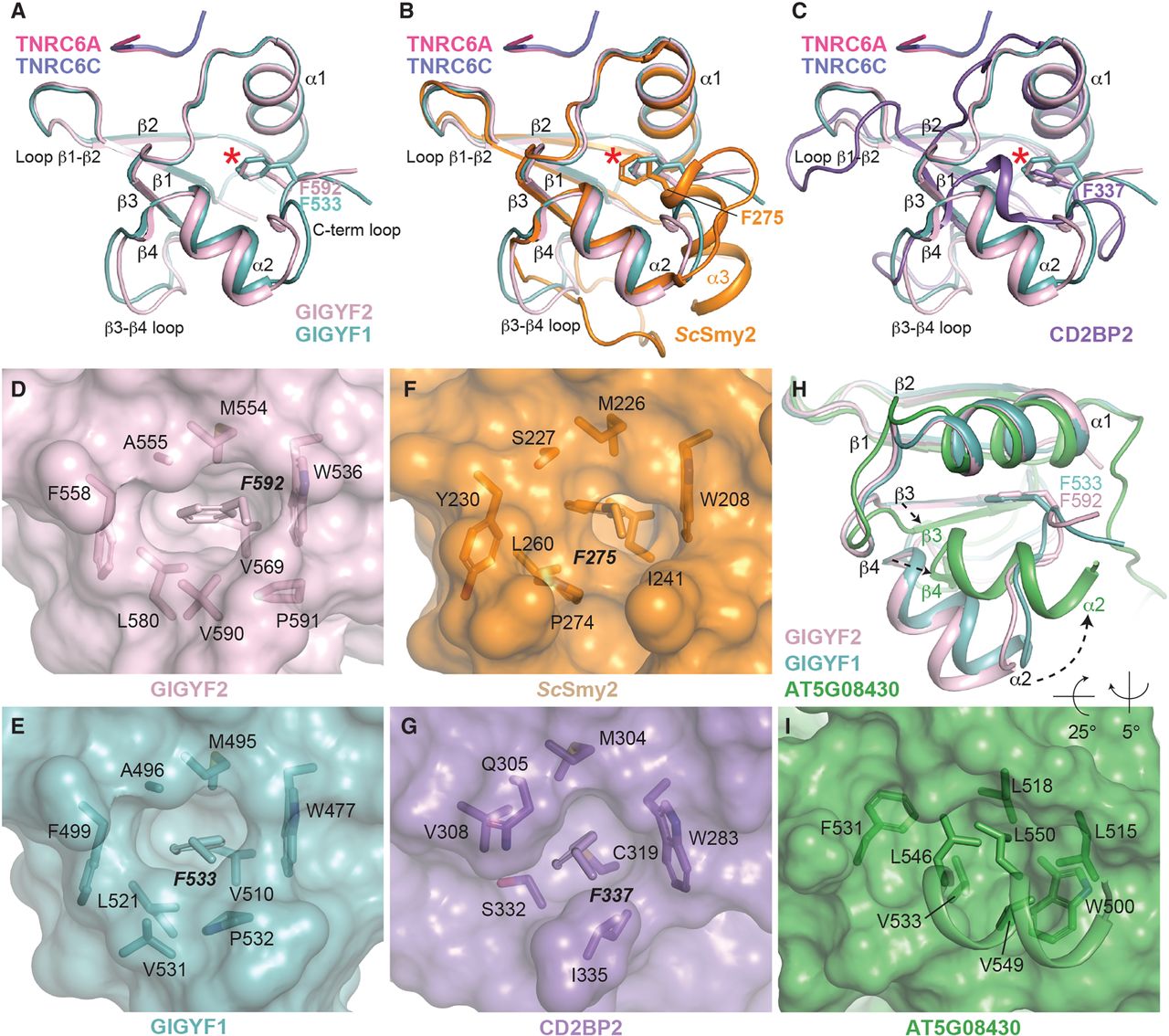
A conserved Phe residue is found at the C terminus of Smy2 and CD2BP2 GYF domain classes from yeast to humans. (A) Superimposition of GYF domains from GIGYF1 and GIGYF2, shown in teal and light pink, respectively. The TNRC6 peptides are shown in hot pink and navy cartoon representation. The conserved Phe residue is shown in sticks and indicated by a red asterisk. The same view is shown in B and C, but with ScSmy2 (orange; PDB ID 3FMA) and CD2BP2 (purple; PDB ID 1L2Z) superimposed, respectively. (D–G) Surface representation of GIGYF2, GIGYF1, ScSmy2 (PDB ID 3FMA), and CD2BP2 (PDB ID 1L2Z), respectively, with residues surrounding the Phe plug shown in sticks. (H) Superimposition of GIGYF2 and GIGYF1 with A. thaliana ATG08430 (green; PDB ID 1WH2). The GYF domain of A. thaliana ATG08430 is found at the extreme C-terminal end of the protein and does not encode a Phe plug residue. Conformational changes are observed between the A. thaliana ATG08430 and GIGYF1/2 in the α2 helix, as well as the β3 and β4 strands of the GYF domain. (I) The α2 helix in the plant GYF domain packs against the hydrophobic surface in the absence of a Phe plug.




