


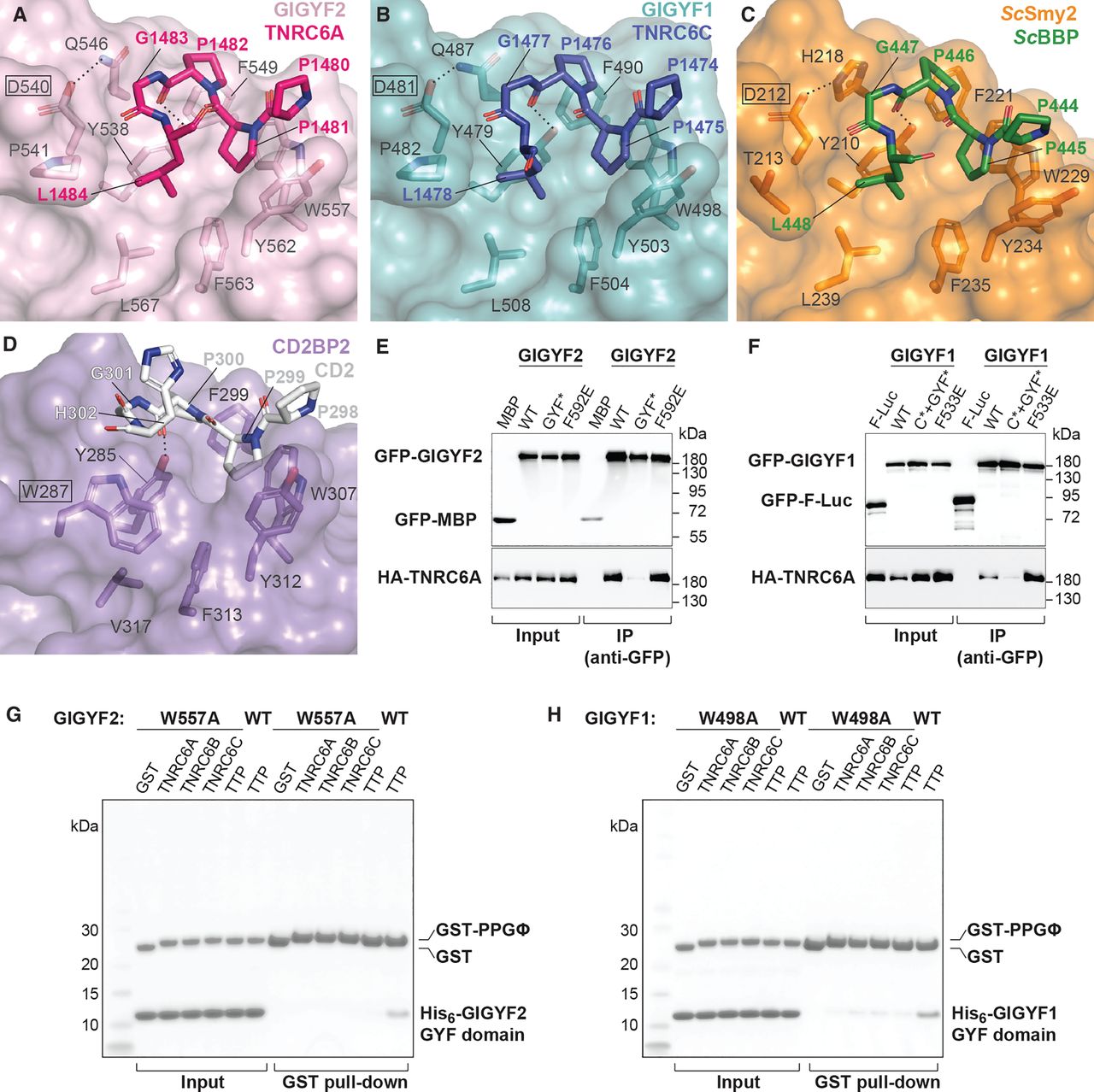
Proline-rich sequences bind to a conserved hydrophobic depression on the GYF domain surface. (A–C) Close-up views of TNRC6A, TNRC6C, and ScBBP peptides binding to the GYF domains of GIGYF2, GIGYF1, and ScSmy2 (PDB ID 3FMA), respectively. The defining Asp residue of the Smy2 class of GYF domains are indicated by black boxes. In contrast, the CD2BP2 class of GYF domains contain a Trp (W287 in human CD2BP2, boxed; PDB ID 1L2Z [Freund et al. 2002]) at this position (D). The conserved Trp in CD2BP2 GYF domains disrupt the hydrophobic cavity, which is exploited by PRS-containing sequences in the Smy2 class of GYF domains. (E,F) GFP-tagged full-length GIGYF1/2 interacts with HA-tagged full-length TNRC6A in HEK293T cells, and substitution of four residues within the PPGΦ-binding site (GYF*) disrupted this interaction, as indicated by western blot analysis. The interaction was not affected by Phe plug mutations F592E and F533E in GIGYF2 and GIGYF1, respectively. GFP-MBP and GFP-F-Luc served as negative controls. (G,H) Pull-down assays using purified His6-GIGYF1/2 GYF domain and GST-PRS sequences. A single mutation within the PPGΦ-binding site of GIGYF2 and GIGYF1 (W557A and W498A, respectively) reduced the interactions in vitro.




