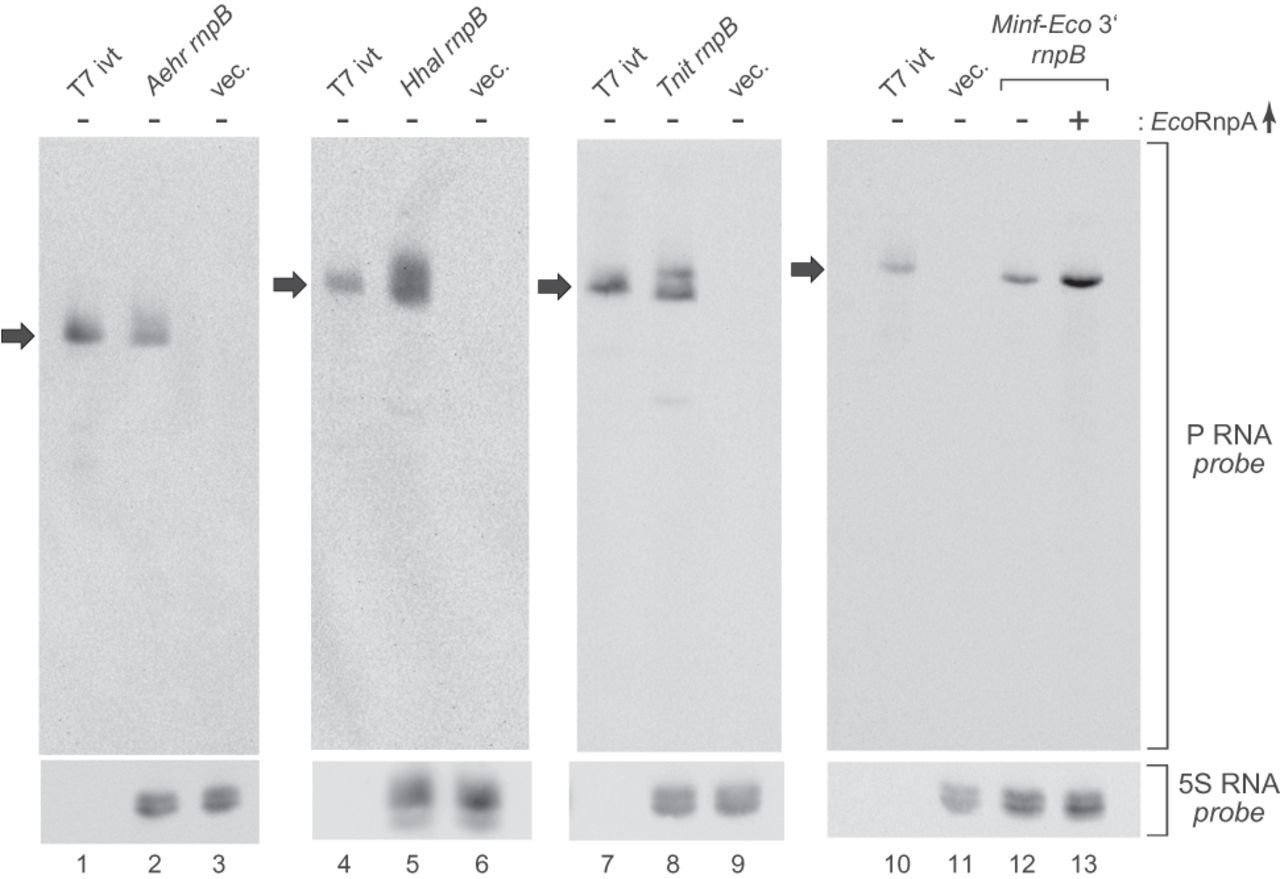
Northern blot analysis of A. ehrlichii (Aehr), H. halophila (Hhal), T. nitratireducens (Tnit), and M. infernorum (Minf) P RNA (rnpB) expression in E. coli BW. Minf-Eco 3′ rnpB, Minf P RNA embedded into the 3′-flanking region of E. coli rnpB. Total RNAs were isolated in exponential growth phase; the DIG-labeled hybridization probes are specified in Supplemental Table S6. In lane 13, the E. coli RnpA protein was simultaneously overexpressed (indicated by EcoRnpA↑). Lanes “T7 ivt”: T7 in vitro transcripts of the respective P RNAs (marked by arrows) that were used as positive and length controls (for the exact 5′- and 3′-ends of the T7 transcripts, see Supplemental Table S4); lanes “vec.”: total RNA extracted from E. coli BW transformed with the empty vector pACYC177. Twin bands for Hhal and Tnit P RNAs expressed in E. coli are likely variants with minor length variations at the 3′-end. Three independent experiments gave identical results. 5S rRNA was used as loading control. For more details, see Materials and Methods.