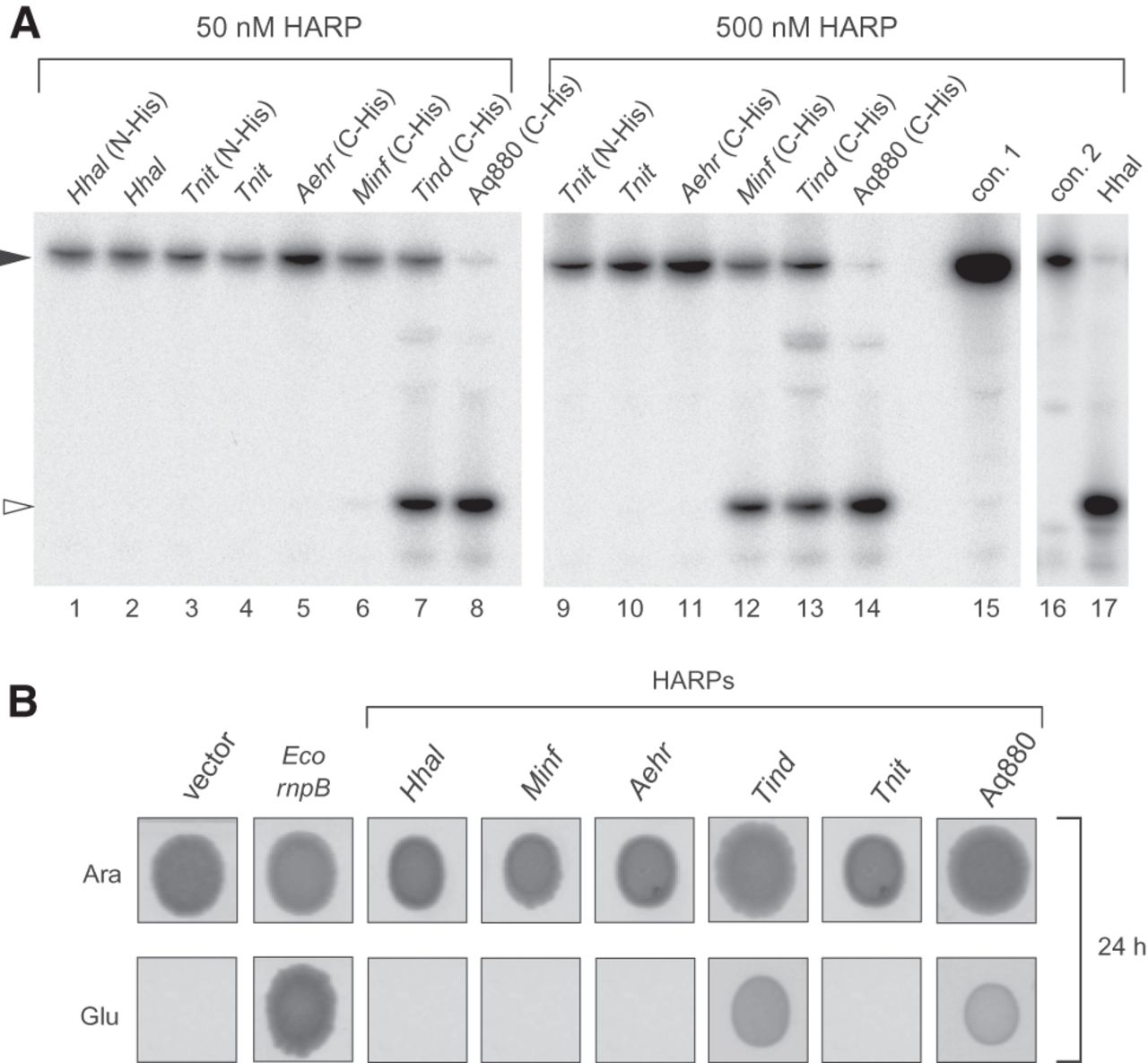
HARP activity in vitro and in vivo. (A) Processing of pre-tRNAGly by HARPs from H. halophila (Hhal), T. nitratireducens (Tnit), A. ehrlichii (Aehr), M. infernorum (Minf), T. indicus (Tind), and A. aeolicus (Aq880, positive control), under single turnover conditions (<1 nM 5′-32P-endlabeled pre-tRNAGly). In lanes 1–14, the substrate and 50 nM (lanes 1–8) or 500 nM HARP (lanes 9–17) were incubated at 37°C in the presence of 4.5 mM Mg2+ for 60 min (120 min in lanes 16 and 17); con. 1, 2: incubation of substrate for 60 min (lane 15) or 120 min (lane 16) without HARP enzyme. Tag-free variants of recombinant HARPs (lanes 2, 4, 10, and 17) were additionally analyzed to assess the influence of His tags (C-His, carboxy-terminal, or N-His, amino-terminal) on processing activities. (B) In vivo complementation ability of the same set of HARP proteins in E. coli BW. Heterologous harp genes were expressed in E. coli BW from vector pDG148(S/X) under control of the spac promoter. The E. coli BW strain containing the empty vector pDG148(S/X)(vector) was included as negative control and cells transformed with plasmid pACYC177 encoding the E. coli rnpB gene (Eco rnpB) as positive control. Single colonies of E. coli BW containing the harp or rnpB expression vector and grown in the presence of arabinose were washed and resuspended in 800 µL LB medium before 10 µL of cell suspension were spotted onto LB agar plates supplemented with arabinose (Ara) or glucose (Glu). After 24 h incubation at 37°C, colony formation was documented. Panels A and B show representative examples out of three independent experiments in each case.