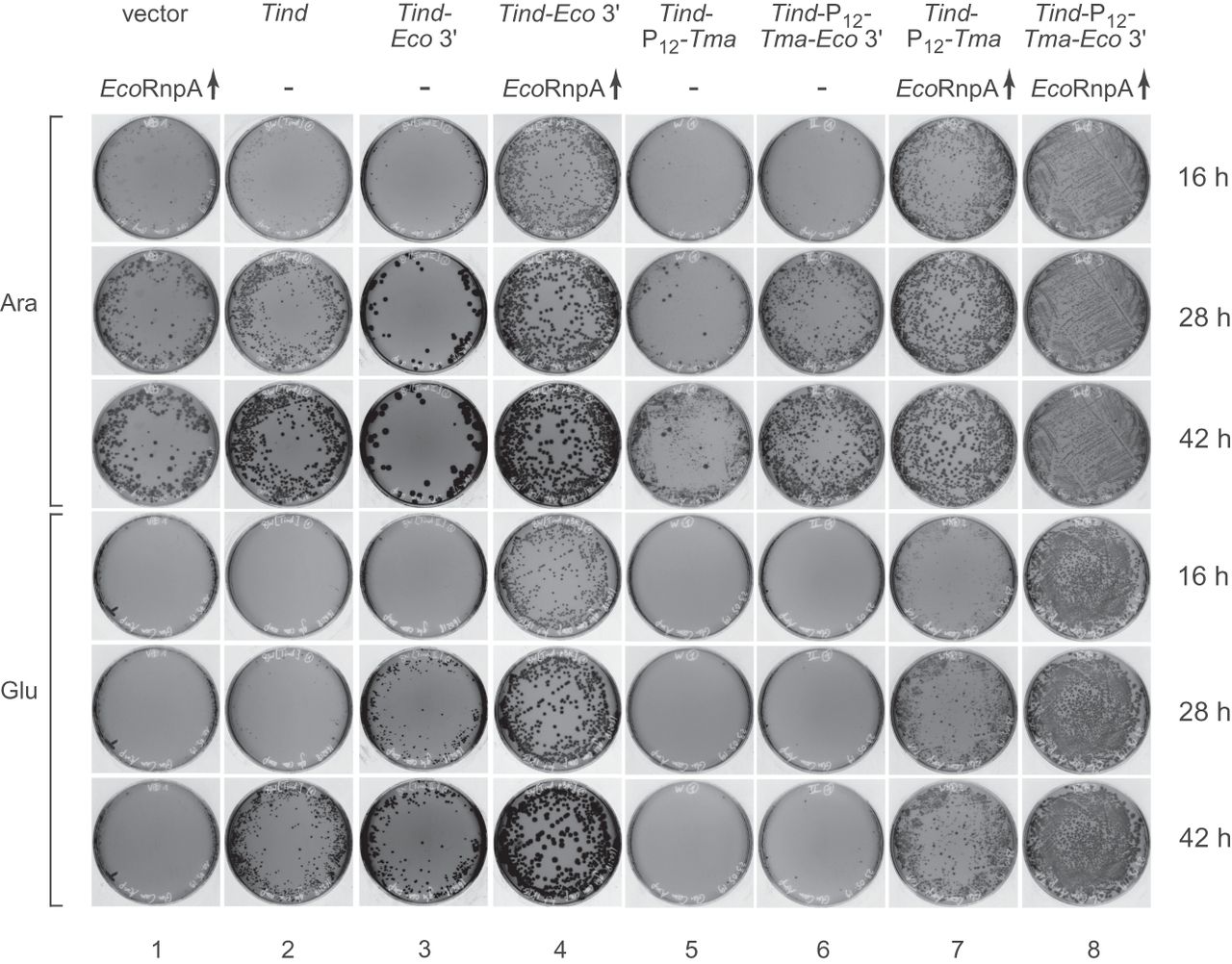
Functionality of heterologous P RNAs in the RNase P complementation test strain E. coli BW. For details, see legends to Figures 3 and 9. Column 1: total RNA extracted from E. coli BW transformed with the empty pACYC177 plasmid (vector) and pBR322-based E. coli RnpA expression plasmid (EcoRnpA↑); column 2: Tind, expression of T. indicus P RNA with 5′- and 3′-ends as annotated in the T. indicus genome, but under control of the E. coli rnpB promoter; column 3: Tind-Eco 3′, as column 2, but Tind P RNA embedded into the 3′-flanking region of E. coli rnpB; column 4: as column 3, but with simultaneous E. coli RnpA overexpression; columns 5–8: corresponding variants of P RNA Tind-P12-Tma. Two independent experiments with two clones each gave comparable results.