Recollections: Yasuhiro Furuichi (1940–2022)
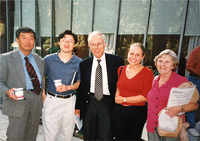
Hiro Furuichi, accompanied by Aaron and Joan Shatkin, at the Jim Darnell 70th Anniversary Symposium in 2000 at The Rockefeller University in New York. Magdalena, Witold Filipowicz's daughter, is standing between the Shatkins and is representing the Filipowicz family. (Photo courtesy of Yasuhiro Furuichi.)
Yasuhiro Furuichi, who made momentous contributions to our understanding of eukaryotic mRNA biogenesis and function, passed away in his home in Kamakura on October 8, 2022, after a long battle with pancreatic cancer. Yasuhiro Furuichi was a towering scientist and imaginative researcher. His ideas and accomplishments left a lasting impact on our knowledge of the basic mechanisms of gene expression.
We were honored to share with him over the years his excitement about science, and we are grateful for the privilege of having had the opportunity to work with him. We were inspired by his enthusiasm, collegiality, and friendship and are thankful for his mentoring. Yasuhiro (Hiro, as we all referred to him) is credited with the discovery of mRNA capping and its role in mRNA stability and function. However, as described below, Hiro's contributions extend to many other areas of molecular biology, covering both fundamental aspects as well as the conversion of basic knowledge into theories of human disease and prevention.
For both of us, our friendship and scientific adventure with Hiro started in the mid-1970s, when the three of us worked on mRNA capping in the laboratory of Aaron Shatkin at the Roche Institute of Molecular Biology (RIMB) in Nutley, New Jersey. Hiro got there first, arriving from Japan in June 1974 after publishing—while working in the laboratory of Dr. Kin-Ichiro Miura at the National Institute of Genetics in Mishima—a highly surprising observation that the synthesis of mRNAs encoded by the silkworm cytoplasmic polyhedrosis virus (CPV) is dramatically stimulated by S-adenosyl-methionine (SAM). The stunning demonstration by Hiro that SAM, a methyl group donor, delivers the methyl to the mRNA 5′-end, inspired an intensive search toward the elucidation of the 5′-terminal structure in viral and cellular mRNAs. Soon after, Hiro's collaboration with others in Aaron Shatkin's laboratory mostly using human reovirus as a model, and work on vaccinia virus mRNAs by Bernard Moss’ group at NIH, elucidated the terminal structure as m7G(5′)ppp(5′)Gm or m7G(5′)ppp(5′)Am, where m7G represents 7-methylguanosine, and Gm or Am, 2′-O-methyl nucleosides. Hiro was the main player and driving force in this research, in deciphering the mechanism and enzymes involved in mRNA capping, in establishing the function of the cap in protecting mRNA against the exonucleolytic degradation, and in stimulating protein synthesis. Although most of the initial work on the biochemistry of capping was performed with viral mRNAs, Hiro and Aaron Shatkin, working together with Jim Darnell of The Rockefeller University, demonstrated that cellular mRNAs and their precursors, known at that time as heterogeneous nuclear RNAs, also harbor m7GpppN caps at their 5′-end.
Witold Filipowicz started to collaborate with the laboratory of Aaron Shatkin in early fall of 1974, after moving to the RIMB together with his postdoctoral adviser, the Nobel Laureate Severo Ochoa, from New York University Medical School. While continuing to work with Dr. Ochoa on translation factors and development of the brine shrimp Artemia salina, Witold Filipowicz became excited by the groundbreaking discoveries in the neighboring laboratory and started to investigate the role of capping with Aaron Shatkin's group. Together with Hiro, they identified and partially purified from high-salt washes of A. salina ribosomes, a protein activity which specifically bound the m7G cap in mRNA. None of the tested known translation initiation factors purified from rabbit reticulocytes showed similar cap binding properties, indicating that this function had to be performed by an unknown factor.
The mystery was solved by Nahum Sonenberg, who arrived in Aaron Shatkin's laboratory in 1976 from the Weizmann Institute of Science in Rehovot, Israel. Nahum was warmly welcomed by Hiro and greatly benefited from his extensive knowledge and insightful ideas. He exploited the chemistry of the cap structure, specifically the availability of the free cis-diol of the cap m7G ribose moiety, to develop an mRNA–protein cross-linking approach (with the help of Charles Cantor at Columbia who advised him to use NaBH3CN instead of NaBH3) to identify proteins interacting with the cap. Nahum Sonenberg identified a protein of ∼24 kDa that specifically cross-linked to oxidized mRNA and purified it using affinity chromatography on Sepharose coupled to m7GDP. This protein, known now as eIF4E, functions together with eIF4A and eIF4G as part of the heterotrimeric complex eIF4F, which binds the mRNA 5′-end during initiation of translation. It also acts as a target of many regulatory pathways controlling cellular protein synthesis.
Hiro remained at the RIMB as an Associate Member until 1985, pursuing collaborative work with Aaron Shatkin on reoviruses and investigating on his own the capping and other aspects of the biology of CPV and rotaviruses. The decade spent at the RIMB was an extremely productive period in Hiro's research: He published over 50 articles during this time and became one of the most cited molecular biologists in the field. Nahum Sonenberg was extremely impressed with the precise timetables Hiro taped on his desk, which detailed his planned experiments and the writing of papers. Witold Filipowicz overlapped with Hiro again during his sabbatical visit to Aaron Shatkin's laboratory at the RIMB in 1981–1982; however, his work in Aaron's lab at that time was unrelated to mRNA capping.
A very successful association with the RIMB made Hiro—upon returning to Japan—an obvious choice to become the head of the Biotechnology/Molecular Genetics Division at the Nippon Roche Research Center in Kamakura. He directed it until 1993 when he became Director of the AGENE Institute, a consortium sponsored by the Japanese government that worked on aging. In 2001, Hiro became the Chairman of the GeneCare Research Institute, and in 2009, the Director of the Hokuriku Innovation Cluster for Health Sciences.
In all the aforementioned institutions based in Japan, Hiro's main objective was to exploit progress in science for the development of new innovative therapeutic strategies. However, at the same time, he also pursued basic research, publishing dozens of groundbreaking studies addressing the role of DNA repair helicases RECQL1 and WRN in cancer and aging, characterizing endothelin receptors and their role in vascular diseases and atherosclerosis, and developing new approaches to the treatment of cancer and age-related diseases. With his passion for teaching, Hiro acted as a role model for young scientists in Japan and beyond.
Decades of Hiro's research have greatly contributed, either directly or indirectly, to developing new drugs. Of particular importance is the anti-influenza drug Xolfuza, developed by the Japanese company Shinogi and based on the original finding by Robert Krug that the influenza virus steals the cap structure of cellular mRNAs to add them to the flu mRNAs. Another exceptional and far-reaching consequence of Hiro's work on capping is the use of synthetic cap analogs to produce stable and efficiently expressed mRNAs, which are obligatory components of SARS-CoV-2 mRNA vaccines, which saved millions of lives.
Our contacts and friendship with Hiro continued beyond the years spent together at RIMB. Witold Filipowicz, who moved in 1984 to Basel, Switzerland, was frequently visited by Hiro on his professional missions to the Roche headquarters, which is located in this city. Each visit was associated with dinners and family visits, resurrecting fond memories of the past. Both of us frequently met Hiro while visiting Japan, taking part in different symposia (with Hiro, as a prominent member of the RNA and gene expression community in Japan, generally attending them too) or giving talks at different institutions, including those directed by Hiro. We vividly remember our visits to Kamakura, with Hiro taking us to the Great Buddha statue, followed by a tea ceremony in the bamboo garden and a visit to Enoshima Island.
Many of our meetings with Hiro took place on the occasion of different gatherings, some very joyful and some sad, celebrating RIMB and Aaron Shatkin. Aaron was a very special person to the three of us, a safeguarding angel who always offered help and advice. We had several joyful reunions. The last reunion was sad as Aaron got very sick, and Hiro and Jim Darnell invited past students, postdocs, and collaborators of Aaron in September 2011 for a “Shatkin Reunion.” Aaron passed away nine months later, and the next time that the three of us met together again was at Aaron's memorial symposium, which took place at the Centre for Advanced Biotechnology and Medicine at Rutgers University, of which Aaron was the Founding Director after departing from the RIMB.
As in his research and public service, Hiro was also a moving force behind all the aforementioned reunions. Hiro's warm character, radiating optimism, and perseverance was infectious and highly motivating in our pursuit of science. We will remain forever grateful for his wisdom and advice. With Hiro's passing, the international—and particularly Japanese—community of scientists working in the areas of RNA biology and gene expression, and their exploitation for development of new therapies, lost one of its guiding figures.