


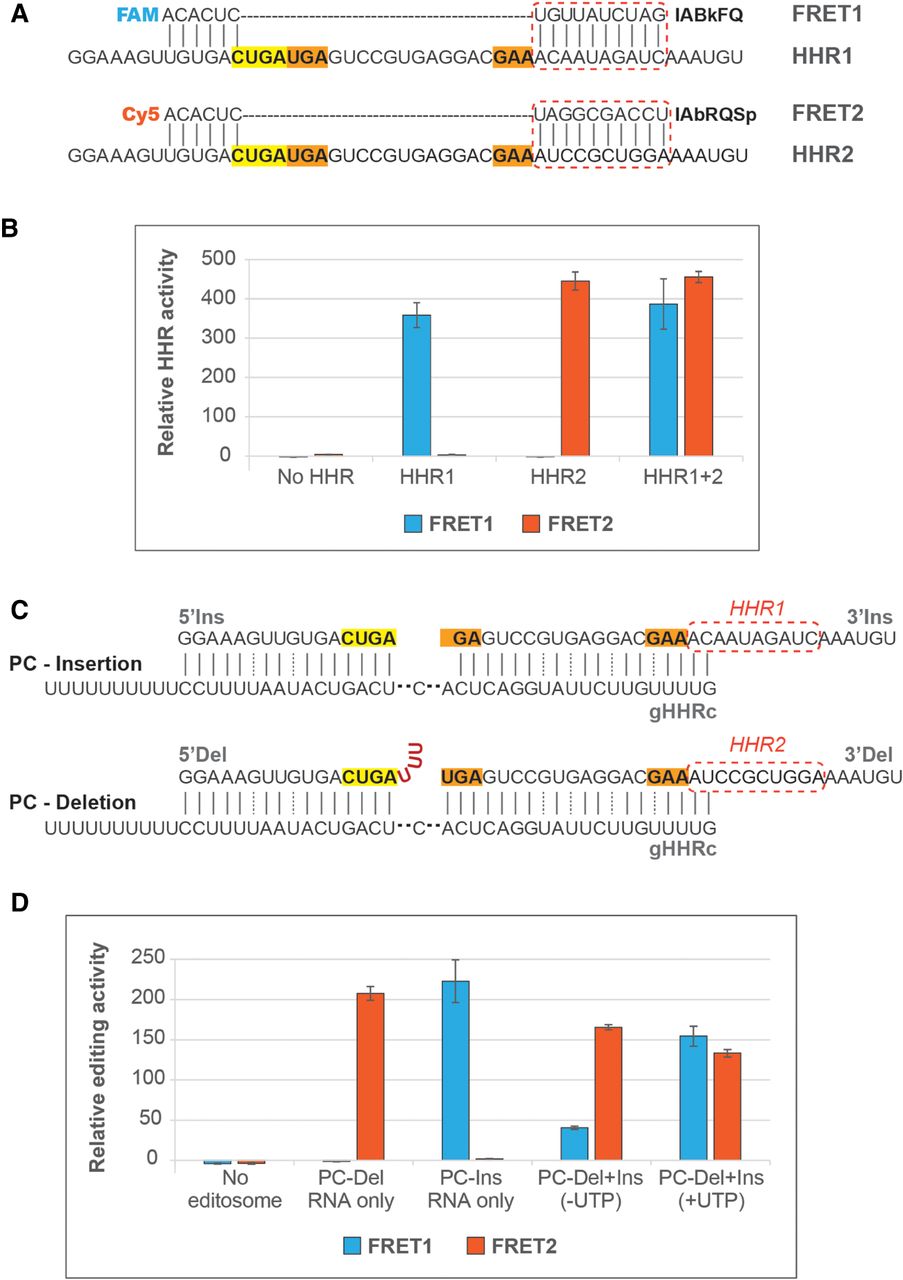
Multiplex measurement of U-insertion and deletion in the ribozyme-based insertion/deletion editing (RIDE) assay. (A) Schematic representation of HHR1 and HHR2 bound to their respective target FRET substrates, FAM-FRET1- IABkFQ and Cy5-FRET2- IAbRQSp. The dissimilar FRET substrate hybridizing region of the two HHRs is shown in red dashed boxes. Essential nucleotides in the catalytic site of the ribozyme are highlighted in yellow and orange. (B) Specificity of HHR1 and HHR2 against their FRET substrates. Signals released because of FRET1 and FRET2 cleavage are shown in blue (FAM) and orange (Cy5) for four experimental conditions. All four lanes contain both FRET1 and FRET2 substrates. The x-axis determines which ribozyme is added to each lane. (C) Diagram of PC-insertion and PC-deletion trimolecular hybrids in the RIDE assay. HHR1 and HHR2 were fragmented to provide the PC RNA substrates for assaying insertion and deletion activities. (D) Measurement of U-insertion and -deletion activities from the RIDE assay. FRET1 and FRET2 substrates are added post-editing. Means and standard deviations were obtained from three replicates, and the values corresponding to each colored bar were statistically significant (P-value < 0.05) by one-way ANOVA (GraphPad Prism).




